IV Macro Policy & Sovereign Debt·Analysis·Americas
Treasury's coupon lock pushes rate risk onto bills
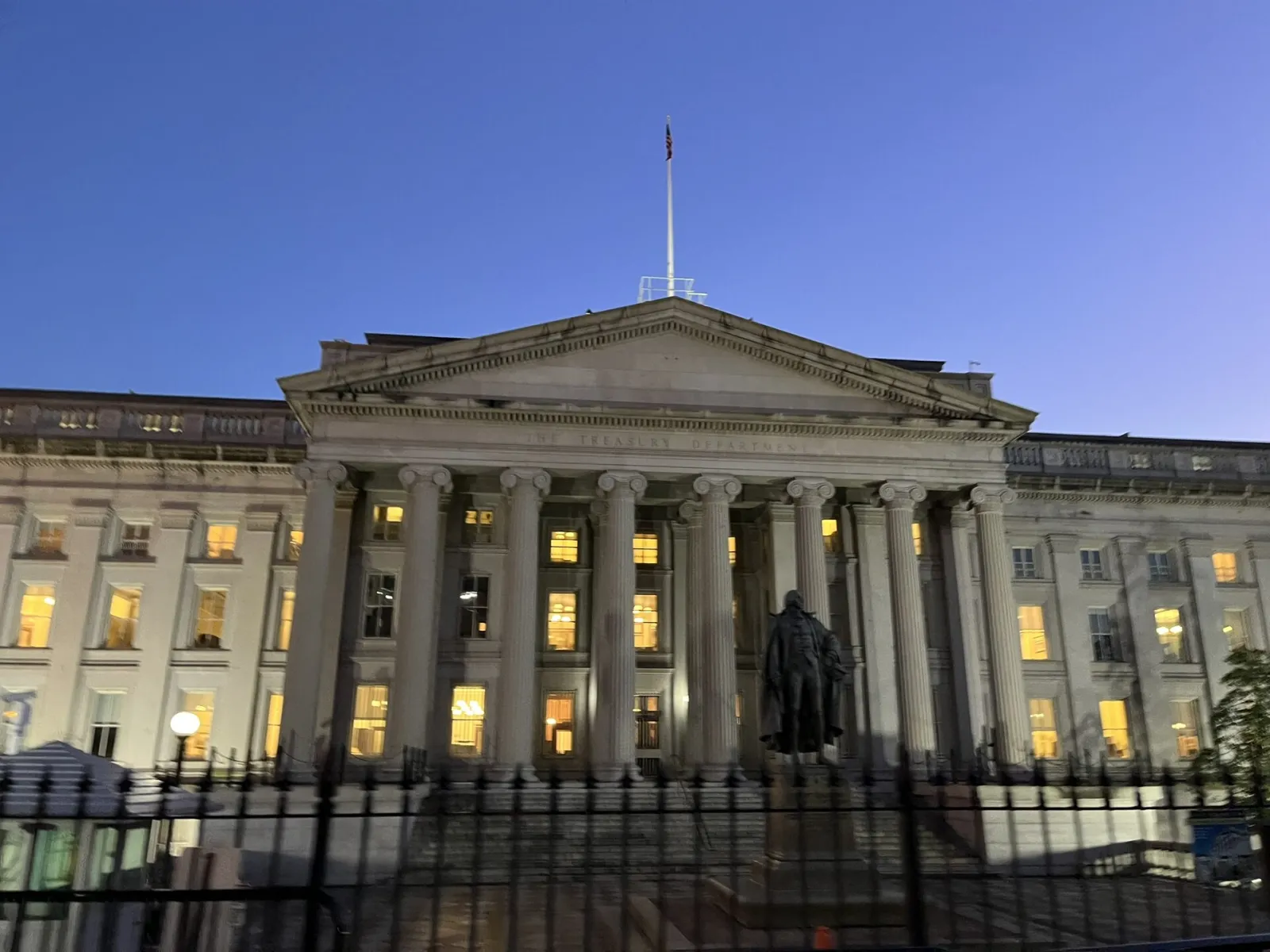
The US Treasury will borrow 800 billion dollars in January–March while holding coupon auctions steady. The difference falls on bills; with the bill share at 22%, markets price a 73% chance of a December Fed hike.
Macro & Debt Markets Desk · 3 November 2026 · 7 min read · 8 sources
Why it matters
Noise: the midterm election will set the direction of Treasury yields; the 10-year rose 4 basis points as voting began on 3 November. Signal: the Treasury will borrow 1.418 trillion dollars over two quarters while holding coupon sizes steady. The gap falls on bills, and at 22% the bill share has overshot the TBAC's 20% average. The coupon lock suppresses term premium but moves rate risk to the front end, squarely in the path of Fed hikes.
Implications
- On 2 November the Treasury projected net marketable borrowing of 618 billion dollars for October–December and 800 billion dollars for January–March, with an assumed end-March cash balance of 1 trillion dollars.
- The bill share was about 22% in September, above the 20% average recommended by the TBAC in 2024; if coupons stay fixed, bills will also carry the first-quarter increase.
- CME FedWatch puts the probability of a hike on 8–9 December at about 73%; bill-heavy financing passes such a hike through to the interest bill within weeks.
Noise
The midterm result will set the direction of Treasury yields
Signal
First-quarter borrowing is 800 billion dollars, and bills carry the load if coupons stay fixed
The headline is the election, the constraint the borrowing calendar
On the morning of 3 November the 10-year yield rose more than 4 basis points to 4.935%; CNBC linked the move to the start of voting in the midterms. The outcome is uncertain, but the refunding calendar for 4 November is not. On 2 November the Treasury projected net marketable borrowing of 618 billion dollars for October–December and 800 billion dollars for January–March. The two quarters add up to 1.418 trillion dollars, whoever wins the election.
The quarterly refunding statement, due tomorrow at 16:30 TRT (UTC+3), is the document in which the Treasury announces auction sizes for notes and bonds; it will show which maturities fund that sum. Dealers expect unchanged sizes of 58 billion dollars in 3-year notes, 42 billion in 10-year notes and 25 billion in 30-year bonds. The 125 billion dollar package in total matches the August refunding.
The coupon lock and the bill share
In its August 2026 statement the Treasury wrote that nominal coupon and floating-rate note auction sizes would stay unchanged for at least the next several quarters. If borrowing needs grow while coupon sizes are fixed, the gap is filled by bills, the discount paper maturing in under a year. According to Bloomberg, bills rose to about 22% of total debt in September. That is above the 20% average recommended in 2024 by the Treasury Borrowing Advisory Committee (TBAC). Last week the Treasury set a weekly auction record of 839 billion dollars.
The lock is a deliberate choice. If no extra supply lands beyond the 10-year point, term premium, the extra yield investors demand for holding extended-maturity bonds, stays contained. The 30-year yield closed 2 November at 5.268% and rose to 5.309% on the morning of 3 November. The Treasury has also raised buybacks in the 10–30 year bucket to as much as 6 billion dollars. These two tools protect the far end of the curve while also choosing where the risk goes.
The price of the lock is paid at the front end
The problem is timing. The tilt towards bills coincides with a period in which the Fed held on 28 October in a 10–2 vote but signalled that its next move is a hike. The policy range is 3.75–4.00%, and CME FedWatch puts the probability of a hike on 8–9 December at about 73%. Because bills roll over within weeks, every 25 basis point hike feeds quickly into the interest bill. The coupon lock suppresses term premium but shifts rate risk to the sub-one-year end of Treasury debt.
The curve already showed this balance on 2 November, when the 2-year closed at 4.581% and the 10-year at 4.893%; by Talay's calculation the 2–10 year spread is 31.2 basis points. According to the TBAC economy statement, the 10-year yield as of 30 October was 76 basis points above its end-2025 level of 4.18%. The statement attributes those 76 basis points partly to growth optimism and to the capital demands of AI investment.
The cash buffer also ties up liquidity
The Treasury's 2 November cash assumption creates a second constraint. The Treasury General Account (TGA), the Treasury's account at the Fed, stood at 984 billion dollars at the end of September and is set to fall to 850 billion dollars by end-December. That 134 billion dollar drawdown releases liquidity into the market in the fourth quarter. The end-March assumption, however, is 1 trillion dollars: the account refills by 150 billion dollars just as borrowing rises to 800 billion.
That sequence means bank reserves will be drained again in the first quarter of 2027. If a Fed hike and the TGA rebuild fall in the same three months, friction in overnight funding markets will rise. The size of the effect in the first quarter of 2027 could not be verified; none of the 5 sources reviewed includes a reserves forecast.
Three dealer readings
Previews compiled by Bloomberg on 2 November split three ways. Citigroup expects 20 and 30-year auctions to shrink this month. JPMorgan expects the guidance to be carried into 2027, with sizes unchanged until next August. Barclays expects the 'at least the next several quarters' formula to be replaced with more flexible wording, while UBS sees no actual change until May 2027.
Cutting the far end would lower term premium but push the bill share even above 22%. Raising coupons would cap the bill share but could lift the 30-year above the 5.3% zone. Neither path removes the 800 billion dollar need in the first quarter; each only chooses which maturity carries the risk.
Data week and the Türkiye channel
October payrolls, due on Friday 6 November, are expected at 65 thousand, against 29 thousand in September and a third-quarter average of 51 thousand. The ISM manufacturing index beat expectations at 55.5 on 2 November, but its prices component stayed high at 75.2. Weak hiring combined with high input prices would complicate the Fed's 9 December decision and make the cost of bill funding harder to forecast.
For Türkiye the channel is the cost of dollar funding. While the US 2-year yield holds at 4.581%, the floor under emerging-market issuers' dollar borrowing stays high too. The dollar index closed 2 November at 101.78; a move above 102.5 would signal that this channel is tightening.
Probabilities
Scenarios
| Scenario | Probability | Trigger | Market impact |
|---|---|---|---|
| H1Sizes held, language loosened | 55% | The 125 billion dollar package is kept on 4 November and the 'at least the next several quarters' formula gives way to more flexible wording. | Most of the first-quarter need falls on bills, the bill share stays above 22% and rate risk builds at the front end. |
| H2Signal of cuts at the far end | 30% | The Treasury signals smaller 20 and 30-year auctions in 2027, moving in the direction Citigroup expects. | Pressure on term premium eases, but the bill share rises further and the interest bill becomes more tightly tied to Fed decisions. |
| H3Coupon increases come early | 15% | The Treasury brings forward language on increases in the 2–10 year bucket to cap the bill share. | The bill burden eases, but worries about extra supply at the far end reopen term premium. |
Module A
Constraints Matrix
STRUCTURAL AVG 4.7 · TACTICAL AVG 2.7Structural constraints dominate: the outcome is set more by these limits than by the actors' preferences.
Hard structural constraintspersistent · beyond the actors' will
Two quarters of borrowing needs · United States
5/5Net marketable borrowing of 618 billion dollars in October–December and 800 billion dollars in January–March; 1.418 trillion dollars in total, independent of the election result.
The Fed's hiking path · United States
5/5The policy range is 3.75–4.00%; CME FedWatch puts the odds of a hike on 8–9 December at about 73%, with PCE inflation at 3.6% year on year in September.
Coupon guidance · United States
4/5In August the Treasury wrote that coupon and floating-rate auction sizes would stay unchanged for at least the next several quarters; the 125 billion dollar package is locked by that pledge.
Tactical frictiontemporary · eases over time
Bill share threshold months
3/5The bill share was about 22% in September, above the 20% average the TBAC recommended in 2024; each new quarter widens the deviation.
Rebuilding the cash buffer months
3/5The TGA falls to 850 billion dollars at end-December and rises to 1 trillion at end-March; the 150 billion dollar rebuild drains reserves in the first quarter of 2027.
Data week days
2/5Payrolls on 6 November are expected at 65 thousand against 29 thousand in September; the ISM prices component is at 75.2. The data move Fed expectations and bill costs together.
Module B
Signal vs Noise
SIGNAL 60% · NOISE 40%
- NOISE
The midterm result will set the direction of Treasury yields
The 10-year yield rose more than 4 basis points to 4.935% as voting began on 3 November, but the 618 and 800 billion dollar borrowing needs were set before the election.
Data: US 10-year yield ›CNBC — Treasury yields rise as investors weigh midterm vote, jobs data and Iran tensions
- SIGNAL
First-quarter borrowing is 800 billion dollars, and bills carry the load if coupons stay fixed
The Treasury projected 800 billion dollars for January–March and 1 trillion dollars of cash at end-March; dealers expect the 125 billion dollar coupon package to stay unchanged.
U.S. Department of the Treasury — Treasury Announces Marketable Borrowing Estimates
- SIGNAL
The bill share has overshot the advisory committee's recommended average
Bloomberg puts the bill share at about 22% in September; the TBAC recommended a 20% average in 2024. Last week the Treasury set a weekly auction record of 839 billion dollars.
Bloomberg via Yahoo Finance — Wall Street Braces for Biggest Treasury Sales Overhaul in Years
- NOISE
Strong ISM data are pushing yields higher
The ISM beat expectations at 55.5 on 2 November, yet the 10-year yield fell 3.5 basis points to close at 4.893% that day as Brent dropped 7.63%.
Data: US 10-year yield ›CAPP Notes — Closing Look, Monday, November 2, 2026
- SIGNAL
A Fed hike reprices bill costs within weeks
CME FedWatch puts the probability of a December hike at about 73%; October payrolls are expected at 65 thousand, against 29 thousand in September.
FXStreet — United States Dollar Index holds steady near 102.00 ahead of US midterm elections
Module C
Asset-Class and Positioning Implications
| Asset class | Exposure | Transmission channel | H1 | H2 | H3 | Expected | Conviction | Horizon | What to watch |
|---|---|---|---|---|---|---|---|---|---|
| Sovereign debt | US Treasury bills | Rising bill supply and the December Fed decision | − | −− | + | −1.00 | ●●● | 0–3 months | Weekly bill auction sizes and the FedWatch December probability |
| Sovereign debt | US 30-year end of the yield curve | Coupon guidance and term premium | + | ++ | −− | +0.85 | ●●● | 3–12 months | Position of the 30-year yield relative to the 5.40% threshold |
| FX | Dollar index | Front-end rate differential and funding costs | + | 0 | + | +0.70 | ●●● | 0–3 months | The index relative to 101.78 and 102.5 |
| Credit | Emerging-market dollar borrowing | Pass-through of US front-end rates to the borrowing floor | − | − | − | −1.00 | ●●● | 3–12 months | Türkiye 5-year CDS and dollar issuance conditions |
| Volatility | US rates volatility | The 4 November statement and 6 November payrolls | 0 | − | ++ | 0.00 | ●●● | 0–3 months | VIX relative to its 21.15 level on 2 November |
Second-order effects
And then what?
Starting point
The Treasury projects 800 billion dollars of borrowing for January–March and says coupon auctions will stay unchanged for at least several quarters; the bill share was 22% in September.
- 1
Debt managementwithin weeks
If the 4 November statement keeps the 125 billion dollar package, most of the first-quarter increase falls on bills and the bill share rises above 22%.
Watch: The 4 November refunding statement and weekly bill auction sizes
- 2
Interest expensewithin weeks
If the Fed hikes on 8–9 December, bill rates reprice within weeks and the interest bill rises without the lag that extended-maturity debt provides.
Watch: The 3-month bill yield and the interest line in the monthly Treasury statement
- 3
Dollar liquiditywithin months
Rebuilding the TGA from 850 billion to 1 trillion dollars by end-March drains reserves; friction in overnight funding feeds into emerging markets' dollar costs.
Watch: The spread between SOFR and the Fed's interest on reserves, and the dollar index
What breaks the chain
If energy prices keep falling and the Fed holds in December, bill costs do not rise; if the Treasury brings coupon increases forward, risk moves back from the front end to the far end and the second step of the chain is cut.
Triggers
Thresholds to watch
| Indicator | Threshold | Today | What it means |
|---|---|---|---|
| US 30-year yield | > 5.40% | 5.37 | A rise in the 30-year from 5.309% on 3 November to this level would show the coupon lock failing to protect the far end and term premium reopening. |
| US 10-year yield | > 5.00% | 5.05 | A 10-year above 5% would mean the 4 November statement or the payrolls data have added supply worries at the far end of the curve. |
| US dollar broad index | > 102.5 | 121.32 | A rise in the index from 101.78 to this level would show US front-end rates tightening emerging-market dollar funding. |
Sources
- U.S. Department of the Treasury — Treasury Announces Marketable Borrowing Estimates
- U.S. Department of the Treasury — Economy Statement for the Treasury Borrowing Advisory Committee
- Bloomberg via Yahoo Finance — Wall Street Braces for Biggest Treasury Sales Overhaul in Years
- IndexBox — Treasury Refunding: Coupon Auction Sizes Seen Unchanged, 2027 Shift Eyed
- CNBC — Treasury yields rise as investors weigh midterm vote, jobs data and Iran tensions
- CAPP Notes — Closing Look, Monday, November 2, 2026
- FXStreet — United States Dollar Index holds steady near 102.00 ahead of US midterm elections
- Markets and News — Treasury refunding Nov. 4: will bigger long-bond buybacks continue?
Sourcing and verification rules: methodology · Report an error: contact
Related reports
IVMacro & Debt·Analysis·Türkiye and Its Neighbourhood
October inflation makes the CBRT's 28% forecast arithmetically unreachable
Consumer prices rose 2.58% in October, taking the increase since January to 27.52%. The CBRT's August year-end forecast of 28% leaves a combined 0.38% for November and December. The constraint is no longer the rate path but the forecast to be rewritten on 12 November and fast-draining reserves.
Türkiye & Neighbourhood Desk · 3 November 2026 · 7 min
IVMacro & Debt·Analysis·Europe
单一利率扛不住四种通胀,实际负担压向法国
10月初值把欧元区一分为二:德国HICP为2.8%,意大利为5.6%。意大利的借贷成本比法国低44个基点;扣除通胀后,两者差距扩大到2.24个百分点。
Macro & Debt Markets Desk · 31 October 2026 · 8 min
IVMacro & Debt·Analysis·Europe
The bond market did the ECB's work, then the Bund cushion melted
On 29 October the ECB unanimously held the deposit rate at 2.50%, citing tighter financing conditions. Yet the German 10-year yield fell from 3.60% to 3.36% in October, and the core leg of that argument could be gone by December.
Macro & Debt Markets Desk · 30 October 2026 · 8 min