Pillar I
Geo-Economics & Chokepoints
Energy flows, maritime chokepoints, freight and insurance costs: where the physical world turns into price.
- Events · 30d
- 56
- High importance
- 21
- Reports · 30d
- 5
- Regions
- 8
Geo-Economics · event map· 37 items · 20 high importance
Indicators
Threshold status and 30-day change
Pillar feed
Events
IGeo-Economics·Analysis·Eurasia
Russia's refining loss has stopped being a war statistic and become a monetary policy line: 45% of capacity is out
Both distillation units at the Moscow Refinery burned, and the Kuibyshev and Ufaneftekhim plants were struck on the night of 21–22 September. The Bank of Russia now counts fuel prices within the core inflation dynamic in its rate statement.
Eurasia Desk · 22 September 2026 · 9 min
IGeo-Economics·Analysis·Europe
The buffer is thin in two places at once: European storage at 68.5% while the Asian spot climbs to 30 dollars
Europe enters winter with storage 68.5% full while Asian spot LNG has climbed to 30 dollars. Two sides are competing for the same cargoes, and the outcome is measured not by price but by who withdraws from the market.
Energy & Shipping Desk · 18 September 2026 · 9 min
IGeo-Economics·In-depth analysis·Türkiye and Its Neighbourhood
From a struck distillation unit to 100-lira diesel: Russian refinery capacity and Türkiye's three-channel bill
Ukrainian drones are cutting Russian refinery capacity, Moscow is closing exports and Türkiye is losing half its cargo allocation. But the 100 lira at the pump is the sum not of one shock but of three separate channels.
Türkiye & Neighbourhood Desk · 18 September 2026 · 12 min
IGeo-Economics·Analysis·Middle East and North Africa
Two straits, one lever: why the Red Sea route is no longer a safe harbour while Hormuz is closed
The closure of the East-West pipeline and the Houthi seizure of the Bab el-Mandeb coast put both exit routes for Gulf exports under pressure in the same week.
Energy & Shipping Desk · 16 September 2026 · 9 min
Decision modules
From the latest report: Africa's fuel problem is no longer price but the last mile: the valve, the road and the pump are cut separately · 22 September 2026
Probabilities
Scenarios
| Scenario | Probability | Trigger | Market impact |
|---|---|---|---|
| H1The disruptions stay local | 55% | The valve in Libya reopens within days, the convoy arrangement in Mali holds, and the drone wave in Sudan remains confined to El-Obeid. | All three disruptions remain regional shortages and make no marked contribution to the global crude balance. |
| H2Force majeure in Libya | 30% | The interruption on the Sharara line drags on, the National Oil Corporation declares force majeure and the Zawiya refinery halts. | A loss of more than 130,000 barrels a day becomes entrenched and Libya runs a deficit in its own product supply as well. |
| H3The Sahel blockade widens | 15% | The JNIM blockade spreads beyond the Senegal and Côte d'Ivoire corridors and fuel distribution is cut in neighbouring countries too. | Fuel scarcity in West Africa crosses national borders; humanitarian displacement rises above the current level of 400,000 people. |
Module A
Constraints Matrix
STRUCTURAL AVG 4.5 · TACTICAL AVG 3.3Structural constraints dominate: the outcome is set more by these limits than by the actors' preferences.
Hard structural constraintspersistent · beyond the actors' will
Refining gap
5/5Across the continent roughly 70% of refined fuel needs are met by imports; in South Africa capacity has halved in a decade.
Supply dependent on roads
5/5Mali imports about 95% of its fuel by road; for a landlocked country there is no alternative corridor.
Export infrastructure tied to a single point
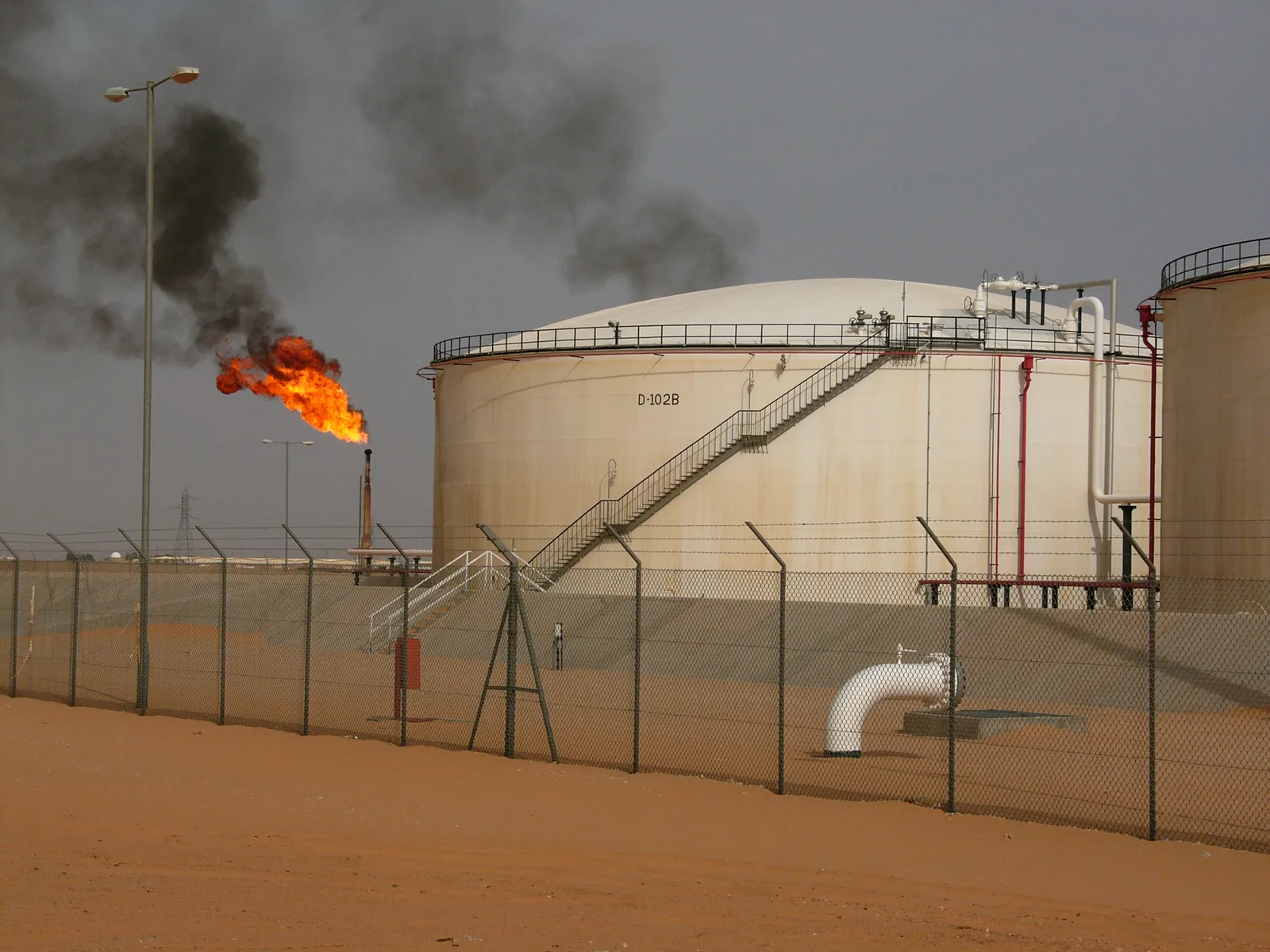
4/5In Libya the 350,000 barrel-a-day Sharara field is linked to the Zawiya terminal through one pipeline and one valve.
The distribution network as a military target
4/5According to UN documents at least 13 petrol stations in El-Obeid and Er-Rahad were damaged in drone attacks.
Tactical frictiontemporary · eases over time
Cost of convoy protection weeks
4/5On 14 September more than 900 tankers could enter Bamako only under military protection; protection capacity limits convoy frequency.
Access for technical teams days
3/5The National Oil Corporation reported that technical teams could not reach the area of the closed valve; repair time depends on security.
Uncertainty over perpetrators weeks
3/5The group that closed the valve in Libya was not named and no one claimed the drone attacks in Sudan; there is no defined counterpart to negotiate with.
Module B
Signal vs Noise
SIGNAL 75% · NOISE 25%
- SIGNAL
A single valve in Libya halted close to a tenth of national output
The National Oil Corporation reported on 22 September that the closure of valve number 7 had brought the daily loss to about 130,000 barrels.
Data: Brent crude oil ›Asharq Al-Awsat — NOC: Sharara pipeline closure losses 130,000 bpd
- SIGNAL
Fuel supply in Mali has turned into a military operation
On 14 September more than 900 tankers entered Bamako under military protection; more than 300 tankers have been destroyed since the blockade began.
Al Jazeera — Mali marks independence amid a worsening security crisis
- SIGNAL
The cost of the refining gap has become measurable
According to a South African Reserve Bank study the closures created a loss of roughly 76 billion rand (4.68 billion dollars) and 5,400 jobs in 2021–2024.
Businessday NG — Refinery closures cost South Africa 4.68 billion dollars
- NOISE
Cheaper oil means the fuel crisis is easing
Brent fell from 104.82 dollars on 17 September to 100.05 dollars on 22 September; over those same days none of the three disruptions in Libya, Mali and Sudan was price-driven and none of them eased.
Data: Brent crude oil ›TradingEconomics — Brent crude price and news page
Module C
Asset-Class and Positioning Implications
| Asset class | Exposure | Transmission channel | H1 | H2 | H3 | Expected | Conviction | Horizon | What to watch |
|---|---|---|---|---|---|---|---|---|---|
| Commodities | Mediterranean refined product premium | Simultaneous refining losses originating in Libya and Russia are tightening product supply | + | ++ | + | +1.30 | ●●● | 0–3 months | Operating status of the Zawiya refinery and any Libyan force majeure declaration |
| Commodities | Light crude curve | Whether the Libyan production loss passes into the global balance | 0 | + | 0 | +0.30 | ●●● | 0–3 months | Daily production notices from the National Oil Corporation |
| Freight & insurance | West African and Red Sea routes | Overland convoy and port risk feeds through into insurance premiums | − | − | −− | −1.15 | ●●● | 3–12 months | Bamako convoy frequency and notices on the Sudanese port-to-road corridor |
| Sovereign debt | Fuel-importing African economies | The refining gap damages the current account independently of the barrel price | − | − | −− | −1.15 | ●●● | 12+ months | Share of refined product imports in the total oil bill |
Last 30 days
Regional distribution
Most cited
Actors
Non-Western sources
Multipolar View
- Morocco · EnglishA Reading from Rabat: Cross-Border Payment Infrastructure Is Splitting into Three Blocs
- South Africa · EnglishA Reading from Pretoria: The Africa Group Seeks to Move Tax Rule-Making from the OECD to the UN
- Japan · EnglishHormuz in its sixth month: the stock buffer is thinning for Asian importers
- Türkiye · TurkishThe real risk in the EU carbon border levy is uncertainty, not cost