I Geo-Economics & Chokepoints·Analysis·Sub-Saharan Africa
Africa's fuel problem is no longer price but the last mile: the valve, the road and the pump are cut separately
Brent fell from 104.82 dollars on 17 September to 100.05 dollars on 22 September. In the same five days a valve in Libya, a trunk road in Mali and petrol stations in Sudan were cut off; the cheaper barrel touched none of them.
Africa Desk · 22 September 2026 · 9 min read · 11 sources
Why it matters
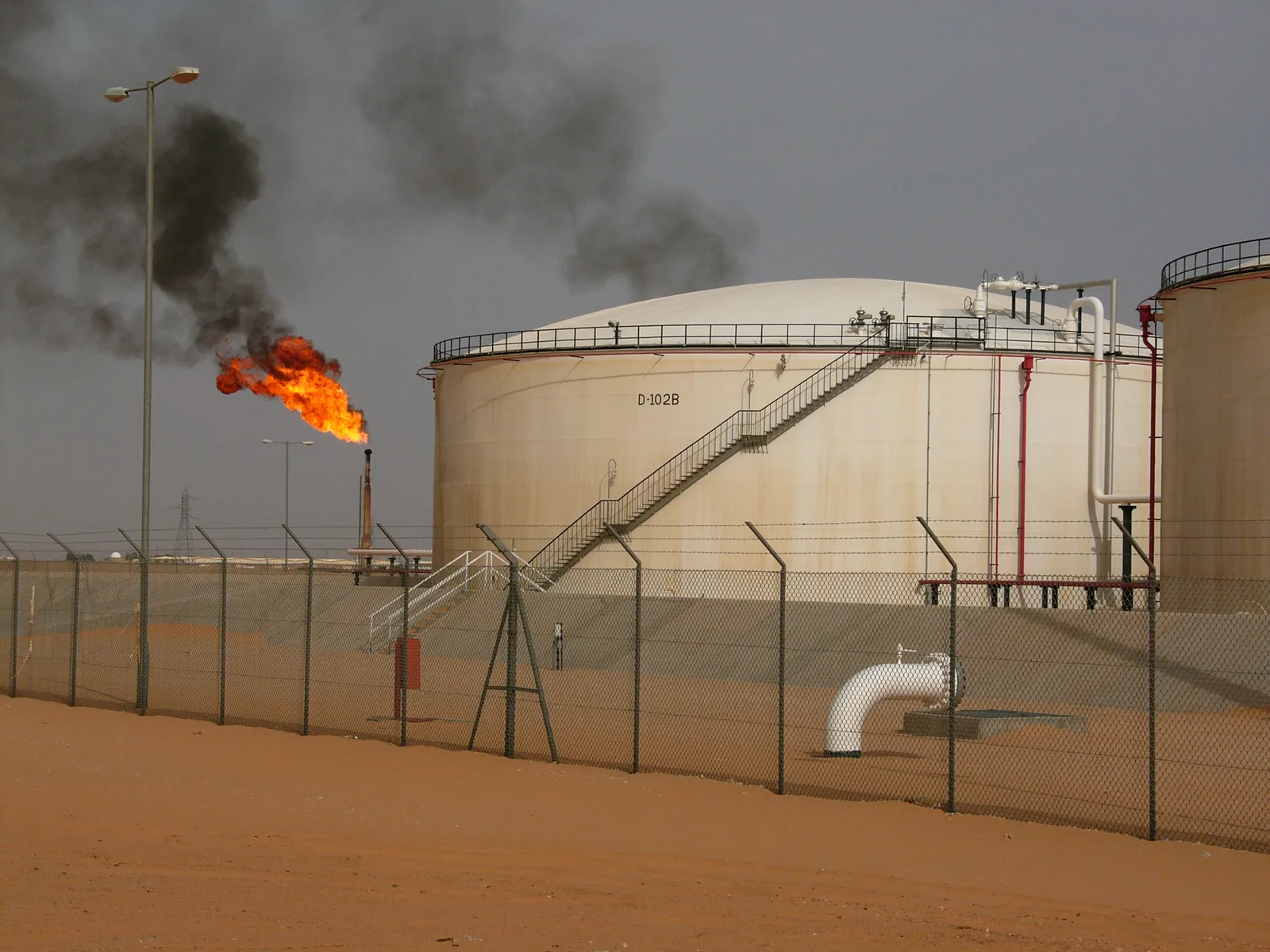
The variable that determines fuel supply in Africa is not the price of the barrel but who controls the final hundred kilometres of the molecule. In Libya valve number 7 halted 130,000 barrels a day; in Mali the road that carries roughly 95% of the country's fuel has been under blockade for a year; in Sudan at least 13 petrol stations in El-Obeid and Er-Rahad have been damaged. None of these three disruptions responds to the price signal, because none of them is caused by price.
Implications
- The closure of the Sharara–Zawiya line in Libya created a production loss of 130,000 barrels a day; at full capacity the field produces about 350,000 barrels a day and accounts for roughly a third of national output.
- Mali imports about 95% of its fuel by road; more than 300 tankers have been destroyed since the blockade began, and on 14 September over 900 tankers could only reach Bamako under military convoy.
- Refinery closures in South Africa added about 76 billion rand (4.68 billion dollars) to the import bill in 2021–2024; across the continent roughly 70% of refined fuel needs are met by imports.
The price fell, the shortage deepened
Oil prices eased this week. According to Wikipedia's chronology of the world oil market, Brent closed at 104.82 dollars on 17 September; TradingEconomics data put it at 100.05 dollars on 22 September, with a session low of 98.63 dollars. According to Fortune's compilation, at 09.35 US Eastern Time on 21 September Brent stood at 101.61 dollars, a daily change of −2.61 per cent. That amounts to an easing of roughly 4.77 dollars in five days.
In those same five days fuel supply tightened at four separate points in Africa, and none of them had anything to do with price. In Libya an armed group closed a valve. In Mali a blockade running for a year carried through to the independence anniversary. In Sudan drones struck a provincial capital for thirteen hours. In South Africa the disruption is not new but structural: refining capacity has halved over the past decade. The cheaper barrel touches none of these four problems, because all four arise not in the price of crude but in the last hundred kilometres of the product.
The valve: a single point in Libya, 130,000 barrels a day
According to Euronews, a valve was closed on the night of 21 September on the line linking the Sharara field, some 700 kilometres south of Tripoli, to the Zawiya export terminal. According to the English service of Asharq Al-Awsat, Libya's National Oil Corporation reported on 22 September that the point shut was valve number 7 on the line and that the daily loss had reached about 130,000 barrels. The corporation announced that pressure was building inside the line, that technical teams had been unable to reach the area and that it might have to declare force majeure if the interruption continued; the most recent similar declaration was made in January 2024.
The asymmetry here sums up the report's central idea. A field able to produce 350,000 barrels a day is losing roughly 37 per cent of its output through a single valve, and the identity of the perpetrator has not even been disclosed; the National Oil Corporation did not identify the group. The incident followed a one-week ultimatum issued by the petroleum facilities guards to seven fields on 16 September. The Zawiya refinery, 45 kilometres west of Tripoli, is also at risk of shutting down; the disruption therefore threatens not only export volumes but Libya's own product supply.
The road: 900 tankers and a military convoy in Mali
According to Al Jazeera's compilation of 22 September, Mali marked its 66th independence anniversary amid a worsening security crisis. The blockade declared in September 2025 by the al-Qaeda-linked JNIM targets fuel convoys arriving overland from Senegal and Côte d'Ivoire; the country imports about 95% of its fuel by road. The Malian government announced on 14 September that more than 900 fuel tankers had entered Bamako under military protection. Open-source tracking indicates that more than 300 tankers have been destroyed since the blockade began; as of June 2026 the number of internally displaced people exceeds 400,000.
The cost of the blockade is visible on the military side as well. JNIM announced through its propaganda channel that in its 10 September attack on the Dioura military camp in central Mali it had neutralised 150 soldiers, including 2 colonels and 1 captain, and taken 93 people captive. According to security and local official statements sourced from AFP and reported by Arab News on 18 September, at least 100 soldiers were killed and between 80 and 93 people taken captive. The Malian army gave no figure for its own losses; an official military casualty number could not be independently verified. Both figures say the same thing: protecting the fuel convoy has become more expensive than protecting the army.
The pump: in Sudan the distribution network is the direct target
According to a Darfur24 report based on local sources, between 04.00 and 08.00 on the morning of 20 September 4 unmanned aerial vehicles struck various points in El-Obeid, the capital of North Kordofan, including the Sudanese army headquarters and the finance ministry building; the attacks continued intermittently until 17.00 in the evening. The independent medical group the Sudan Doctors' Network reported 2 dead and more than 20 wounded. The perpetrator could not be independently verified; no direct claim of responsibility came from the Rapid Support Forces.
The critical point lies in the choice of target. The UN Office of the High Commissioner for Human Rights had previously documented that in El-Obeid and its surroundings alone 45 civilians were killed and 41 wounded in 15 drone attacks, and that at least 13 petrol stations in El-Obeid and Er-Rahad were damaged. According to the UN's August 2026 assessment, 1,100 civilians were killed in drone attacks across Sudan between January and June 2026. Striking petrol stations is the cheapest method of halting a city's economic functioning without advancing the front; and it is a type of disruption that cannot be offset by the import price.
The refining gap makes the cost permanent
On top of the three acute disruptions sits the continent's structural gap. According to a study by South African Reserve Bank economists, reported by Businessday NG and confirmed by Chief Economist Konstantin Makrelov, shrinking refinery capacity cost the country roughly 76 billion rand, or 4.68 billion dollars, in additional refined product imports over 2021–2024; 5,400 direct and indirect jobs were lost. The study calculates that refined products accounted for about 25 per cent of total imports in 2010–2019, and that had this share been maintained the oil import bill could have been on average 6.1 per cent lower over the four years. Semafor, reporting the same study, gives the cost as 4.7 billion dollars; the difference stems from rounding.
According to the same source, South Africa's refining capacity has halved over the past decade, imported refined products now meet more than half of domestic demand, and across the continent roughly 70% of refined fuel needs are met by imports. The country's global ranking in bitumen imports rose from 123rd in 2019 to 20th; in other words, the refineries that closed produced external dependence not only in fuel but in road-building inputs. On a continent with a refining gap, cheaper crude does not help: what is missing is not the barrel but the capacity to turn the barrel into product and to move that product.
The Mediterranean channel and Türkiye
The face this picture turns towards Türkiye is the Mediterranean product balance. The risk that Libya's Zawiya refinery shuts is the second simultaneous source tightening product supply in the Mediterranean basin; the first is Russia. According to Interfax-Ukraine, the Ukrainian General Staff announced that as of 21 September more than 45 per cent of the design capacity of Russia's oil refining industry was out of action. That figure comes from a party to the war and could not be independently verified, though its direction is not in dispute.
As a product importer, Türkiye feels this tightening independently of the crude price. With the increase that reached the pump at midnight on 17 September, diesel rose above 100 lira on both sides of Istanbul and above 101 lira in Ankara and Izmir; it was the third rise in a row. Brent's retreat from 104.82 dollars to 100.05 dollars in the same week does not bring that price back down, because Türkiye's cost arises not in crude but in the product premium and the exchange rate. The cutting of the valve in Africa, the road in Mali and the pump in Sudan, and the failure of the pump price in Türkiye to fall, are two ends of the same mechanism: scarcity is being distributed by access, not by price.
Probabilities
Scenarios
| Scenario | Probability | Trigger | Market impact |
|---|---|---|---|
| H1The disruptions stay local | 55% | The valve in Libya reopens within days, the convoy arrangement in Mali holds, and the drone wave in Sudan remains confined to El-Obeid. | All three disruptions remain regional shortages and make no marked contribution to the global crude balance. |
| H2Force majeure in Libya | 30% | The interruption on the Sharara line drags on, the National Oil Corporation declares force majeure and the Zawiya refinery halts. | A loss of more than 130,000 barrels a day becomes entrenched and Libya runs a deficit in its own product supply as well. |
| H3The Sahel blockade widens | 15% | The JNIM blockade spreads beyond the Senegal and Côte d'Ivoire corridors and fuel distribution is cut in neighbouring countries too. | Fuel scarcity in West Africa crosses national borders; humanitarian displacement rises above the current level of 400,000 people. |
Module A
Constraints Matrix
STRUCTURAL AVG 4.5 · TACTICAL AVG 3.3Structural constraints dominate: the outcome is set more by these limits than by the actors' preferences.
Hard structural constraintspersistent · beyond the actors' will
Refining gap
5/5Across the continent roughly 70% of refined fuel needs are met by imports; in South Africa capacity has halved in a decade.
Supply dependent on roads
5/5Mali imports about 95% of its fuel by road; for a landlocked country there is no alternative corridor.
Export infrastructure tied to a single point
4/5In Libya the 350,000 barrel-a-day Sharara field is linked to the Zawiya terminal through one pipeline and one valve.
The distribution network as a military target
4/5According to UN documents at least 13 petrol stations in El-Obeid and Er-Rahad were damaged in drone attacks.
Tactical frictiontemporary · eases over time
Cost of convoy protection weeks
4/5On 14 September more than 900 tankers could enter Bamako only under military protection; protection capacity limits convoy frequency.
Access for technical teams days
3/5The National Oil Corporation reported that technical teams could not reach the area of the closed valve; repair time depends on security.
Uncertainty over perpetrators weeks
3/5The group that closed the valve in Libya was not named and no one claimed the drone attacks in Sudan; there is no defined counterpart to negotiate with.
Module B
Signal vs Noise
SIGNAL 75% · NOISE 25%
- SIGNAL
A single valve in Libya halted close to a tenth of national output
The National Oil Corporation reported on 22 September that the closure of valve number 7 had brought the daily loss to about 130,000 barrels.
Data: Brent crude oil ›Asharq Al-Awsat — NOC: Sharara pipeline closure losses 130,000 bpd
- SIGNAL
Fuel supply in Mali has turned into a military operation
On 14 September more than 900 tankers entered Bamako under military protection; more than 300 tankers have been destroyed since the blockade began.
Al Jazeera — Mali marks independence amid a worsening security crisis
- SIGNAL
The cost of the refining gap has become measurable
According to a South African Reserve Bank study the closures created a loss of roughly 76 billion rand (4.68 billion dollars) and 5,400 jobs in 2021–2024.
Businessday NG — Refinery closures cost South Africa 4.68 billion dollars
- NOISE
Cheaper oil means the fuel crisis is easing
Brent fell from 104.82 dollars on 17 September to 100.05 dollars on 22 September; over those same days none of the three disruptions in Libya, Mali and Sudan was price-driven and none of them eased.
Data: Brent crude oil ›TradingEconomics — Brent crude price and news page
Module C
Asset-Class and Positioning Implications
| Asset class | Exposure | Transmission channel | H1 | H2 | H3 | Expected | Conviction | Horizon | What to watch |
|---|---|---|---|---|---|---|---|---|---|
| Commodities | Mediterranean refined product premium | Simultaneous refining losses originating in Libya and Russia are tightening product supply | + | ++ | + | +1.30 | ●●● | 0–3 months | Operating status of the Zawiya refinery and any Libyan force majeure declaration |
| Commodities | Light crude curve | Whether the Libyan production loss passes into the global balance | 0 | + | 0 | +0.30 | ●●● | 0–3 months | Daily production notices from the National Oil Corporation |
| Freight & insurance | West African and Red Sea routes | Overland convoy and port risk feeds through into insurance premiums | − | − | −− | −1.15 | ●●● | 3–12 months | Bamako convoy frequency and notices on the Sudanese port-to-road corridor |
| Sovereign debt | Fuel-importing African economies | The refining gap damages the current account independently of the barrel price | − | − | −− | −1.15 | ●●● | 12+ months | Share of refined product imports in the total oil bill |
Triggers
Thresholds to watch
| Indicator | Threshold | Today | What it means |
|---|---|---|---|
| Brent crude oil | < 95 | 130.80 | If the barrel price keeps easing, it becomes clearer that the physical disruptions in Africa are independent of price. |
| Brent crude oil | > 115 | 130.80 | The zone in which the physical disruptions turn into a price signal, meaning the supply loss passes into the global balance. |
Sources
- Euronews — Armed group shuts Libya's largest oil field pipeline
- Asharq Al-Awsat — NOC: Sharara pipeline closure losses 130,000 bpd
- Al Jazeera — Mali marks independence amid a worsening security crisis
- Arab News — Death toll passes 100 soldiers in Mali attack: sources
- Darfur24 — Drone strike on El-Obeid kills two, injures over 20
- Businessday NG — Refinery closures cost South Africa 4.68 billion dollars and 5,400 jobs
- Semafor — South Africa lost 4.7 billion dollars on oil refinery closures
- TradingEconomics — Brent crude price and news page
- Fortune — The price of oil as of 21 September 2026
- Interfax-Ukraine — Ukraine has knocked out more than 45 per cent of Russian refining capacity
- Cumhuriyet — Diesel prices passed 100 lira, 17 September 2026
Sourcing and verification rules: methodology · Report an error: contact
Related reports
IGeo-Economics·Analysis·Eurasia
Russia's refining loss has stopped being a war statistic and become a monetary policy line: 45% of capacity is out
Both distillation units at the Moscow Refinery burned, and the Kuibyshev and Ufaneftekhim plants were struck on the night of 21–22 September. The Bank of Russia now counts fuel prices within the core inflation dynamic in its rate statement.
Eurasia Desk · 22 September 2026 · 9 min
IGeo-Economics·Analysis·Europe
The buffer is thin in two places at once: European storage at 68.5% while the Asian spot climbs to 30 dollars
Europe enters winter with storage 68.5% full while Asian spot LNG has climbed to 30 dollars. Two sides are competing for the same cargoes, and the outcome is measured not by price but by who withdraws from the market.
Energy & Shipping Desk · 18 September 2026 · 9 min
IGeo-Economics·In-depth analysis·Türkiye and Its Neighbourhood
From a struck distillation unit to 100-lira diesel: Russian refinery capacity and Türkiye's three-channel bill
Ukrainian drones are cutting Russian refinery capacity, Moscow is closing exports and Türkiye is losing half its cargo allocation. But the 100 lira at the pump is the sum not of one shock but of three separate channels.
Türkiye & Neighbourhood Desk · 18 September 2026 · 12 min