V Technology Geopolitics & AI·Analysis·Americas
The truce covers tariffs as Washington turns to capital and components
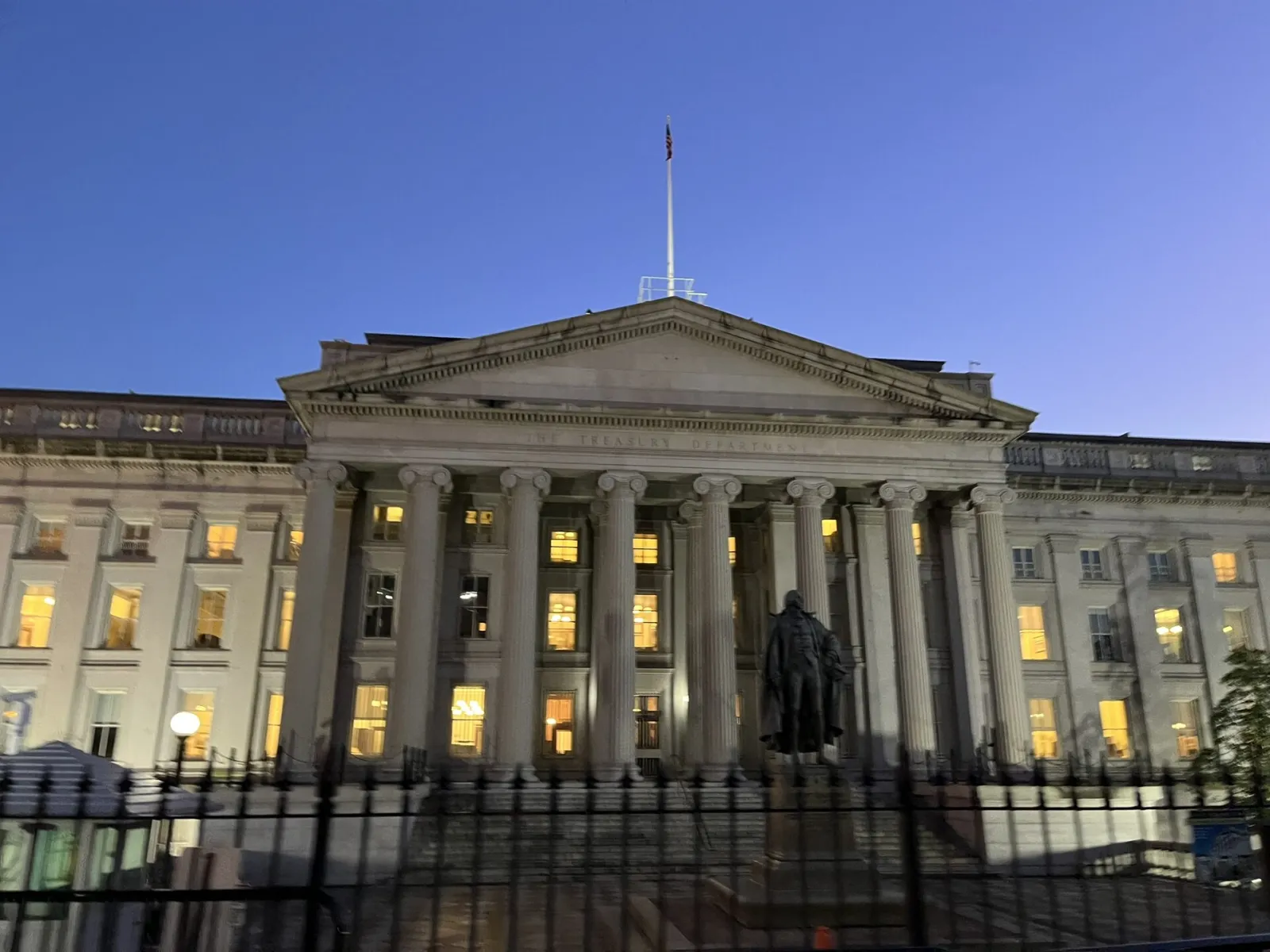
On 22 October the US Treasury published a draft rule restricting investment in Chinese biotech, and the FCC blocked 2 devices carrying Huawei chips. With the tariff truce extended to January, pressure is shifting to capital and components 4 weeks before APEC.
Technology Geopolitics Desk · 24 October 2026 · 7 min read · 9 sources
Why it matters
Noise: the truce extension to January and Trump's planned trip to Shenzhen on 18–19 November read like a thaw on the technology front. Signal: on 22 October the Treasury widened its outbound investment programme to 6 technology areas, adding biotech, and the FCC applied its component rule, in force since 13 October, for the first time. Neither step touches tariffs, yet both narrow China's access to US capital and the US market. Both sides are leaving the licensing channel open.
Implications
- The Treasury's 22 October draft adds biotech to semiconductors, AI, quantum, high-performance computing and hypersonics; comments are open until 7 December 2026.
- According to AP, the rule applies only to investments above 50,000 dollars; pure drug licensing deals are excluded, while joint ventures and equity stakes are covered.
- On 22 October the FCC shut 2 devices carrying HiSilicon chips out of the US market, the first use of the component rule that took effect on 13 October.
Noise
The longer truce and Trump's Shenzhen trip mean a thaw in technology rivalry
Signal
Pressure is moving from tariffs to capital and is being locked in by statute
The noise is in the truce, the signal in capital
The headlines are about the tariff truce between the US and China, now extended to January, and about Trump attending the Shenzhen APEC summit on 18–19 November. At first glance that suggests a cooling on the technology front. Yet on 22 October, 27 days before the summit, Washington rolled out two new tools from two separate agencies, and both operate outside the tariff talks.
The Treasury published a draft rule implementing the COINS Act, passed in December 2025 as part of the defence authorisation bill for fiscal 2026. Using the Secretary's discretion, the draft adds biotech to semiconductors, AI, quantum, high-performance computing and hypersonics; the Treasury's statement puts the number of areas at 6. On the same day the FCC blocked 2 devices carrying a chip from HiSilicon, a Huawei subsidiary. It was the first case under the component rule that took effect on 13 October. One tool targets capital flowing to China; the other targets Chinese components entering the US.
Why biotech is on the list now
The draft defines biotech broadly. According to a Treasury fact sheet cited by BioPharm International, it covers biologically derived compounds, brain-computer interfaces, biomanufacturing equipment, sequencing and biological design technologies, and bioinformatics tools. Equity acquisitions, convertible debt, joint ventures, greenfield investment and some fund investments fall under review. The countries of concern are China, including Hong Kong and Macau, Cuba, Iran, North Korea and Russia.
The critical detail lies in the exemption. Pure licensing deals, meaning transfers of drug rights for upfront payments, milestones and royalties, are excluded. Structures that involve a transfer of technology or know-how do not qualify. According to AP, the rule will apply to investments above 50,000 dollars, and many financial investments, such as buying listed shares, will remain outside it. STAT wrote that the draft is tougher than expected but could change during the comment period. MassBio, which has more than 1,700 members in Massachusetts, said it would submit comments.
Beijing's move mirrors the same exemption. According to Bloomberg, China proposed a week earlier to add several biomedical technologies to its own export control list, while explicitly allowing drug licensing deals to continue. Both capitals are narrowing flows of capital and technology to each other's companies while keeping molecule licensing open. Chinese foreign ministry spokeswoman Mao Ning said the concept of national security was being overstretched and that Beijing would take the necessary measures.
The component rule scans the supply chain from inside
The FCC's step is narrower but structurally deeper. According to The Record, until 13 October a device made by another company could win approval even if it contained a part from a firm on the Covered List. The new rule bars approval of devices that contain logic-bearing components from companies on the list, which has been kept since 2019. The makers of the vehicle camera and wireless video transmitter blocked on 22 October were not named.
Enforcement has moved from the brand level down to the chip level. FCC chairman Brendan Carr said the agency would keep enforcing the rule aggressively. For third-party camera and IoT makers in Asia, the result is the cost of component declarations and supplier changes to secure US approval. The 200,000-dollar penalty the Treasury imposed in July over an unreported 92,500-dollar investment also shows that compliance failures are expensive.
What would falsify this reading
Our thesis is that Washington is preserving the tariff truce while pursuing technology competition through capital and components, and that these channels will stay outside the APEC bargaining. We put the probability of the rule being finalised with narrower drug provisions at 55%. A wider scope met by Beijing's retaliation stands at 30%, and a suspension of both steps at APEC at 15%.
The first falsifier: if a joint statement after 18–19 November says investment restrictions are postponed, the capital channel will have entered the bargaining. The second: if the final version of China's biomedical export control list removes the licensing exemption, the door both sides kept open would close and our stability assumption would collapse. The third: if the FCC announces no new component case before the end of 2026, the rule will remain symbolic.
Probabilities
Scenarios
| Scenario | Probability | Trigger | Market impact |
|---|---|---|---|
| H1Narrower final rule | 55% | After the comment period the Treasury narrows the drug provisions, while biomanufacturing and sequencing stay covered. | The licensing channel stays open, while joint-venture and venture capital flows shrink for good. |
| H2Tit-for-tat tightening | 30% | The final rule stays broad and Beijing narrows the licensing exemption in its biomedical export controls. | Technology flows slow in both directions; FCC component cases multiply. |
| H3Suspension at APEC | 15% | At the 18–19 November Shenzhen talks the truce is broadened and investment curbs are postponed. | The capital channel enters the bargaining and enforcement slows. |
Module A
Constraints Matrix
STRUCTURAL AVG 3.3 · TACTICAL AVG 2.7Structural constraints and tactical friction are balanced: short-term noise may mask the persistent trend.
Hard structural constraintspersistent · beyond the actors' will
The COINS Act is binding law · United States
4/5The programme was codified in statute in December 2025. Because the Treasury draft implements a law rather than an executive order, it is hard to withdraw in APEC bargaining.
US drug pipelines depend on Chinese licences · United States
3/5According to Bloomberg, US drugmakers increasingly license from Chinese biotech firms to fill their pipelines; that is why both sides are protecting the licensing exemption.
The Covered List and component rule · United States
3/5The list the FCC has kept since 2019 and the 13 October rule ban components from firms such as HiSilicon even inside third-party devices; enforcement sits at the level of an administrative decision.
Tactical frictiontemporary · eases over time
7 December comment deadline weeks
3/5The draft is not final; comments close on 7 December 2026 and the effective date will be set by the final rule.
Uncertain scope months
3/5The Treasury counts 6 areas while AP lists the newly covered ones under 4 headings; where licences involving technology transfer fall remains unclear.
APEC calendar weeks
2/5The Shenzhen summit on 18–19 November is 4 weeks away; Beijing may calibrate its response to the summit bargaining.
Module B
Signal vs Noise
SIGNAL 60% · NOISE 40%
- NOISE
The longer truce and Trump's Shenzhen trip mean a thaw in technology rivalry
According to Fortune, the truce was extended to January; in the same week, on 22 October, the Treasury added biotech to the investment curbs and the FCC enforced its first component ban.
- SIGNAL
Pressure is moving from tariffs to capital and is being locked in by statute
The Treasury's 22 October draft implements the COINS Act and covers 6 technology areas; comments close on 7 December and the final rule will set the effective date.
- SIGNAL
Enforcement has moved from the brand level down to the chip
Under the rule in force since 13 October, the FCC blocked 2 third-party devices carrying HiSilicon chips on 22 October; previously such devices could win approval.
The Record — FCC bans two devices with surveillance chips linked to Huawei
- SIGNAL
Both capitals are deliberately keeping the licensing channel open
According to Bloomberg, the US draft does not explicitly ban licensing deals, and China's biomedical export control proposal of a week earlier also permits licensing.
Taipei Times (Bloomberg) — US moots curbs on funds to Chinese biotech firms
- NOISE
The draft cuts off US investment in Chinese biotech entirely
According to AP, the rule will not apply to investments below 50,000 dollars or to many financial investments, such as buying listed shares.
Module C
Asset-Class and Positioning Implications
| Asset class | Exposure | Transmission channel | H1 | H2 | H3 | Expected | Conviction | Horizon | What to watch |
|---|---|---|---|---|---|---|---|---|---|
| Equities | Chinese biotech companies | Narrower access to US venture capital and joint ventures | − | −− | + | −1.00 | ●●● | 3–12 months | Hong Kong biotech IPOs and fundraising data |
| Equities | US pharmaceutical companies | Pipeline renewal through molecules licensed from China | 0 | − | + | −0.15 | ●●● | 3–12 months | New US–China licensing deal announcements |
| Equities | Asian surveillance and IoT hardware makers | Cost of switching suppliers under the FCC component rule | − | −− | 0 | −1.15 | ●●● | 3–12 months | New blocking notices from the FCC Office of Engineering and Technology |
| FX | Chinese yuan | Response to technology curbs and truce expectations | 0 | − | + | −0.15 | ●●● | 0–3 months | USD/CNY relative to the 6.80 threshold |
| Volatility | Global equity volatility | Surprise restrictions ahead of APEC | 0 | + | − | +0.15 | ●●● | 0–3 months | The VIX relative to the 20 threshold |
Second-order effects
And then what?
Starting point
On 22 October the Treasury published a draft that bans, or makes notifiable, equity, joint-venture and fund investment in Chinese biotech; pure licensing deals were left outside its scope.
- 1
Deal structurewithin weeks
US drugmakers and investors shift new China deals away from equity and joint-venture structures towards pure licensing; NewCo-style partnerships are put on hold.
Watch: Industry comments filed by 7 December and new US–China licensing deal announcements
- 2
Cost of capitalwithin months
Chinese biotech firms turn from US venture capital to domestic and Hong Kong funding; valuations and funding costs begin to diverge.
Watch: Hong Kong biotech IPOs and Chinese biotech fundraising data
- 3
Technology transferwithin months
Beijing responds with its final biomedical export control list; if the licensing exemption is narrowed, access to drug development pipelines becomes costlier in both directions.
Watch: The final text of China's biomedical export control list
What breaks the chain
The chain stops at the first step if the Treasury narrows the drug provisions after the comment period, or if investment curbs are postponed in the 18–19 November bargaining at APEC.
Triggers
Thresholds to watch
| Indicator | Threshold | Today | What it means |
|---|---|---|---|
| USD/CNY | > 6.80 | 6.6616 | A move above 6.80 from 6.6743 on 22 October would suggest Beijing is answering technology curbs with a weaker yuan, or that hopes for the truce have soured. |
| VIX volatility index | > 20 | 16.91 | A VIX above 20 would show that a surprise restriction before APEC has dented global risk appetite. |
Sources
- U.S. Department of the Treasury — Treasury Issues Proposed Rule to Implement Comprehensive Outbound Investment National Security Act
- PBS NewsHour (AP) — Treasury proposes rule to curb high-tech investments in China and other adversaries
- BioPharm International — Treasury Proposes Adding Biotech to Outbound Investment Restrictions Under COINS Act
- STAT — Treasury proposes major restrictions to U.S. investment in Chinese biotech sector
- Fortune — Treasury proposes rule to crack down on AI, biotech, investments greater than $50,000 in China, Russia
- Taipei Times (Bloomberg) — US moots curbs on funds to Chinese biotech firms
- The Record — FCC bans two devices with surveillance chips linked to Huawei
- Light Reading — FCC blocks two devices powered by Huawei silicon subsidiary
- Seoul Economic Daily — Kim Jong Un Visits China via New Yalu River Bridge
Sourcing and verification rules: methodology · Report an error: contact
Related reports
IVMacro & Debt·Analysis·Americas
Canada's hike flattened its curve; the Fed's hold steepened America's
On 28 October the Bank of Canada raised its rate to 2.50% and the Fed held at 3.75–4.00% by 10–2. Both answered the same energy shock, yet Canada's front end rose while the US far end did. The market priced the Fed's pause as inflation risk, not looseness.
Macro & Debt Markets Desk · 29 October 2026 · 7 min
VTech & AI·Analysis·Americas
Washington puts chip licences on the table in exchange for American fabs
Solidigm has made a $45 billion US plant conditional on an equipment licence for its Dalian facility in China. The same week, with 11 days to go, the text extending the affiliates rule suspension is still missing from the Federal Register.
Technology Geopolitics Desk · 29 October 2026 · 6 min
IVMacro & Debt·Analysis·Americas
The energy shock splits central banks three ways in a single week
The Fed and the Bank of Canada decide on 28 October, the ECB on 29 October. All three face the same oil and gas shock. Yet markets price a hike in Ottawa, a hawkish hold in Washington and, in Frankfurt, a hold that hides behind tightening credit.
Macro & Debt Markets Desk · 28 October 2026 · 7 min