I Geo-Economics & Chokepoints·Analysis·Türkiye and Its Neighbourhood
Black Sea war premiums outstrip the tanker war, sparing only coastal waters
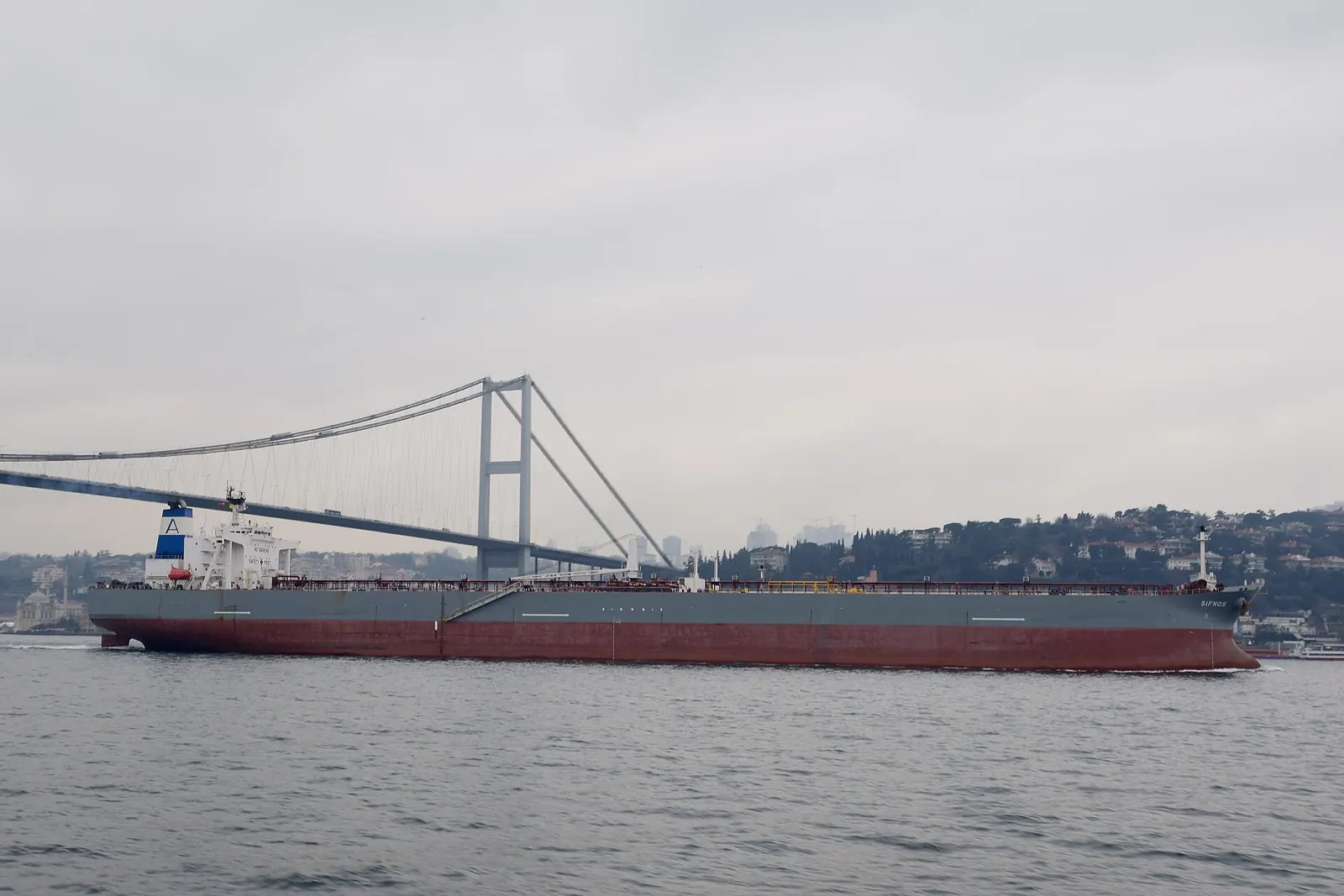
Some ships bound for the CPC terminal at Novorossiysk have been quoted war premiums of 20% of hull value. In the tanker war of the 1980s the ceiling was 7.5–10%. The only premium-free zone left in the basin is the territorial waters of Türkiye, Romania, Bulgaria and Georgia.
Türkiye & Neighbourhood Desk · 12 November 2026 · 7 min read · 7 sources
Talay Insight Analysis Desk·AI-assisted analysis, reviewed by an editor
Why it matters
Noise: the 20% war premium headline. Most quotes are far below that level, and the figure applies only to some ships calling at CPC. Signal: the cost is no longer confined to ships entering the war zone. From 9 November CMA CGM has charged $35 per TEU on all Black Sea cargo, including Constanța and Poti. What keeps trade moving is that the Joint War Committee's 16 September map left four coastal states' territorial waters outside. Ankara's 7 November chokepoint initiative aims to protect that strip; a single attack inside it would cost both the exemption and Ankara's leverage.
Implications
- UkrAgroConsult, citing The Insurer on 9 November, reported that some ships calling at the CPC terminal were quoted war premiums of 20% of hull value; most quotes were well below that level.
- From 9 November CMA CGM is charging a $35-per-TEU war risk surcharge on all cargo to and from Black Sea countries; for cargo linked to the US, Australia and Latin America it starts on 1 December.
- On 16 September the Joint War Committee added almost the entire Black Sea to its listed high-risk areas; the territorial waters of Türkiye, Romania, Bulgaria and Georgia were left out.
Noise
Black Sea war premiums have reached 20% of hull value
Signal
War costs have moved from the war zone onto container cargo across the basin
The premium ceiling has broken
UkrAgroConsult, citing The Insurer on 9 November, reported that war premiums on the riskiest Black Sea voyages have reached 20% of hull value. A war premium is the additional charge paid on top of standard cover when a ship enters a listed conflict zone. The same report says that in the Iran–Iraq tanker war of the 1980s the rate was around 7.5% and only occasionally topped 10%. For a $20 million tanker, 20% means $4 million for a single voyage; the calculation is Talay's.
The figure needs to be sized correctly. The 20% was quoted only for some ships calling at the Caspian Pipeline Consortium (CPC) terminal at Novorossiysk, and most quotes were well below it. The report gives no average rate per voyage; a November average could not be verified. The headline therefore shows not the whole market but the extreme point at which insurers are close to shutting the door.
Why the CPC terminal
According to a chronology compiled by The Times of Central Asia, tankers bound for CPC came under drone attack on 13 January 2026, and on 14 March a tanker was struck outside Russian territorial waters. In July 2026 there were attacks around the terminal on 17, 19, 20, 23 and 30 July. On 8 September a drone incident briefly halted loading at two buoys. CPC carries more than 80% of Kazakhstan's oil exports and moved 64.8 million tonnes in 2025.
For insurers, the problem is the location of attacks as much as their frequency. Tankers are now being hit not only at the terminal but on the open-sea leg of the route, as the 14 March incident shows. That pulls stretches far from the terminal into the pricing too. On 25 August Kazakhstan's Energy Ministry cut its 2026 output plan from 98 million to 96 million tonnes, blaming the attacks for a loss of about 3.5 million tonnes.
The cost spreads across the basin
UkrAgroConsult reported on 3 November that from 9 November CMA CGM is charging a $35-per-TEU war risk surcharge on all cargo to and from Black Sea countries. A TEU is the standard 20-foot container unit. The surcharge covers cargo on third-party feeder services as well as the company's own. The report names Constanța and Poti, where Ukrainian cargo is transhipped; whether Turkish ports are included could not be verified.
This break shows the premium moving from ships entering the war zone onto container cargo across the whole basin. The same report says the Joint War Committee added almost the entire Black Sea to its high-risk list on 16 September. The area left off the list is the territorial waters of four countries: Türkiye, Romania, Bulgaria and Georgia. As we wrote in October, the shift of trade onto this coastal strip is a direct result of where the list draws its line.
Ankara's hand
Foreign Minister Hakan Fidan called on 7 November, at the TRT World Forum in Istanbul, for a global initiative to protect maritime chokepoints, naming three: the Black Sea, Hormuz and the Bab el-Mandeb. Fidan cited the 2022 Black Sea Grain Initiative as proof that diplomacy can deliver while fighting continues. No new agreement text or timetable was announced. Russia's Defence Ministry said it struck bulk and container ships near Odesa and Chornomorsk on 7–8 November; the ships' names and number could not be verified.
Ankara's tool is the Straits. According to a Bloomberg report carried by USM, the Coast Guard said on 8 August that some ships bound for Novorossiysk would be refused transit permission or delayed. As of 13:00 that day, ships bound for Bulgarian and Turkish ports were still passing north through the Dardanelles. This selective brake is also a way of protecting the exemption for Turkish territorial waters: risk-carrying voyages are slowed at the Straits.
The exemption has a price. RFI reported on 21 September that grain prices had risen by up to 30%, and that ships staying out of the Black Sea face mooring and crew costs of up to €50,000 a month. Turkish owners gain on traffic that stays within the coastal strip and lose by missing out on high war-zone freight. If a single attack lands inside territorial waters, the chance of the Joint War Committee widening its map is Talay's biggest tail risk.
Probabilities
Scenarios
| Scenario | Probability | Trigger | Market impact |
|---|---|---|---|
| H1The coastal strip holds | 55% | Attacks stay in Russian and Ukrainian ports and on the open sea; the Joint War Committee map is unchanged. | Trade is squeezed into four countries' territorial waters, and surcharges become permanent, but flows are not cut. |
| H2Moratorium or maritime ceasefire | 25% | A text banning attacks on merchant ships emerges from Russia–Ukraine talks or from Ankara's initiative. | War premium quotes fall quickly and surcharges are withdrawn within a few weeks. |
| H3The exemption is breached | 20% | A merchant ship is struck in Turkish, Romanian or Bulgarian territorial waters. | The Joint War Committee widens the list; Straits transits and Turkish ports fall under war premiums. |
Module A
Constraints Matrix
STRUCTURAL AVG 4.0 · TACTICAL AVG 2.3Structural constraints dominate: the outcome is set more by these limits than by the actors' preferences.
Hard structural constraintspersistent · beyond the actors' will
The war risk listing map
5/5On 16 September the Joint War Committee listed almost the entire Black Sea; only the territorial waters of Türkiye, Romania, Bulgaria and Georgia were left out.
Dependence on CPC
4/5CPC carries more than 80% of Kazakhstan's oil exports and moved 64.8 million tonnes in 2025; alternative routes can carry only a small fraction of that volume.
The parties' intransigence · Russia
4/5In August Russia rejected Ukraine's proposal for a merchant shipping ceasefire and demanded a broader deal; Fidan unveiled no new text on 7 November.
Montreux and transit authority · Türkiye
3/5Ankara can slow Straits transits: on 8 August some ships bound for Novorossiysk were refused transit permission or delayed.
Tactical frictiontemporary · eases over time
Unverified attack claims days
3/5Russia's Defence Ministry said it struck ships near Odesa on 7–8 November; ship names and damage could not be verified, which complicates insurers' assessment.
Container surcharge weeks
2/5Since 9 November CMA CGM has charged $35 per TEU on Black Sea cargo; for cargo linked to the US and Latin America it starts on 1 December.
Idle ship costs months
2/5RFI reported on 21 September that mooring and crew costs for a ship staying out of the Black Sea reach €50,000 a month.
Module B
Signal vs Noise
SIGNAL 60% · NOISE 40%
- NOISE
Black Sea war premiums have reached 20% of hull value
The 20% was quoted only for some ships calling at the CPC terminal; UkrAgroConsult reported on 9 November that most quotes are well below that level.
UkrAgroConsult — Black Sea vessel insurance costs reach record 20%
- SIGNAL
War costs have moved from the war zone onto container cargo across the basin
From 9 November CMA CGM is charging $35 per TEU on all cargo to and from Black Sea countries, including Constanța and Poti; feeder services are also covered.
UkrAgroConsult — CMA CGM introduces additional war risk surcharge
- SIGNAL
Trade rests on the exemption for four countries' territorial waters
On 16 September the Joint War Committee listed almost the entire Black Sea; the territorial waters of Türkiye, Romania, Bulgaria and Georgia were left out.
Data: Turkish Straits waiting time ›UkrAgroConsult — CMA CGM introduces additional war risk surcharge
- NOISE
Fidan's chokepoint initiative brings a Black Sea solution within reach
On 7 November Fidan named three chokepoints but announced no text or timetable; Russia said it struck ships near Odesa on 7–8 November.
Yeni Şafak — Türkiye calls for global initiative to secure maritime chokepoints
- SIGNAL
The country risk premium is not yet pricing Black Sea risk
Five-year TR CDS fell to 237.18 basis points on 10 November, from 247.45 on 6 November.
Data: Türkiye 5-year CDS ›Investing.com — Turkey CDS 5 Years USD
Module C
Asset-Class and Positioning Implications
| Asset class | Exposure | Transmission channel | H1 | H2 | H3 | Expected | Conviction | Horizon | What to watch |
|---|---|---|---|---|---|---|---|---|---|
| Freight & insurance | Black Sea container and dry bulk freight | War premiums and carrier surcharges feed through to cargo | + | −− | ++ | +0.45 | ●●● | 0–3 months | Black Sea surcharge announcements from major carriers |
| Commodities | Light crude supply to the Mediterranean | A CPC outage halts Kazakhstan's exports | + | − | ++ | +0.70 | ●●● | 0–3 months | CPC loading programme and terminal outage notices |
| Credit | Türkiye sovereign risk premium | Risk spreading into territorial waters lifts the country premium | 0 | − | ++ | +0.15 | ●●● | 0–3 months | Five-year TR CDS and the 260 basis-point threshold |
| Equities | Turkish ports and coastal shipping | Cargo volume shifting to the unlisted strip | + | − | −− | −0.10 | ●●● | 3–12 months | Turkish Straits transit counts and port handling data |
Second-order effects
And then what?
Starting point
Some ships calling at the CPC terminal are being quoted war premiums of 20% of hull value, and since 9 November CMA CGM has charged $35 per TEU on all Black Sea cargo.
- 1
Freight and insurancewithin days
Other major container lines spread similar surcharges across the basin; costs for Constanța, Varna and Poti cargo rise without ships entering the war zone, and owners turn to routes that stay inside territorial waters.
Watch: Black Sea surcharge announcements from MSC and Maersk; tariffs after 15 November
- 2
Ports and transhipmentwithin weeks
Traffic concentrates on the coastal strip; Turkish ports and Straits transits draw more cargo and transhipment as the only large safe zone outside the list.
Watch: Monthly Turkish Straits transit counts and container handling data for Samsun and Istanbul ports
- 3
Cover mapwithin months
Denser traffic magnifies the impact of any attack in territorial waters; after such an attack the Joint War Committee widens the list, and Turkish owners' cost advantage is wiped out by a single decision.
Watch: The Joint War Committee's next list update and incidents reported in Turkish territorial waters
What breaks the chain
A moratorium on attacks against merchant ships signed by Moscow and Kyiv, or a maritime ceasefire emerging from Russia–Ukraine talks, would stop the chain at the first step; premium quotes could then fall back to the 1% band.
Triggers
Thresholds to watch
| Indicator | Threshold | Today | What it means |
|---|---|---|---|
| Turkish Straits waiting time | If coastal waters are listed | — | If the Joint War Committee lists Turkish territorial waters, war premiums land on Straits transits and Turkish ports, removing the basis for coastal trade. |
| Brent crude oil (futures) | If CPC loading halts over a week | — | A CPC shutdown of more than a week halts over 80% of Kazakhstan's exports and tightens light crude supply to the Mediterranean. |
| Türkiye 5-year CDS | > 260 bp | — | A rise in TR CDS from 237.18 basis points on 10 November to above 260 would show Black Sea risk spilling into the country risk premium. |
Sources
- UkrAgroConsult — Black Sea vessel insurance costs reach record 20% amid fresh attacks
- UkrAgroConsult — CMA CGM introduces additional war risk surcharge for Black Sea container shipments
- The Times of Central Asia — Attacks on CPC and Kazakhstan's oil exports
- Yeni Şafak — Türkiye calls for global initiative to secure maritime chokepoints
- USM — Turkey begins restricting ship passage to Black Sea amid attacks on merchant fleet (Bloomberg)
- Hellenic Shipping News (RFI) — Turkey seeks Black Sea shipping deal as attacks threaten grain trade
- Investing.com — Turkey CDS 5 Years USD historical data
Sourcing and verification rules: methodology · Report an error: contact
Related reports
IGeo-Economics·Analysis·Middle East and North Africa
Brent has priced in peace; Hormuz insurance is still pricing war
January ICE Brent fell 5.85% on 9 November to $92.57. Within the same 48 hours another tanker was hit in Hormuz, the East-West pipeline caught fire and weekly transits stayed roughly 65% below pre-war levels.
Energy & Shipping Desk · 11 November 2026 · 7 min
IGeo-Economics·Analysis·Türkiye and Its Neighbourhood
As Hormuz reopens, Ceyhan's bargaining window is closing
Brent fell to $91.49 on 10 November and dipped below $90 intraday. About 40% of the Iraqi crude flowing to Ceyhan is Basra oil moved by truck; what keeps that volume there is not the pipe but the war premium in the Gulf.
Türkiye & Neighbourhood Desk · 11 November 2026 · 7 min
IVMacro & Debt·Analysis·Türkiye and Its Neighbourhood
Tight money steadies the lira, leaving cheques and SME loans to pay
The value of bounced cheques rose 50% in January–September to 270 billion lira. Non-performing SME loans grew 65% between the start of the year and 16 October; rate cuts have begun, but the backward-looking real rate is still above 6 points.
Türkiye & Neighbourhood Desk · 8 November 2026 · 7 min