HighI Geo-Economics & Chokepoints16 October 2026, Friday
Iran's army makes reopening Hormuz conditional on a US withdrawal
Iranian army spokesman Mohammad Akraminia said on 16 October that the Strait of Hormuz would reopen only if the United States withdrew from the region. According to Kpler, oil flows through the strait stood at about 68% of normal that day.
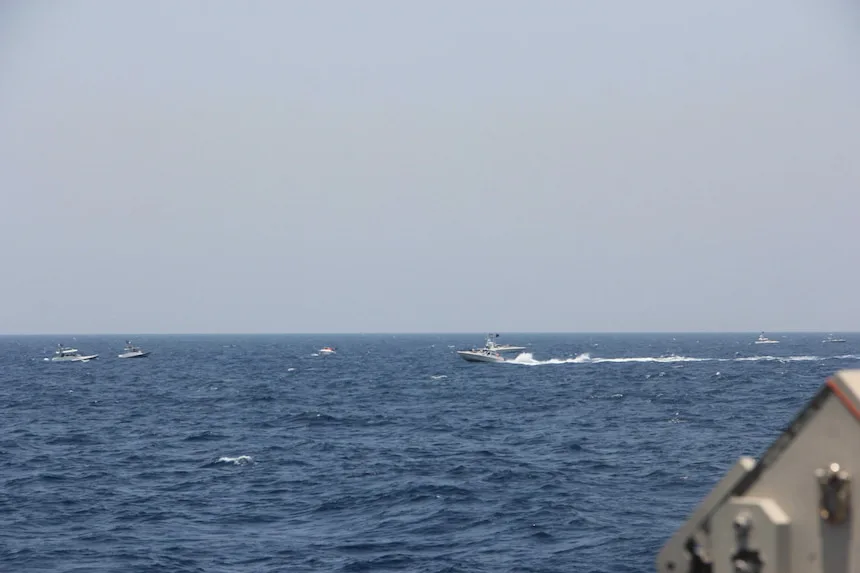
According to the state outlet Tehran Times, Rear Admiral Habibollah Sayyari, the army's deputy coordinator, said on 15 October that the strait was closed and every transit had to be coordinated with Iranian authorities. On 16 October Akraminia claimed US warships had been pushed more than 500 kilometres from the Gulf coast; the claim could not be verified. A CBS round-up published on Yahoo says the spokesman did not clarify whether the withdrawal condition covered forces sent during the war or the entire US presence in the region. According to HNGN, the temporary safe corridor Iran says it agreed with Oman had not yet entered operation as of 16 October.
Flow data diverge by source. Kpler data cited by SBS show exports through the strait fell to 9.4 million barrels a day over 8–14 October, about 70% of the pre-war average. HNGN says Kpler measured crude exports at 8.5 million barrels a day in the week to 12 October, with daily flows swinging between 3 and 6 million barrels. Gulf News reported on 16 October that CENTCOM said more than 19 million barrels of crude had passed through the strait in a single day. According to HNGN, at least 10 ships have been attacked since 11 October, the highest count for a comparable period in the war that began on 28 February.
Talay assessment
Bottom line
For the first time, Tehran has explicitly tied passage to the US presence in the region, a condition no negotiation can meet in the near term. The strait is not closing; the coordination requirement keeps it half open, with flows at about 68–70% of normal according to Kpler. The most likely path is that a conditional, intermittent transit regime persists for weeks.
Likely effects
- Oil pricesNegativeWeeks
The political condition clouds the timetable for any resolution; December Brent futures rose to 109.86 dollars the same day and the risk premium settles into the futures curve.
- Freight and insuranceNegativeWeeks
Attacks on at least 10 ships since 11 October and the coordination requirement keep war-risk premiums high for transits through the escorted corridor.
- TürkiyeNegative1–6 months
Hormuz flows staying below normal raise the energy bill and freight costs for Türkiye, which depends on Gulf-origin crude and product imports.
Possibilities, ranked
- 1Conditional, intermittent transit persists55%
Iran keeps its coordination demand and escorted transits continue, but flows fluctuate between 60% and 75% of normal.
Watch: Kpler's weekly Hormuz export data
- 2Coordination requirement hardens30%
Iran steps up attacks on ships transiting without coordination, and weekly flows fall well below 9.4 million barrels a day.
Watch: UKMTO and JMIC attack reports
- 3Oman corridor comes into use15%
The temporary Iran–Oman corridor is submitted to the IMO and enters use, and the number of attacks falls.
Watch: An Iranian Foreign Ministry statement that the corridor has been submitted to the IMO
Probabilities are calibrated judgement based on the sources, not measurement, and are revised as new information arrives. Not investment advice.
Market reaction
Indicators affected
- Hormuz oil flow (Kpler)▼ ~68%
- Hormuz exports (8–14 October)▼ 9.4 mn b/d
Sources
- Tehran Times (state media) — Iran reaffirms Strait of Hormuz closure, says passage must be coordinated
- Yahoo News (CBS) — Iran says Strait of Hormuz will reopen if U.S. leaves region
- HNGN — Iran Ties Hormuz Reopening to U.S. Exit as Tanker Burns
- SBS — Brent Crude Surges Past $109 to 5-Month High
- Gulf News — US destroys Iranian-linked dhow as Tehran shifts tactics near Hormuz