V Technology Geopolitics & AI·Analysis·Asia-Pacific
In AI hardware the binding constraint is packaging and optics, not chips
Washington pulled on both ends this week: markets priced a possible FCC curb on Chinese optical transceivers, and the first US source of interposers for TSMC's packaging was announced. Neither step yields a substitute before 2028.
Technology Geopolitics Desk · 10 October 2026 · 7 min read · 10 sources
Why it matters
Noise: Chinese laser-chip makers fell by the 20% daily limit on 8 October, and headlines read it as an imminent import ban. Signal: the $2 billion interposer deal GlobalFoundries announced on 8 October reaches volume production only in the first half of 2028, and Counterpoint says Western optical makers cannot replace China's volumes within two years. The binding constraint is that the United States cannot substitute the interconnect layer of its AI hardware before 2028.
Implications
- According to a Morgan Stanley note of 1 October, a possible FCC curb could target 3.2-terabit optical products and require at least 65% US content for Chinese-made modules; one Chinese maker says commercial production of these products will not start before 2028–2029.
- The five-year, $2 billion deal GlobalFoundries signed with TSMC on 8 October will create the first US source of silicon interposers, but volume production starts only in the first half of 2028.
- A TrendForce estimate cited on 14 September has TSMC's CoWoS capacity rising from about 130,000 wafers a month at end-2026 to 260,000 by end-2028, with most of the expansion staying in Taiwan.
Noise
The 20% fall in Chinese optical chip stocks signals an imminent import ban.
Signal
US dependence on Taiwan for packaging starts to ease in 2028 at the earliest.
The headline is a ban, the constraint is the calendar
8 October was the first session after China's national holiday, and two laser-chip makers closed the day at the 20% limit-down. EFY's compilation shows losses of 5.4% to 6.5% continuing on 9 October, while the large module makers fell between 2.14% and 2.5%. The trigger was a Morgan Stanley note dated 1 October, which said the US Federal Communications Commission (FCC) could restrict Chinese makers of optical transceivers in October. An optical transceiver is the part that converts data moving between servers and accelerators in a data centre into light signals.
Headlines read this as the footsteps of an import ban, but the detail of the note says something else. The curb is most likely to target 3.2-terabit products, a next generation not yet on the market. One Chinese maker has said commercial production of these products will not begin before 2028–2029. Washington's real option is to restrict what comes two years from now, not today, because its own data centres would pay the price of restricting today's supply.
No substitute in optics
Counterpoint's August estimate shows Chinese makers holding about two-thirds of global optical transceiver unit supply. The market leader alone has 27% of the data-centre transceiver market; the largest US rival has 17%. That same Chinese leader earned more than 60% of its revenue in the United States in the first quarter of 2026, and its customers include America's largest AI companies. According to Counterpoint, Western makers cannot replace this volume within two years.
That is why the likely rule takes the form of a content requirement, not a ban. According to the Morgan Stanley note, Washington could allow Chinese-made modules whose bill of materials is at least 65% US-sourced. The requirement targets not the module but the laser chip inside it; the fact that upstream laser-chip suppliers, not module makers, fell hardest on 8 October points the same way. One Chinese maker called the 65% figure market speculation but did not rule out building a plant in the United States.
Political pressure is also building. On 25 September four senators introduced a bill banning Chinese-made optical modules from the federal government's classified systems, naming two Chinese makers. Under a draft reported by Reuters in August, the administration planned to ban new Chinese-made transceiver models and announce the rule by the end of 2026. The rules the FCC finalised in September, however, did not name any product.
In packaging, the dependence sits in Taiwan
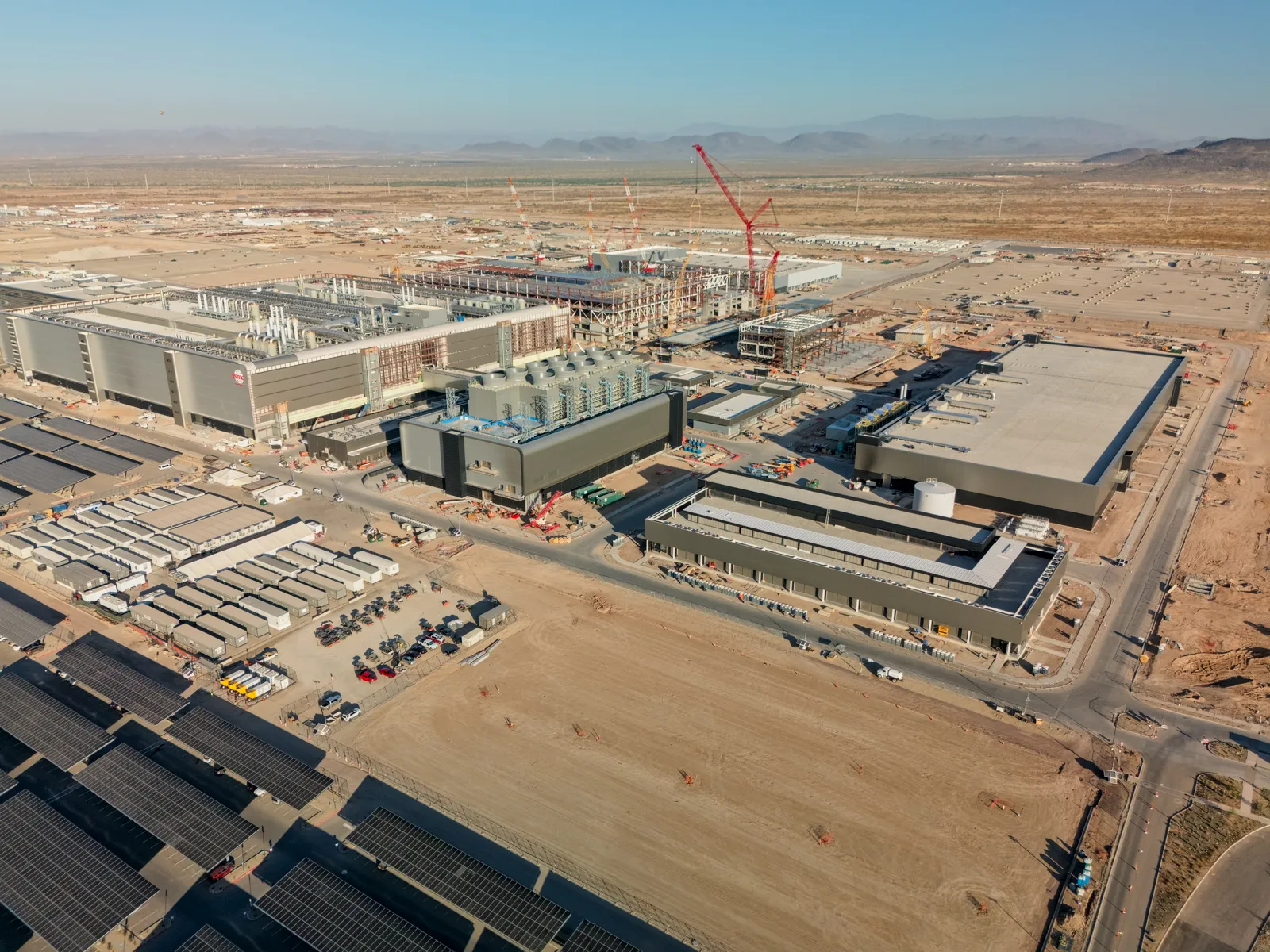
The other end of the interconnect layer is packaging. AI accelerators link the compute die and high-bandwidth memory inside a single package via a silicon interposer; TSMC builds this structure with a method called CoWoS. According to The Register, when TSMC began producing Nvidia's Blackwell chips in Arizona in 2025, they were shipped back to Taiwan for final assembly. A chip made in the United States cannot be used until it is packaged.
The deal GlobalFoundries announced on 8 October is the first piece aimed at breaking that loop: its Malta fab will produce interposers for TSMC's CoWoS ecosystem for five years, in a deal worth $2 billion. Volume production starts in the first half of 2028. Output at Amkor's Arizona packaging plant is planned for early 2028, and TSMC's own Arizona packaging plant for 2029. End-to-end AI chip production in the United States will therefore be possible in 2028 at the earliest.
Capacity in Taiwan is meanwhile growing fast. According to an estimate cited by TrendForce, TSMC's CoWoS capacity will rise from about 130,000 wafers a month at end-2026 to 260,000 by end-2028, with most of the expansion at the AP7 site in Taiwan. The record quarterly revenue of NT$1.49 trillion TSMC reported on 8 October shows demand is filling that capacity. The US share will grow in absolute terms but remain small in proportion until 2028.
Why now, and what comes next
The two steps landing in the same week is no coincidence. On 23 September the US–China truce was extended from 10 November to 10 January 2027; whether the suspension of China's rare-earth controls is also covered by the extension could not be verified. Within this three-month window, Washington wants to reduce dependence on China without breaking the truce. Targeting the next optical generation and building a domestic packaging source both shape the post-2028 landscape without cutting today's supply.
The first test is the FCC's October–November agenda: if the rule targets only 3.2-terabit products and upstream components, this reading is confirmed. The second test is the investment timetables of GlobalFoundries and Amkor; if the 2028 target slips, US dependence on Taiwanese packaging extends to 2029. Türkiye's direct exposure is limited, but Turkish data-centre investment draws on the same optical and accelerator supply chain and will see cost increases in import prices.
Probabilities
Scenarios
| Scenario | Probability | Trigger | Market impact |
|---|---|---|---|
| H1Targeted content requirement | 55% | The FCC publishes a conditional curb aimed only at 3.2-terabit products and upstream components. | Current 800G and 1.6T supply continues; Chinese laser-chip suppliers lose the US market and module makers change components and production sites. |
| H2Deferral tied to the truce | 30% | Washington holds the rule back as a bargaining chip while the November APEC summit and truce talks continue. | Uncertainty rolls into 2027; Chinese makers slow their US capacity plans. |
| H3Broad import ban | 15% | A rule covering all new Chinese-made optical transceiver models is published in the Federal Register. | Next-generation optical interconnect becomes a bottleneck in US data centres; China could reactivate its rare-earth controls in retaliation. |
Module A
Constraints Matrix
STRUCTURAL AVG 4.5 · TACTICAL AVG 2.7Structural constraints dominate: the outcome is set more by these limits than by the actors' preferences.
Hard structural constraintspersistent · beyond the actors' will
China's share of optical supply · China
5/5Counterpoint says Chinese makers hold about two-thirds of global optical transceiver unit supply, and Western rivals cannot replace this volume within two years.
The US packaging gap · United States
5/5The first US source of silicon interposers comes on line in the first half of 2028, Amkor's Arizona plant in 2028 and TSMC's own plant in 2029.
Capacity concentrated in Taiwan · Taiwan
4/5TSMC's CoWoS capacity will rise from about 130,000 wafers a month at end-2026 to 260,000 by end-2028, with most of the expansion at the AP7 site in Taiwan.
Truce calendar · China
4/5The US–China truce was extended to 10 January 2027 on 23 September; rare-earth controls announced on 9 October 2025 are suspended, and a harsh curb could trigger Chinese retaliation.
Tactical frictiontemporary · eases over time
Uncertain rule text weeks
3/5The rules the FCC finalised in September named no product; the 65% content requirement rests solely on a broker's note.
Co-development cycles months
3/5Chinese module makers co-develop products with US cloud customers over extended cycles; switching suppliers takes months.
Legislative pressure months
2/5A bill introduced on 25 September proposes banning Chinese-made optical modules from federal classified systems and names two Chinese makers.
Module B
Signal vs Noise
SIGNAL 60% · NOISE 40%
- NOISE
The 20% fall in Chinese optical chip stocks signals an imminent import ban.
Morgan Stanley's 1 October note says the curb could target 3.2-terabit products; one Chinese maker said commercial production of these products will not start before 2028–2029.
EFY — Potential US Curbs Bears Down on Chinese Optical Chip Stocks
- SIGNAL
US dependence on Taiwan for packaging starts to ease in 2028 at the earliest.
Volume production under GlobalFoundries' $2 billion interposer deal starts in the first half of 2028; Amkor targets 2028 and TSMC's Arizona packaging plant 2029.
The Register — TSMC taps GlobalFoundries to bolster US silicon interposer production in $2B deal
- SIGNAL
The curb targets the upstream laser chip, not the module.
Two laser-chip makers hit the 20% limit-down on 8 October, while large module makers fell only 2.14–2.5% on 9 October; the possible requirement is 65% US content.
EFY — Potential US Curbs Bears Down on Chinese Optical Chip Stocks
- SIGNAL
There is no substitute capacity in optics.
Counterpoint says Chinese makers hold about two-thirds of unit supply; the market leader has a 27% share and earns more than 60% of its revenue in the United States.
- NOISE
The Senate bill means Chinese optical modules will be pushed out of the US market.
The bill introduced on 25 September covers only the federal government's classified systems and is not yet in force.
Longbridge (etnet) — US Bipartisan Proposal to Restrict Chinese Optical Modules
Module C
Asset-Class and Positioning Implications
| Asset class | Exposure | Transmission channel | H1 | H2 | H3 | Expected | Conviction | Horizon | What to watch |
|---|---|---|---|---|---|---|---|---|---|
| Equities | China optical component sector, upstream | A US content requirement shrinking the export market | −− | − | −− | −1.70 | ●●● | 3–12 months | FCC equipment authorisation decisions |
| Equities | Taiwan advanced packaging and foundry sector | CoWoS demand concentrated in Taiwan until 2028 | + | + | 0 | +0.85 | ●●● | 3–12 months | TSMC's 15 October quarterly results and CoWoS capacity guidance |
| Equities | US optical component and packaging sector | Demand shifting from China and domestic capacity investment | + | 0 | + | +0.70 | ●●● | 12+ months | Order backlogs and capacity announcements from US makers |
| Volatility | Asian semiconductor equity volatility | The curb overlapping with the truce calendar | 0 | + | ++ | +0.60 | ●●● | 0–3 months | The 20 threshold on the VIX and the 10 January 2027 truce date |
Second-order effects
And then what?
Starting point
On 8–9 October markets priced the possibility that the United States could require at least 65% US content in next-generation Chinese-made optical transceivers; the sharpest falls hit upstream Chinese laser-chip suppliers.
- 1
Supply chainwithin weeks
To protect the US market, Chinese module makers switch from Chinese-made laser chips to US and third-country components in next-generation products, and some announce plans for production plants in the United States.
Watch: Capacity announcements by Chinese optical makers in the US and South-East Asia
- 2
Component priceswithin months
Because Western laser-chip and module capacity cannot meet this demand within two years, lead times for next-generation optical components lengthen and prices rise.
Watch: Quarterly lead-time and order-backlog disclosures from US optical component makers
- 3
Data-centre investmentwithin months
Costlier and later interconnect components raise the cost of US data-centre investment, which stays tied to Taiwanese packaging until 2028, and push back the commissioning of next-generation clusters.
Watch: Capital-expenditure guidance from the large cloud companies and first shipment dates for 3.2-terabit products
What breaks the chain
The chain stops at the first step if the FCC rule is confined to security-sensitive federal systems or the curb is deferred as part of the truce package; Chinese modules then keep entering the US commercial market on current terms.
Triggers
Thresholds to watch
| Indicator | Threshold | Today | What it means |
|---|---|---|---|
| VIX volatility index | > 20 | 15.41 | A VIX above 20 would show the interconnect-layer constraint spreading into sector-wide risk perception; this week the impact was confined to optical component stocks in China. |
Sources
- EFY — Potential US Curbs Bears Down on Chinese Optical Chip Stocks
- MarketScreener (Dow Jones) — Chinese Optical Module Stocks Fall After Report of Possible U.S. Import Ban
- Longbridge (etnet) — US Bipartisan Proposal to Restrict Chinese Optical Modules
- Hello China Tech — FCC's Chinese Optical Transceiver Ban: What It Would Freeze
- GlobalFoundries — GlobalFoundries reaches agreement to establish U.S.-based supply of silicon interposers for advanced AI packaging
- The Register — TSMC taps GlobalFoundries to bolster US silicon interposer production in $2B deal
- Silicon UK — TSMC begins building Arizona packaging plant
- TrendForce — TSMC reportedly targets capacity boost, CoWoS to double by 2028
- TrendForce — TSMC Q3 Revenue Beats Forecasts at Record NT$1.49 Trillion
- NBC News — US and China agree to extend trade truce to 10 January
Sourcing and verification rules: methodology · Report an error: contact
Related reports
IICyber & Infrastructure·Analysis·Asia-Pacific
Japan's cyber weak point is backups sitting beside the attack
The IDCF Cloud attack hit 495 customers, but where the backup sat made the difference. Movable Type, with backups on Google Cloud, migrated; Soliton, whose backups lived on the same infrastructure, is rebuilding.
Cyber & Critical Infrastructure Desk · 9 October 2026 · 6 min
VTech & AI·Analysis·Asia-Pacific
Factory labour in Taiwan is the memory shortage's new bottleneck
Samsung's record 107.4 trillion won grabs the headlines. Prices, though, are set by capacity locked into server memory; in Taiwan, which makes 50–60% of Micron's chips, 1,994 of 2,258 union members voted to authorise a strike.
Technology Geopolitics Desk · 8 October 2026 · 6 min
VTech & AI·Analysis·Asia-Pacific
Truce defers tariffs, yet chip and rare-earth suspensions still expire in November
On 23 September Bessent extended the truce to 10 January 2027. The BIS Affiliates Rule suspension ends on 9 November and China's rare-earth suspension on 10 November. As of 2 October, no official notice puts the extension on paper.
Technology Geopolitics Desk · 7 October 2026 · 6 min