VI Energy Politics & Supply Security·Analysis·Middle East and North Africa
The blockade moves ashore, but Iraqi oil still hangs on Hormuz insurance
On 7 November the US set up a task force extending the Iran blockade to land borders and the Caspian, and asked Iraq to cut its crossings to 2. Yet roughly 93% of Iraq's exports, now above 3.4 million barrels a day, still transit the strait.
Energy & Shipping Desk · 8 November 2026 · 7 min read · 8 sources
Talay Insight Analysis Desk·AI-assisted analysis, reviewed by an editor
Why it matters
The noise is Brent falling more than 16% in a week to $98.32 as it priced in peace, and the IRGC lifting its missile range cap. The signal is that Washington is widening the blockade onto land rather than narrowing it. The sea gate has already blocked more than $25 billion of Iranian crude exports; the next gates are the Iraqi border and the Caspian. Iraq is caught between the two.
Implications
- CENTCOM set up the 20-strong Iron Gate task force on 7 November. It said the naval blockade had blocked more than $25 billion of Iranian crude exports and turned back 144 vessels by the end of October.
- Iraqi Foreign Minister Fuad Hussein said on 7 November that the US had asked for Iran border crossings to be cut to 2; Iraq had closed the al-Shib crossing on 21 October.
- Iraq's October exports topped 3.4 million barrels a day, but the Ceyhan line carries only 200,000–230,000 barrels a day; on 14 October the Gulf war risk premium stood at 6–10% of hull value.
Noise
Brent's sharp weekly drop is pricing the end of the war
Signal
The US is widening the blockade onto land, not narrowing it
Noise and signal
The market's headline is peace. According to CNBC, ICE Brent settled at $98.32 on 6 November after shedding more than 16% over the week. The next day the IRGC announced that its 2,000-kilometre cap on missile range had been lifted. One headline says the confrontation is over, the other that a fresh escalation is at the door; both are noise at headline level.
The quiet parameter is the reach of the blockade. On 7 November US Central Command set up the Iron Gate task force to cut the flow of weapons and sanctioned goods across Iran's land borders and the Caspian Sea. The same day Iraq's foreign minister disclosed that Washington had formally asked Baghdad to close every border crossing with Iran bar two. The economic war is not contracting; its geography is expanding.
The sea gate is shut, the land gate is next
CENTCOM says the naval blockade has so far blocked more than $25 billion of Iranian crude exports; CBS reports that it had turned back 144 merchant vessels by the end of October. The leakage is no longer at sea. A Reuters investigation cited by CNBC found that Iran has brought in at least $2 billion of equipment and heavy trucks since January 2025. They arrived by ship across the Caspian, by road from Central Asia and by air from China.
The task force has a staff of about 20 and sits in Tampa; there is no word on whether US ships will enter the Caspian. A unit of that size cannot build a barrier on the ground, but it can shift the pressure onto neighbouring states. The request that Iraq cut its crossings to two is the first visible use of that tool. Baghdad closed the al-Shib crossing in Maysan on 21 October, officially for refurbishment, and a government adviser denied any US pressure.
Iraq between two gates
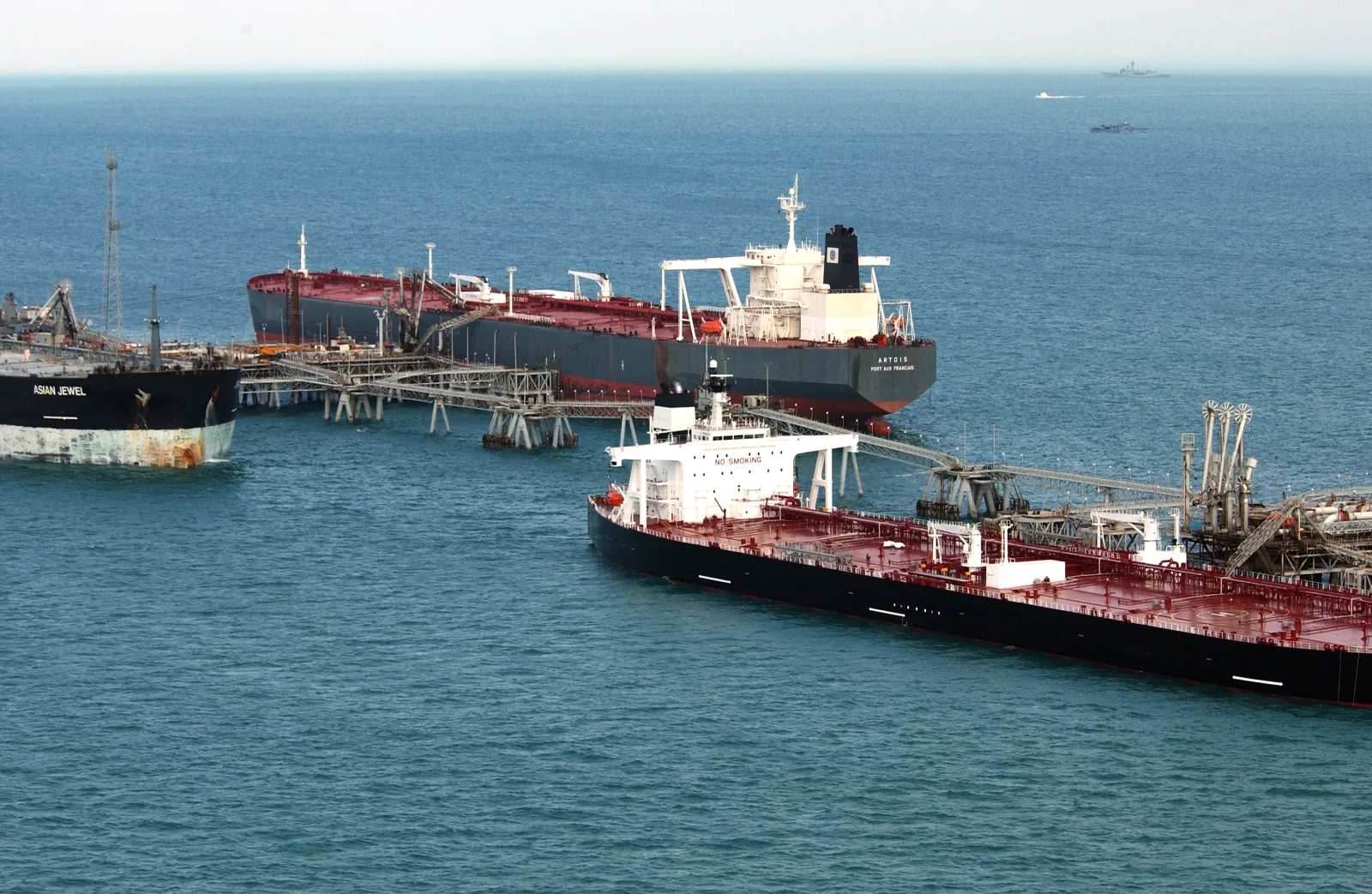
Iraq's energy constraint is route, not volume. Ministry figures cited by 964media show exports collapsing from more than 99 million barrels in February to 18.6 million in March, before recovering to above 3.4 million barrels a day in October. With the Ceyhan line carrying 200,000–230,000 barrels a day, roughly 93% of exports still leave from Basra and cross Hormuz. Fuad Hussein puts the cost of the disruption at around $60 billion.
The balance sheet is shrinking too. Oilprice reports that Iraq's foreign reserves have fallen by $20 billion, the central bank has devalued the dinar for the first time in more than 3 years, and oil supplies about 90% of budget revenue. In a country like this, the US demand on border crossings and Iran's de facto control over Hormuz press on the same budget line. As of 7 November Baghdad had not said how it would respond.
The insurance threshold and the FOB trap
A route does not close until the insurance premium becomes unbearable. Iraq's route has not closed, but who carries the premium is changing. Brokers speaking to the Financial Times said that on 14 October the war premium for a tanker entering the Gulf was 6–10% of hull value, up to $20 million for a single supertanker voyage. The pre-war rate was about 0.25%; Windward estimates that roughly 1 in every 50 ships transiting the strait in the third quarter was hit.
Iraq sells FOB, meaning the cargo passes to the buyer at the loading port, so transit risk sits with the buyer. Oilprice reports that buyers now want delivery outside the strait. The state-owned Iraqi Oil Tankers Company moved 2 million barrels through the strait on its own supertanker and is in talks to buy more tankers. In effect, risk that the insurance market struggles to price is being written onto the state's balance sheet.
Türkiye and the probabilities
Türkiye is exposed through two channels. The first is Ceyhan: Iraq's only pipeline outlet that bypasses Hormuz runs at 200,000–250,000 barrels a day and carries a small slice of 3.4 million barrels of daily exports. The second is the land border. Sources have not named which neighbours Iron Gate covers, but the way a 20-strong task force operates exposes the border trade and banks of Iran's land neighbours to secondary sanctions scrutiny.
The desk's base case, at 50%, is that the land gates narrow while Iraqi exports hold at 3–3.4 million barrels a day. At 30%, a Qatari formula eases the blockade; at 20%, fighting resumes and Basra loadings fall. The thesis would be falsified if Iraq openly rejected the two-crossing demand and the Treasury published no new sanctions list targeting the Caspian. Through the insurance lens, the falsifier is the Gulf war premium dropping below 2% of hull value.
Probabilities
Scenarios
| Scenario | Probability | Trigger | Market impact |
|---|---|---|---|
| H1Land gates narrow, Iraqi volumes hold | 50% | Iraq closes several crossings, the Treasury sanctions Caspian traffic, and Hormuz sees no major wave of attacks. | Iran's overland imports grow costlier; Iraqi exports stay at 3–3.4 million barrels a day, but on harsher terms. |
| H2A Qatari formula eases the blockade | 30% | The US accepts a step towards lifting the blockade, Iran grants IAEA access and reopens Hormuz under a temporary arrangement. | Iranian barrels return to the market, Iraq's strait risk recedes, and the land task force loses relevance. |
| H3Fighting resumes | 20% | The US relaunches major operations before January and Iran retaliates against Gulf infrastructure. | Basra loadings fall and Iraqi exports slide back towards March levels. |
Module A
Constraints Matrix
STRUCTURAL AVG 4.3 · TACTICAL AVG 2.7Structural constraints dominate: the outcome is set more by these limits than by the actors' preferences.
Hard structural constraintspersistent · beyond the actors' will
Dependence on Hormuz
5/5Roughly 93% of Iraq's exports, now above 3.4 million barrels a day, leave from Basra and cross the strait; Ceyhan carries 200,000–230,000 barrels a day.
Gulf war risk premium · Iran
4/5On 14 October the premium for a tanker entering the Gulf was 6–10% of hull value, up to $20 million per supertanker voyage, against about 0.25% before the war.
Reach of the US blockade · United States
4/5The naval blockade has blocked more than $25 billion of Iranian crude exports; since 7 November land borders and the Caspian are also targeted.
Tactical frictiontemporary · eases over time
Iraqi domestic politics weeks
3/5A government adviser denied US pressure over the al-Shib closure, while an MP close to the Coordination Framework argued that pressure had been applied.
Buyer delivery terms weeks
3/5Buyers want delivery outside the strait to avoid the war premium; Iraq had to move 2 million barrels on its own supertanker.
Task force capacity months
2/5Iron Gate runs from Tampa with a staff of about 20; how it will enforce on the ground, and whether ships will go into the Caspian, has not been disclosed.
Module B
Signal vs Noise
SIGNAL 67% · NOISE 33%
- NOISE
Brent's sharp weekly drop is pricing the end of the war
Brent settled at $98.32 on 6 November after falling more than 16% over the week; Rapidan puts the odds of renewed fighting at 80%.
Data: Brent crude oil (futures) ›CNBC — Oil prices set for sharp weekly fall after midterm elections as investors weigh Iran conflict risk
- SIGNAL
The US is widening the blockade onto land, not narrowing it
CENTCOM set up the 20-strong Iron Gate task force on 7 November; the naval blockade has blocked more than $25 billion of Iranian crude exports.
CNBC — U.S. looks to restrict Iranian land commerce with new task force
- NOISE
Iran showed a new capability by lifting its missile range cap
The IRGC said on 7 November that the 2,000-kilometre cap had been lifted, but did not say whether it has a missile that exceeds it.
Times of Israel — IRGC claims a self-imposed limit on ballistic missile range 'has been lifted'
- SIGNAL
The pressure is moving down to Iraq's border crossings
Fuad Hussein said on 7 November that the US had asked for Iran crossings to be cut to 2; al-Shib has been closed since 21 October.
964media — Iraqi foreign minister says US asked it to close all but 2 crossings with Iran
- SIGNAL
Iraq has recovered volume but not diversified its routes
October exports topped 3.4 million barrels a day; Ceyhan carries 200,000–230,000 barrels a day and the remaining 93% or so crosses Hormuz.
Data: Strait of Hormuz transits ›964media — Iraqi foreign minister says US asked it to close all but 2 crossings with Iran
- SIGNAL
War risk is shifting from buyers to the state
Buyers want delivery outside the strait; the Iraqi Oil Tankers Company moved 2 million barrels through Hormuz on its own supertanker.
Oilprice.com — Iraq's October Oil Exports Top 3.4 Million Bpd, Nearing Pre-War Levels
Module C
Asset-Class and Positioning Implications
| Asset class | Exposure | Transmission channel | H1 | H2 | H3 | Expected | Conviction | Horizon | What to watch |
|---|---|---|---|---|---|---|---|---|---|
| Freight & insurance | Gulf war risk premium | Frequency of Hormuz incidents and pricing of cover | + | −− | ++ | +0.30 | ●●● | 0–3 months | Broker war premium quotes and UKMTO incident counts |
| Commodities | Front end of the crude curve | Transit risk on Iraqi and Iranian barrels through the strait | 0 | −− | ++ | −0.20 | ●●● | 0–3 months | ICE Brent futures settlement and Basra loadings |
| FX | Iraqi dinar | Erosion of oil revenue and loss of reserves | − | + | −− | −0.60 | ●●● | 3–12 months | Central Bank of Iraq reserve data and the official exchange rate |
| Credit | Gulf sovereign credit spreads | Risk of retaliation against infrastructure and revenue erosion | 0 | + | −− | −0.10 | ●●● | 3–12 months | Saudi Arabia 5-year CDS spread |
Second-order effects
And then what?
Starting point
The US naval blockade has already blocked more than $25 billion of Iranian crude exports. On 7 November Washington extended it to Iran's land borders and the Caspian, and asked Iraq to cut its Iran crossings to two.
- 1
Border tradewithin weeks
Baghdad closes more crossings or tightens controls; trade on Iran's western border is squeezed into a handful of points, and political friction with Iran-aligned Iraqi factions rises.
Watch: Iraqi government statements on Iran crossings other than al-Shib
- 2
Freight and insurancewithin weeks
Tehran answers by tightening its grip on Hormuz; incidents in the strait rise, the Gulf war premium holds in or above the 6–10% band, and buyers press Iraq for delivery outside the strait.
Watch: Weekly UKMTO and JMIC incident counts in Hormuz and broker war premium quotes
- 3
Pipeline transitwithin months
To protect net revenue per barrel, Iraq leans on its own tankers and the Ceyhan line; Ceyhan loadings rise, and Türkiye's transit income and Mediterranean crude supply reflect the shift.
Watch: Monthly Iraqi loadings at the Ceyhan terminal and reports of SOMO tanker purchases
What breaks the chain
If Qatari mediation secures an easing of the blockade and a temporary arrangement that reopens Hormuz, pressure on the land gates loses its point and the chain breaks at the first step.
Triggers
Thresholds to watch
| Indicator | Threshold | Today | What it means |
|---|---|---|---|
| Brent crude oil (futures) | > $110 | — | A move above this level from the $98.32 close on 6 November would show the market pricing a renewed supply disruption in the Gulf and putting Iraqi loadings at risk. |
| Strait of Hormuz transits | < 20 transits/day | — | A drop below this level would show shipowners pulling back from Basra loadings and Iraq failing to fill the gap with its own tankers. |
| Brent crude oil (futures) | < $90 | — | A drop below this level would show the market pricing an easing of the blockade and the return of Iranian barrels. |
Sources
- CNBC — U.S. looks to restrict Iranian land commerce with new task force
- Jerusalem Post — Expanding on naval blockade, US military to create task force to restrict Iranian land commerce
- 964media — Iraqi foreign minister says US asked it to close all but 2 crossings with Iran
- Oilprice.com — Iraq's October Oil Exports Top 3.4 Million Bpd, Nearing Pre-War Levels
- Insurance Business — Hormuz sinking hands marine war underwriters another total loss as attacks surge
- CNBC — Oil prices set for sharp weekly fall after midterm elections as investors weigh Iran conflict risk
- CBS News — Live updates: U.S. expands naval blockade to include task force on disrupting ground transport
- Times of Israel — IRGC claims a self-imposed limit on ballistic missile range 'has been lifted'
Sourcing and verification rules: methodology · Report an error: contact
Related reports
VIEnergy & Supply·Analysis·Middle East and North Africa
Houthi missiles reach Aramco's Riyadh tower as onshore cover thins
Saudi Arabia's energy ministry said on 8 November that falling shrapnel lightly damaged Aramco's building in Riyadh. Barrels keep flowing. The real constraint is that political violence cover in the Gulf has shrunk from about 1 billion dollars to 200 million.
Energy & Shipping Desk · 9 November 2026 · 7 min
VIEnergy & Supply·Analysis·Middle East and North Africa
Riyadh has its volumes back; Asian refining margins now set the price
Aramco deepened its Asian discount by 2 dollars for December, and HSBC raised its Saudi output forecast by 2 million barrels a day. Empty tankers returning to the Gulf now outnumber cargoes. The constraint is shifting from the wellhead and the strait to the buyer's margin.
Energy & Shipping Desk · 7 November 2026 · 7 min
VIEnergy & Supply·Analysis·Türkiye and Its Neighbourhood
Russian gas contracts expire at year-end, and Europe's ban is Ankara's leverage
On 5 November Bayraktar called Russian gas expensive. BOTAŞ's Gazprom contracts, worth about 22 billion cubic metres a year, expire in 54 days; the 9.6 billion cubic metre Iranian contract lapsed on 29 July.
Türkiye & Neighbourhood Desk · 7 November 2026 · 7 min