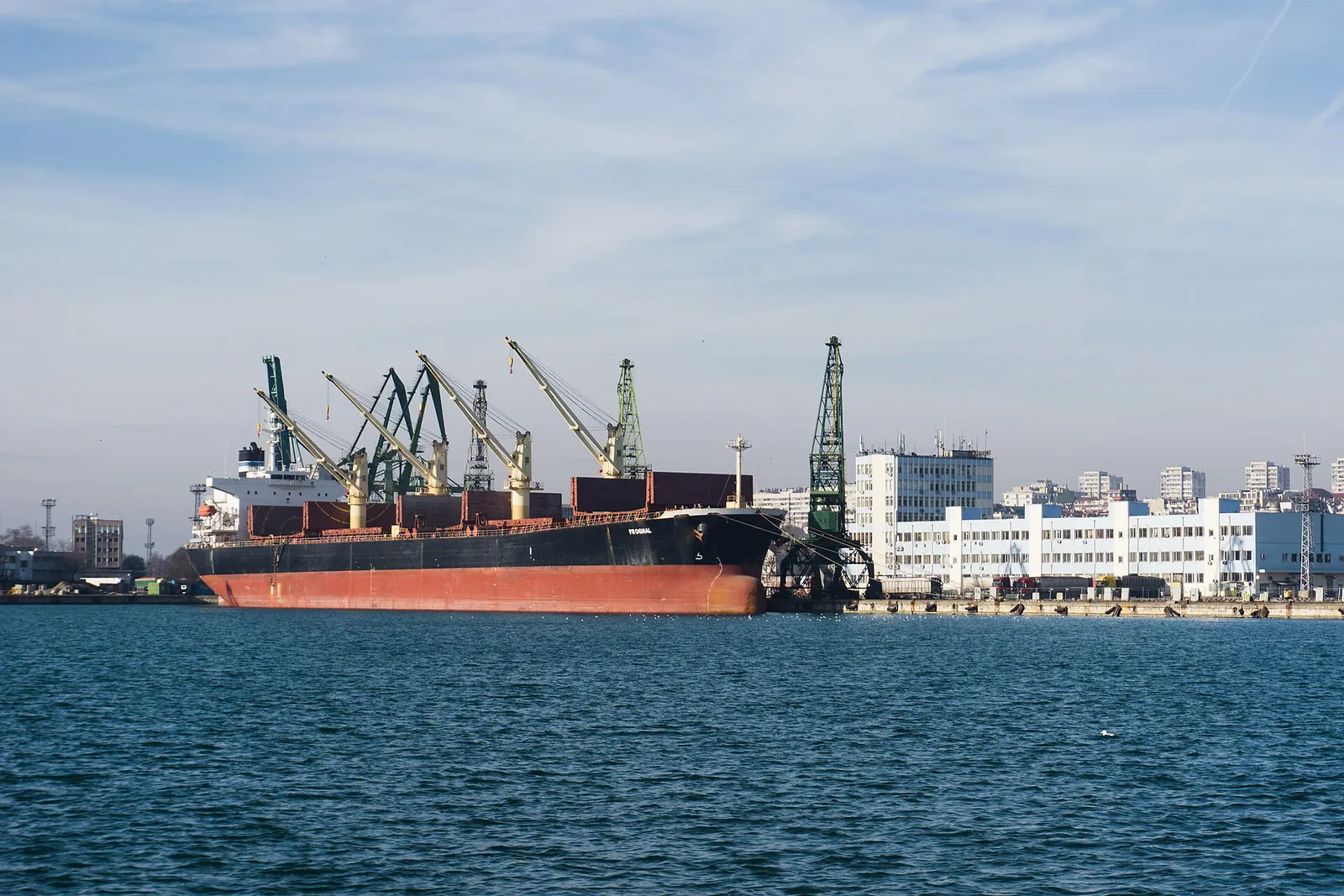
I Geo-Economics & Chokepoints·Analysis·Türkiye and Its Neighbourhood
Black Sea risk reaches NATO economic zones; small Turkish owners pay
On 5 and 6 October three Turkish-owned ships were hit in the economic zones of Romania and Bulgaria, and two sank. The 12-mile territorial waters that the insurance market carved out on 16 September are now the only safe lane, and Ankara's moratorium proposal has sat in Moscow for two months.
Türkiye & Neighbourhood Desk · 6 October 2026 · 6 min read · 12 sources
Why it matters
Noise: another ship has sunk in the Black Sea. Signal: the attacks have moved into the economic zones of NATO members Romania and Bulgaria, 30 and 80 miles offshore. On 16 September the Joint War Committee exempted only the 12-mile territorial waters from additional premiums; deterrence stops at that line. The bill falls on old, small Turkish-owned dry bulk ships flying flags such as Togo and Palau. Türkiye is at once a NATO member, a mediator and a shipowning nation, and Moscow has not answered its 8 August moratorium proposal.
Implications
- Royad Mammadov sank about 30 miles off Romania on 5 October and Alfa Watan about 80 miles off Bulgaria on 6 October. Both positions lie outside the 12-mile territorial waters exempted by insurers.
- Casualty figures conflict: Novinite attributes 2 dead and 11 rescued to Alfa Watan, while Türkiye Today ties the same figures to Royad Mammadov and lists Alfa Watan's crew as missing.
- Turkish-owned ships were hit leaving Novorossiysk on 3 August and on the Danube route in October. Exposure to both belligerents is symmetrical, and it narrows Ankara's room as a mediator.
Noise
Another ship has sunk in the Black Sea; this is a routine wartime attack.
Signal
Risk has moved from the Ukrainian coast into NATO members' economic zones, outside the insurance exemption.
The headline tells of a sinking; the signal is the location
The headline fits in one sentence: a new attack in the Black Sea, another ship lost. According to the Kyiv Post, the Turkish-owned Royad Mammadov, carrying maize from Izmail to Ravenna, sank on 5 October about 30 nautical miles south of Sfântu Gheorghe in Romania. Two seafarers died and 11 people were rescued. The next day, at around 04:00 local time, two more Turkish-owned ships were hit about 80 miles east of Cape Sveti Atanas in Bulgaria. The Togo-flagged Alfa Watan sank; fire broke out aboard the Palau-flagged Able, whose 18-strong crew was rescued in full.
The casualty picture is not yet clear. Citing Romania's Interior Ministry, Novinite reports 2 dead and 11 rescued from Alfa Watan. Türkiye Today, however, listed Alfa Watan's crew as missing on 6 October and attributed the same figures of 2 dead and 11 rescued to Royad Mammadov, which sank the day before. The two figures may be a double count of one incident; until the conflict is resolved, we report both. The perpetrator is also unclear. Zelenskiy blamed two Russian drones for the sinking off Romania, Romanian authorities have not confirmed the cause, and Bulgaria is investigating who owned the drones.
The signal lies not in the number of ships sunk but in where they sank. Both attacks took place in a NATO member's exclusive economic zone. These are waters where the coastal state holds resource rights such as fishing and energy, but which do not count as sovereign territory. Three Turkish-owned ships were hit in 48 hours, and the risk has shifted from the Ukrainian coast to the main commercial lane of the western Black Sea.
The gap beyond twelve miles
According to Beinsure on 23 September, the London insurance market's Joint War Committee extended the area subject to war risk premiums to most of the Black Sea on 16 September. The 12-mile territorial waters of Türkiye, Bulgaria and Romania were left off the list. That line rested on an implicit assumption that the coasts of NATO members deter attackers. The 5 and 6 October attacks took place roughly 30 and 80 miles beyond it. An attack in an economic zone does not directly trigger the alliance's collective defence clause; in practice, deterrence ends at the territorial sea.
Insurers' tools act fast. The same report says the cancellation notice is 7 days for hull war risk cover and 48 hours for cargo cover; the Swedish Club's notice of cancellation took effect on 1 October. According to Baird Maritime on 13 January 2026, Black Sea policy terms were then being reviewed every 24 hours, and premiums for voyages to Russian ports had reached about 1% of hull value. After the September extension, Beinsure estimated the additional premium for a handysize vessel at 0.10–0.20% of value, or $12,000–24,000 on a $12 million ship. Premium quotes after the October attacks have not been made public; this could not be verified.
According to Türkiye Today, Alfa Watan was built in 1976 and is 3,160 tonnes, while Able is 7,416 tonnes. For a ship of that age and size, the war risk premium may stay low in absolute terms. The real burden is that cover can be withdrawn on a week's notice, and the cost of finding crews. As of 6 October, it had not been disclosed which P&I club the three ships belong to. P&I clubs are mutual insurers covering third-party liabilities such as crew injury, pollution and wreck removal. Whether the wreck and pollution bill stays with the war policy or with P&I will decide the small owner's balance sheet.
A fleet hit from both sides
Turkish-owned ships are not being hit only when trading with Ukraine. According to Asharq Al-Awsat on 4 August, the Panama-flagged Yasar and the Cameroon-flagged Nadezhda, both owned by Turkish companies, came under drone attack on the evening of 3 August as they left Russia's Novorossiysk port. Crew members were injured. The same report says one person died in an attack on a Turkish fishing boat near Crimea in late June. The three ships hit in October, by contrast, were trading on the Izmail and Sulina route, serving Ukrainian and Romanian ports.
That makes the Turkish owner's exposure symmetrical: whichever port it serves, it ends up on one side's target list. According to Maritime Executive in September, Turkish ships and seafarers have suffered disproportionately from the attacks. The Kyiv Post says more than 300 merchant ships have been damaged or sunk since the full-scale invasion. The ships hit in October flew the flags of Togo, Palau and Saint Kitts and Nevis, and their owners are in Mersin and Istanbul. The flag state cannot protect these ships, and if Ankara steps in to protect their owners it spends its capital as a mediator.
The limits of mediation
Ankara's channel has been awaiting a reply for two months. According to UNN on 8 August, Foreign Minister Hakan Fidan called for a moratorium on attacks against merchant ships. Fergana reported on 9 August that Ukraine drafted the text, Türkiye passed it to Russia and Moscow's formal reply is awaited. The same report says Fidan had proposed on 16 July starting with a two-track moratorium covering sea and energy. For Russia, that would mean giving up attacks on Ukrainian ports, one of the few effective tools it has.
A new round is in preparation. According to gCaptain, Türkiye and the UN are convening Black Sea ceasefire talks with Russia and Ukraine in early October, mediated by the Swiss-based Centre for Humanitarian Dialogue. The aim is a narrowly defined, reciprocal arrangement protecting commercial navigation and infrastructure. Maritime Executive reports that the Turkish draft proposes safe passage for Ukrainian grain along the western coast and for Russian ships along the southern and eastern edges. An independent farm group has also proposed state-backed war risk insurance. Lavrov, however, called a return to the 2022 deal "completely unacceptable and unrealistic".
Türkiye's constraint runs three ways. As a NATO member it must respond to attacks in the economic zones of Romania and Bulgaria. As a mediator it must avoid naming the perpetrator. As a shipowning nation it must protect its own fleet. According to USM, citing Bloomberg on 9 August, the Coast Guard delayed Strait transit permits for some Novorossiysk voyages. The Strait is Ankara's only physical lever, but that lever slows its own owners' voyages first.
What comes next
Three indicators matter. The first is the Joint War Committee's area definition. If the 12-mile exemption holds, the market keeps trusting NATO territorial waters; if it narrows, approaches to Romanian and Bulgarian ports also attract premiums. The second is daily transits through the Bosphorus: the IMF PortWatch series we track showed 45–60 ships a day on 23–27 September, and a figure below 38 would signal curtailed Black Sea voyages. The third is the scope of any text from the October round: whether it protects only grain carriers or also the Turkish-owned coastal dry bulk fleet.
Talay's reading: the most likely path (55%) is that attacks continue sporadically and the moratorium stays in limbo. On that path the small Turkish owner keeps paying the bill: cover periods shorten, crew costs rise and Danube voyages fall. A narrow reciprocal arrangement (25%) would lower premiums, but Russia's objection to the 2022 model makes a signature in October less likely. Attacks moving closer to Türkiye's economic zone (20%) would push Ankara from mediation towards protective measures and directly affect Strait transits.
Probabilities
Scenarios
| Scenario | Probability | Trigger | Market impact |
|---|---|---|---|
| H1Sporadic attacks, moratorium in limbo | 55% | The October round ends with a statement of principles, Moscow gives no formal reply on the moratorium, and several merchant ships a month keep being hit in the western Black Sea. | Risk becomes entrenched in the economic zones; small Turkish owners cut Danube voyages, and insurance cover stays near-term and revocable. |
| H2Narrow reciprocal arrangement | 25% | The Türkiye–UN round produces a limited text of reciprocal commitments covering commercial navigation and grain infrastructure. | Attack frequency falls, Türkiye's mediating role strengthens and Turkish-owned ships begin returning to the Danube route. |
| H3Escalation nears Turkish waters | 20% | A merchant ship is hit in Türkiye's economic zone or the Bosphorus approaches, or Ankara systematically delays transit permits. | Ankara moves from mediation to protective measures; transit management tightens under the Montreux framework and Black Sea voyages fall markedly. |
Module A
Constraints Matrix
STRUCTURAL AVG 4.0 · TACTICAL AVG 3.0Structural constraints dominate: the outcome is set more by these limits than by the actors' preferences.
Hard structural constraintspersistent · beyond the actors' will
Russia's port-strike tool · Russia
5/5For Russia a moratorium means giving up attacks on Ukrainian ports; Lavrov rejected a return to the 2022 model, and there is no formal reply to the 8 August proposal.
The 12-mile exemption
4/5On 16 September the Joint War Committee exempted only the 12-mile territorial waters of Türkiye, Bulgaria and Romania from premiums; the 5–6 October attacks came 30–80 miles beyond that line.
No perpetrator named
4/5Romania and Bulgaria have not said who owned the drones; until a perpetrator is formally identified, concrete NATO-level naval measures are hard to agree.
Türkiye's triple role · Türkiye
3/5Türkiye is a NATO member, a mediator and a shipowning nation; naming the perpetrator strains its mediation, while silence strains the alliance and its own fleet.
Tactical frictiontemporary · eases over time
Short cancellation notice days
4/5Cancellation notice is 7 days for hull war risk cover and 48 hours for cargo cover; cover can be withdrawn within a week of an attack.
Old, small tonnage weeks
3/5Alfa Watan was built in 1976 and is 3,160 tonnes; on ships flagged in Togo, Palau and Saint Kitts and Nevis, crewing difficulties and uncertain P&I liability push up costs.
Transit permit delays weeks
2/5In August the Coast Guard delayed Strait transit permits for some Novorossiysk voyages; similar practice also slows Turkish owners' own voyages.
Module B
Signal vs Noise
SIGNAL 67% · NOISE 33%
- NOISE
Another ship has sunk in the Black Sea; this is a routine wartime attack.
Royad Mammadov sank off Romania on 5 October, with 2 seafarers dead and 11 rescued; more than 300 merchant ships have been damaged or sunk since the full-scale invasion.
- SIGNAL
Risk has moved from the Ukrainian coast into NATO members' economic zones, outside the insurance exemption.
On 16 September only the 12-mile territorial waters were exempted from premiums; Royad Mammadov sank about 30 miles offshore and Alfa Watan about 80.
Beinsure — Black Sea War Risk Expansion Raises Shipping Insurance Costs (23 September 2026)
- SIGNAL
Turkish-owned ships are exposed to attack from both belligerents.
The Turkish-owned Yasar and Nadezhda came under drone attack leaving Novorossiysk on 3 August; the three ships hit in October were on the Danube route.
Asharq Al-Awsat — Turkish Ministry Denounces Attacks on Two Ships in Black Sea (4 August 2026)
- SIGNAL
Ankara's moratorium channel has produced nothing for two months.
A Ukrainian-drafted moratorium text was passed to Moscow via Türkiye on 8–9 August; a formal reply was reported to be awaited.
Fergana — Turkey Pushes Moscow and Kyiv to Spare Black Sea Shipping (9 August 2026)
- NOISE
Türkiye–UN talks are bringing a Black Sea ceasefire closer.
Lavrov called a return to the 2022 deal unacceptable; Ukraine's agriculture minister said he saw no positive signs in the coming months.
gCaptain — Turkey and UN broker new talks on Russia-Ukraine Black Sea truce
- SIGNAL
Ankara's only physical lever is the Strait transit permit.
According to a report citing Bloomberg, the Coast Guard delayed transit permits for some Novorossiysk voyages in August; ships bound for Bulgarian and Turkish ports kept transiting on 8 August.
Data: Bosphorus transits ›USM (citing Bloomberg) — Turkey begins restricting ship passage to Black Sea amid attacks on merchant fleet
Module C
Asset-Class and Positioning Implications
| Asset class | Exposure | Transmission channel | H1 | H2 | H3 | Expected | Conviction | Horizon | What to watch |
|---|---|---|---|---|---|---|---|---|---|
| Freight & insurance | Western Black Sea war risk premium | Sinkings in economic zones feeding into cover terms and premium quotes | + | − | ++ | +0.70 | ●●● | 0–3 months | Joint War Committee area definition and premium quotes for Danube voyages |
| Freight & insurance | Coastal dry bulk freight | Small Turkish owners cutting voyages on the Danube route | + | − | ++ | +0.70 | ●●● | 0–3 months | Port call counts at Izmail and Reni, Ukraine's October grain exports |
| Commodities | Black Sea wheat and maize delivery premium | Insurance and freight costs passing into delivered prices | + | − | ++ | +0.70 | ●●● | 3–12 months | Delivered prices for Black Sea-origin wheat and maize |
| FX | Türkiye's grain import bill | Higher delivered costs feeding into the external balance | − | + | −− | −0.70 | ●●● | 3–12 months | TurkStat grain import unit values and daily Bosphorus transits |
Second-order effects
And then what?
Starting point
On 5–6 October three Turkish-owned ships were hit in the economic zones of Romania and Bulgaria, 30–80 miles beyond the 12-mile territorial waters exempted by insurers, and two sank.
- 1
War risk insurancewithin days
War risk underwriters reprice voyages to the Danube mouth and the western Black Sea. For old, small tonnage, cover periods shorten or cover is withdrawn on 7 days' notice.
Watch: Updates to the Joint War Committee's area definition and premium quotes published in October for Sulina–Izmail voyages
- 2
Coastal dry bulk freightwithin weeks
Small Turkish owners cut voyages to Ukrainian and Romanian Danube ports or demand higher freight and war zone pay for crews; grain volumes leaving the Danube route fall.
Watch: Ukraine's October grain exports (early November data) and port call counts at Izmail and Reni
- 3
Grain imports and Strait transitswithin months
Tighter Black Sea dry bulk supply raises the delivered cost of Türkiye's wheat and maize imports, and the number of voyages through the Bosphorus falls.
Watch: Daily IMF PortWatch Bosphorus transits against the 38-ship threshold, and TurkStat's October–November grain import unit values
What breaks the chain
The chain stops at the second step if the October round yields a reciprocal moratorium covering merchant ships. State-backed war risk insurance, or stepped-up NATO surveillance of western Black Sea economic zones, would have the same effect.
Triggers
Thresholds to watch
| Indicator | Threshold | Today | What it means |
|---|---|---|---|
| Bosphorus transits | < 38 ships/day | 46 | Daily Bosphorus transits falling below 38 from the 45–60 range of 23–27 September would show Black Sea voyages being curtailed on insurance and security grounds. |
| Turkish Straits waiting time | > 24 hours | — | Strait waiting times above 24 hours would show transit permit delays or a pile-up of voyages turning into costs. |
Sources
- Kyiv Post — Suspected Drone Strike Sinks Turkey-Owned Grain Ship From Ukraine Near Romania, Killing 2
- Kyiv Post — Russian Drones Sink Turkish-Owned Grain Ship Amid Black Sea Security Push
- Türkiye Today — Drones hit two Turkish-owned ships off Bulgaria; one sinks, crew missing
- Novinite — Drone Attack Rocks Bulgaria's Black Sea Waters, Ship Sinks
- Beinsure — Black Sea War Risk Expansion Raises Shipping Insurance Costs (23 September 2026)
- Baird Maritime — Drone attacks push Black Sea war insurance rates higher for oil tankers (13 January 2026)
- Asharq Al-Awsat — Turkish Ministry Denounces Attacks on Two Ships in Black Sea (4 August 2026)
- UNN — Turkey called on Russia and Ukraine to introduce a moratorium on attacks against commercial vessels
- Fergana — Turkey Pushes Moscow and Kyiv to Spare Black Sea Shipping (9 August 2026)
- USM (citing Bloomberg) — Turkey begins restricting ship passage to Black Sea amid attacks on merchant fleet
- gCaptain — Turkey and UN broker new talks on Russia-Ukraine Black Sea truce
- Maritime Executive — Turkey proposes an expanded grain initiative to end Black Sea strikes
Sourcing and verification rules: methodology · Report an error: contact
Related reports
IVMacro & Debt·Analysis·Türkiye and Its Neighbourhood
Food pulled headline inflation down; reserves hold the key to rates
Annual CPI fell to 29.73% in September, but the decline was carried by food, down 0.20% on the month. Core C rose 2.1% on the month, above the headline. The room the MPC has on 22 October is set by a 21.2 billion dollar reserve drain and $100 Brent.
Macro & Debt Markets Desk · 6 October 2026 · 6 min
IVMacro & Debt·Analysis·Türkiye and Its Neighbourhood
Record exports leave reserves, not inflation, as the MPC's binding constraint
September exports hit a record $26 billion, yet the annualised deficit of $96 billion sits above its end-2025 level. Net reserves excluding swaps fell $16 billion in a month to $39.9 billion, and the fund crisis adds household dollar demand to the same pool.
Macro & Debt Markets Desk · 4 October 2026 · 5 min
IGeo-Economics·Analysis·Eurasia
Russian diesel has left the market, and G7 stocks only buy time
Russia's diesel exports of about 1 million barrels a day have fallen close to zero, and Volgograd was hit again on 2 October. The G7's 100 million barrel release over 4 months builds a bridge rather than closing the gap. At the far end of that bridge sit tankers and US export curbs.
Energy & Shipping Desk · 3 October 2026 · 7 min