I Geo-Economics & Chokepoints·Analysis·Eurasia
Russia's war economy squeezed at the port and in the budget: 90% of Krasnodar's grain export capacity out, 2027 gap closed with new taxes
On 23–24 September Krasnodar declared a state of emergency and the Finance Ministry presented a 2027 draft budget with taxes of up to 22% on passive income. After the refineries, the cost of the war is moving to grain ports and to taxpayers.
Eurasia Desk · 25 September 2026 · 7 min read · 7 sources
Why it matters
Ukraine's August strikes knocked out about 90% of Krasnodar's grain export capacity; a harvest of 11.4 million tonnes cannot reach the ports. The same week Moscow projected a 2027 deficit of 2–2.2% of GDP and proposed new taxes on passive income, e-commerce and mining companies. The Kremlin keeping the door open to Türkiye's proposal for safe grain passage is where these two pressures intersect.
Implications
- On 23 September the Governor of Krasnodar declared a state of emergency backdated to 12 August; about 90% of the region's grain export capacity is out of action, and the harvest is 11.4 million tonnes, some 2 million tonnes more than in 2025.
- The 2027 draft budget projects revenue of 43.3 trillion roubles and spending of 48.8 trillion roubles; it introduces a 13–22% tax on passive income, 22% VAT on cross-border e-commerce and a 30% tax on the excess profits of mining and metals companies.
- The Kremlin said contacts were continuing on Türkiye's proposal for safe grain passage in the Black Sea; on 23 September Rubio said both sides had shown interest in a limited ceasefire covering grain and energy targets.
The port front: after the refineries, grain
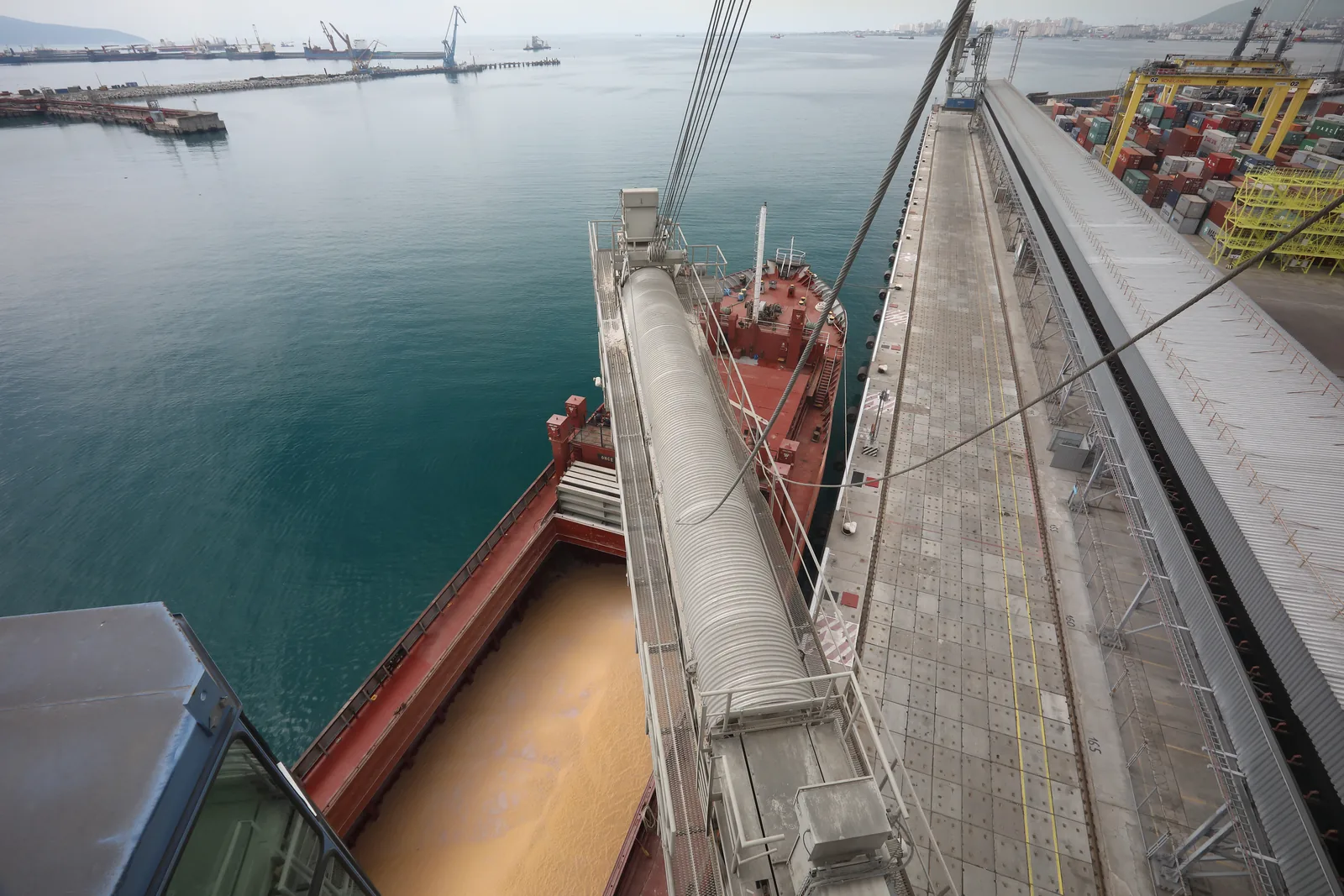
According to a report by The Moscow Times on 24 September, Krasnodar Governor Veniamin Kondratyev signed a decree on 23 September bringing a state of emergency into force retroactively from 12 August. The grounds cited were mass attacks on logistics facilities, the suspension of port operations and disruption to shipping in the Azov–Black Sea basin. According to sector analysts, August's drone and missile strikes knocked out about 90% of the region's grain export capacity. According to a Reuters report published by ThePrint, Krasnodar harvested 11.4 million tonnes of grain and pulses this year, about 2 million tonnes more than in 2025. Because the record harvest cannot be exported, it is piling up in the domestic market.
This picture shows that a second class of targets has opened up in Ukraine's long-range strikes. Since the start of September refineries had been the targets: after strikes on the Kuibyshev and Ufa refineries on 22 September, more than 45% of Russian refining capacity was reported to be out of action. According to a report by The Moscow Times on 23 September, regions are reinstating fuel purchase limits: there is a limit of 30 litres per vehicle in the Leningrad region and 15 litres in Zabaykalsky, and the petrol export ban has been extended to 31 January 2027. With the grain ports also out of action, Russia's war economy is being squeezed in both energy and agricultural exports at the same time.
Russia is seeking alternative routes to make up for this loss. According to The Moscow Times, fertiliser and coal terminals at Baltic and Arctic ports are being converted to handle grain arriving by rail from the south. These routes are longer and more expensive; daily shipment figures from Novorossiysk could not be verified tonight.
The budget front: the bill for the war goes to the taxpayer
On 24 September the Finance Ministry submitted the 2027–2029 draft budget to the government. According to The Moscow Times, the draft introduces a graduated 13–22% scale on deposit interest, dividends and securities gains, currently taxed at 13–15%, affecting about 4 million high earners; military personnel are exempt. It also proposes 22% VAT on cross-border online shopping and a flat fee of 100 roubles on parcels under 200 euros, a 35% tax on dividends paid to non-resident accounts and a 30% tax on the excess earnings of mining and metals companies.
Deficit estimates vary by source. The Moscow Times and Meduza put the 2027 deficit at 2% of GDP on an oil price assumption of 50 dollars a barrel, while the Reuters report published by Euronext says 2.2%; the discrepancy between the two figures could not be verified. According to Reuters, 2027 revenue is 43.3 trillion roubles and spending 48.8 trillion roubles; the 2026 deficit is expected to reach 3%, almost double the plan. According to the same report, the projections include a 5.4% contraction in fixed investment, the sharpest fall since 2015, a 0.2% decline in industrial output and 6.8% inflation.
The logic of the budget is clear: a financing model resting on oil revenue falls short in an environment where refineries and ports are being hit, and the deficit is being shifted onto the domestic tax base. This came immediately after the 21 September elections that secured a constitutional majority in the Duma; United Russia had reached up to 355 of the 450 seats.
Türkiye's place at the table
According to Reuters, the Kremlin said diplomatic contacts were continuing on Türkiye's proposal for the safe passage of grain in the Black Sea. Russia withdrew in 2023 from the Black Sea Grain Initiative of 2022. US Secretary of State Rubio said on 23 September, after talks with Lavrov, that both sides had shown interest in a limited ceasefire covering grain and energy targets. Attacks on commercial ships in the Black Sea are nonetheless continuing: with the strike on an Antigua-flagged cargo ship on 23 September, in which its Ukrainian captain was killed, the number of recorded attacks on ships rose to 226.
This combination gives Türkiye an opportunity to resume the mediating role it played in 2022, but the conditions are harder. First, this time both sides are striking each other's export infrastructure; safe passage would have to cover both Ukrainian and Russian ports. Second, Ukraine's exports for the 2026/27 season stood at 4.55 million tonnes as of 18 September, 20% behind the previous year, with wheat exports down 43%. Losses on both shores amplify the effect of Black Sea grain on world prices and carry the risk of raising input costs for Türkiye's flour and pasta industries; the size of this effect cannot yet be measured in figures.
Probabilities
Scenarios
| Scenario | Probability | Trigger | Market impact |
|---|---|---|---|
| H1Mutual infrastructure war continues | 55% | Ukraine continues its strikes on ports and refineries, Russia keeps hitting Ukrainian energy and port infrastructure; the safe passage proposal remains at the contact stage. | Russian grain and fuel exports stay low and the 2027 tax package passes the Duma. |
| H2Limited grain–energy ceasefire | 30% | A limited ceasefire covering grain and energy infrastructure is accepted through US and Turkish mediation. | Shipments from Krasnodar and Odesa ports increase gradually. |
| H3Escalation | 15% | Attacks concentrate on commercial ships in the Black Sea and on traffic approaching the Turkish Straits. | Commercial shipping in the Black Sea effectively halts. |
Module A
Constraints Matrix
STRUCTURAL AVG 4.0 · TACTICAL AVG 2.3Structural constraints dominate: the outcome is set more by these limits than by the actors' preferences.
Hard structural constraintspersistent · beyond the actors' will
Port capacity · Russia
4/5About 90% of Krasnodar's grain export capacity was knocked out by the August strikes; the alternative Baltic and Arctic routes are longer and more expensive.
Budget deficit · Russia
4/5The 2026 deficit is expected to reach 3% of GDP; 2–2.2% is projected for 2027, and the aim is to close the gap with new taxes.
Refinery losses · Russia
4/5As of 22 September more than 45% of Russian refining capacity was out of action; the petrol export ban has been extended to 31 January 2027.
Tactical frictiontemporary · eases over time
Fuel purchase limits weeks
3/5A limit of 30 litres per vehicle in the Leningrad region and 15 litres in Zabaykalsky; managing domestic demand has fallen to administrative measures.
Black Sea ship attacks weeks
3/5With the strike on an Antigua-flagged cargo ship on 23 September, the number of recorded attacks on ships rose to 226.
Deficit estimate uncertainty months
1/5The 2027 deficit is 2% or 2.2% depending on the source; the discrepancy could not be verified.
Module B
Signal vs Noise
SIGNAL 67% · NOISE 33%
- SIGNAL
Strikes have shifted to grain export infrastructure
About 90% of grain export capacity in Krasnodar is out of action; the state of emergency was declared retroactively to 12 August.
- SIGNAL
War financing is shifting to the domestic tax base
A 13–22% tax on passive income, 22% VAT on e-commerce and a 30% tax on mining and metals excess profits; 2027 revenue of 43.3 and spending of 48.8 trillion roubles.
- NOISE
The record harvest shows Russian agriculture is strong
Krasnodar's harvest is 11.4 million tonnes, 2 million tonnes more, but grain that cannot reach the ports generates no export revenue.
Module C
Asset-Class and Positioning Implications
| Asset class | Exposure | Transmission channel | H1 | H2 | H3 | Expected | Conviction | Horizon | What to watch |
|---|---|---|---|---|---|---|---|---|---|
| Commodities | Black Sea wheat and world grain prices | Loss of export capacity and route changes | + | − | ++ | +0.55 | ●●● | 0–3 months | Monthly grain export volumes of Russia and Ukraine |
| Freight & insurance | Black Sea dry bulk freight and war risk premium | Ship attacks and port closures | + | −− | ++ | +0.25 | ●●● | 0–3 months | Number of recorded attacks on ships in the Black Sea |
| Commodities | Refined product (diesel and petrol) margins | Russian refinery losses and the export ban | + | − | ++ | +0.55 | ●●● | 0–3 months | Pace of recovery in Russian refining capacity |
Second-order effects
And then what?
Starting point
About 90% of Krasnodar's grain export capacity is out of action and a harvest of 11.4 million tonnes cannot reach the ports; more than 45% of Russian refining capacity has also been halted by strikes.
- 1
Grain export revenuewithin weeks
Grain that cannot be exported piles up in the domestic market, depressing Russian domestic prices while cutting export revenue; Moscow diverts grain by rail to Baltic and Arctic ports, raising transport costs.
Watch: Russia's October grain export volume and grain shipments from Baltic ports
- 2
Budget and tax basewithin months
Losses in both grain and fuel exports weaken the revenue side of the 2027 budget despite its 50-dollar oil assumption, increasing the need to close the deficit with domestic taxes.
Watch: Whether the Duma adopts the tax package with or without amendments; end-October budget execution data
- 3
Diplomacy and the Black Seawithin months
Rising domestic costs and falling export revenue could make Moscow more willing to accept a limited ceasefire covering grain and energy targets; Türkiye's safe passage proposal would become the vehicle for this bargain.
Watch: Whether Türkiye's safe grain passage proposal turns into a written mechanism
What breaks the chain
Russia rapidly making up exports via the alternative rail–Baltic route, or the oil price staying well above the budget assumption and closing the revenue gap, would break the chain at the second step.
Triggers
Thresholds to watch
| Indicator | Threshold | Today | What it means |
|---|---|---|---|
| Bosphorus transits | Safe passage text | 62 | Türkiye's proposal turning into a written mechanism: the precondition for grain ship traffic through the Turkish Straits to increase again. |
| Brent crude oil (futures) | > 110 | 105.28 | The zone in which the loss of Russian refineries and ports is reflected a second time in global product and crude prices, and the Russian budget gets partial relief from oil revenue. |
Sources
- The Moscow Times — Krasnodar region declares state of emergency as Ukrainian strikes cripple grain exports
- ThePrint (Reuters) — Russia's Krasnodar region declares state of emergency as drone attacks slow grain exports
- The Moscow Times — Finance Ministry unveils 2027 budget draft with fresh tax hikes to fund war deficit
- Meduza — Russia plans higher taxes on passive income and foreign online purchases as budget deficit continues
- Euronext (Reuters) — Russia plans array of tax hikes in 2027–29 to fund military spending
- The Moscow Times — Russian regions slowly reimpose fuel purchase limits amid ongoing refinery attacks
- WRRU — Updates on the situation in Ukraine, 24 September 2026
Sourcing and verification rules: methodology · Report an error: contact
Related reports
IGeo-Economics·Analysis·Middle East and North Africa
Yanbu oil flows again as Red Sea risk settles into insurance premiums
Saudi Arabia resumed loadings at Yanbu on 28 September after 17 days, and Brent fell from a high of $108.83 to $105.28. But war risk insurance at Yanbu has tripled since July, and Bab el-Mandeb traffic is below half of normal.
Energy & Shipping Desk · 29 September 2026 · 7 min
IGeo-Economics·Analysis·Middle East and North Africa
Both exit gates under pressure as markets price a lasting disruption
After Trump rejected Iran's 7-day reopening plan on 26 September, Brent topped $106 at the Asian open on 28 September. In the same week the Houthis targeted Yanbu, and schools in Riyadh moved to remote learning.
Energy & Shipping Desk · 28 September 2026 · 7 min
IGeo-Economics·Analysis·Middle East and North Africa
The spread draws a border: the Hormuz disruption is now priced outside the US, and Brent-linked importers pay for the $11.91 gap
The Brent–WTI spread widened from $7.97 to $11.91 between 21 and 25 September. About $8 of the gap sits in freight, the rest in the US debate over keeping diesel at home; Türkiye has made the US its top crude supplier but cannot bring the discount to the pump.
Energy & Shipping Desk · 27 September 2026 · 5 min