VI Energy Politics & Supply Security·In-depth analysis·Middle East and North Africa
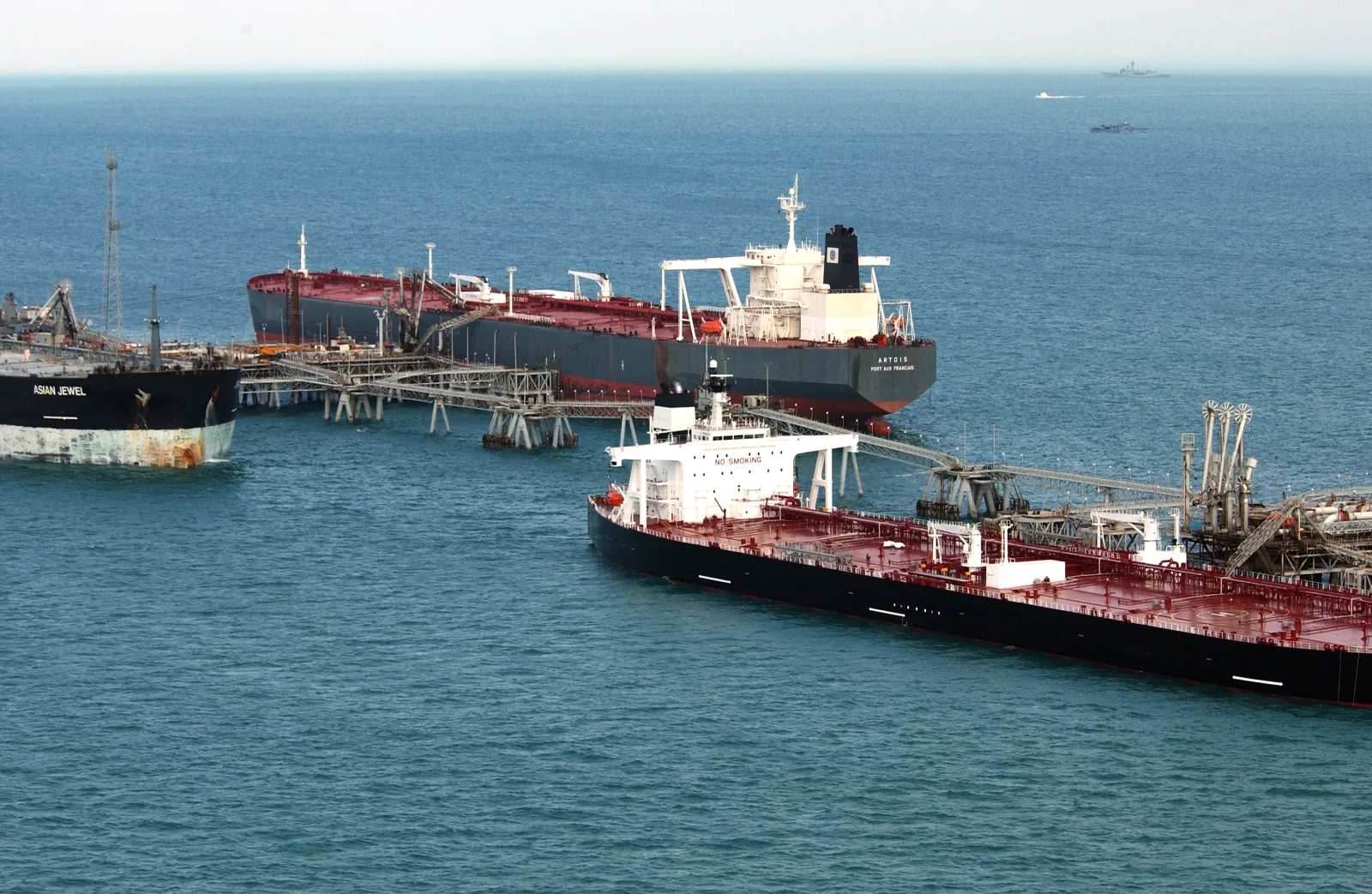
Hormuz becomes a selective filter as Iranian exports hit zero
Three data points landed together on 19 October. Iran's crude exports have been at zero since late August, while Iraq's are back in their pre-war band at 3.4 million barrels a day. Iran's Strait Authority, meanwhile, raised its list of non-compliant ships to 122.
Energy & Shipping Desk · 20 October 2026 · 11 min read · 17 sources
Why it matters
Noise: Kpler puts Gulf crude exports at 8.5 million barrels a day in the week before 19 October. The US Energy Secretary said the same day that flows stood at 80% of pre-war levels, so even the direction of the average is disputed. Signal: the strait has not closed but now runs on ship-by-ship permission. The list has grown from 46 to 122 since 24 August, and a blockade that has driven Iranian exports to zero has made this permit regime cost-free for Tehran.
Implications
- According to Bloomberg data published on 19 October, Iran's crude exports have fallen from roughly 1 million barrels a day in July to zero since late August. In September Kpler recorded no Iranian crude departures at all for the first time since 2013.
- Iraq's oil minister said on 19 October that October exports had exceeded 3.4 million barrels a day. The pre-war band is 3.3–3.5 million barrels, most of the volume passes through Hormuz, and the Ceyhan pipeline carries only 200–230 thousand barrels.
- Iran's Strait Authority expanded its non-compliance list to 122 ships on 19 October; 19 vessels are negotiating their removal, and it said around 30 more could be added.
Noise
Gulf oil flows collapsed to 8.5 million barrels a day in a single week.
Signal
With Iranian exports at zero, restricting the strait now costs Tehran nothing.
The noise is in the average, the signal in the distribution
The figure the market fixed on during 19 October was an average. Kpler data cited by Egypt Oil & Gas showed Gulf crude exports falling to 8.5 million barrels a day in the week before 19 October, down from more than 20 million the week before. On the same day, according to a Bloomberg report carried by Rigzone, US Energy Secretary Chris Wright said flows had recovered to roughly 80% of pre-war levels. Measured against the 20.64 million barrels of pre-war flow that Kpler recorded in February, the two readings are almost a factor of two apart. Which one is right cannot be verified from these sources. gCaptain reports that the same Kpler had put Middle East crude exports at 18.3 million barrels over the last seven days of September. An average whose very direction is in dispute cannot anchor a decision this week, which is why we treat it as noise.
The signal lies in how that average is distributed. Iraq's oil minister, Basim Mohammed Khudair, said on 19 October that October exports had exceeded 3.4 million barrels a day, describing this as a return to the pre-war band of 3.3–3.5 million barrels. Bloomberg data published by gCaptain the same day showed Iran's crude exports at zero since late August, with the Kharg terminals standing empty for around 40 days. Iran's Strait Authority also raised the number of ships it deems non-compliant to 122 that day. Read together, the three data points describe a strait that is not shut but filtered through a 122-ship list. Our thesis is that the constraint in Hormuz is no longer volume but permission. By driving Iran's exports to zero, the blockade has made that permit regime cost-free for Tehran.
1 · The logistical constraint and its threshold
The constraint works through a list. According to Argus, the Persian Gulf Strait Authority (PGSA) published its first list on 24 August with 46 ships, and automatically added any vessel conducting a ship-to-ship transfer with a listed ship. Middle East Monitor reported that the list reached 77 ships on 15 September, and Fox News reported 122 on 19 October. The authority says it has been in contact with more than 40 ships. It adds that 19 are negotiating their removal and 2 have met their obligations and agreed to be struck off. It also announced that around 30 more vessels that have not responded could be added. The figures come from Iranian authorities, and Straits.live flagged them in its 20 October briefing as unverified state media claims.
What turns the list into an enforcement tool is coercion. UKMTO data cited by gCaptain show 15 incidents around the strait in August and 18 in September, while 25 ships were targeted in the first two weeks of October. According to Straits.live, IMF PortWatch recorded only 2 transits on 11 October, against a pre-crisis average of 85 a day; as of 03:22 UTC on 20 October, 127 ships were waiting in the area. The threshold sits here. Once the list grows large enough that charterers can no longer find clean tonnage, passage is effectively closed to anyone who has not come to terms with Iran. The 19 ships in negotiation suggest that some owners have already accepted this threshold and, in practice, recognised the permit regime.
2 · Supply security and critical thresholds
On the supply side, the permit regime cuts asymmetrically. As reported by the Daily Caller, Kpler recorded no Iranian crude departures in September for the first time since its tracking began in 2013; in July exports had been around 1 million barrels a day. The US reimposed the blockade on 14 July, and CENTCOM said it had turned back 138 commercial ships by 17 October, a figure supplied by the US military itself. In the year to April 2026 Iran had exported roughly 650 million barrels, most of it to China. gCaptain reports that UANI estimated on 6 October that no more than 10 million barrels remained in floating storage off Malaysia. That is the last Iranian buffer feeding China's independent refiners.
The critical threshold is that zero itself. For an Iran exporting 1 million barrels a day, as it did in July, squeezing the strait would also have cut its own revenue. With exports at zero, that cost has disappeared. A Tehran with no barrels left to lose holds the strait as its only bargaining chip. Neighbouring producers, by contrast, are recovering inside the permit regime. Iraq's October exports have topped 3.4 million barrels a day, and World Oil reports that Kuwaiti output reached 2 million barrels a day on 5 October, 75% of its pre-war 2.6 million.
The recovery remains well below quota. According to a Reuters report carried by ARY News, OPEC+'s seven core members produced 25 million barrels a day in August, roughly 5 million below February levels. The same report says Gulf exports have run at 60–80% of normal in recent months. The threshold to watch for supply security is Iraq. If Baghdad's exports drop below 3 million barrels a day, the filter is tightening against Iran's neighbour too. The National reports that in early October Iraq moved a 2-million-barrel cargo through the strait on its own tanker for the first time, and had to offer buyers discounts at Basra. Passage, in other words, is expensive for Iraq as well.
3 · Second-order effects
The permit regime hits insurability first. According to Argus, any ship that transfers cargo with a listed vessel is itself listed. Maritime Executive reports that on 14 September the PGSA also warned insurers, P&I clubs and classification societies against servicing listed ships. A P&I club is a mutual insurer that covers shipowners' third-party liabilities. The 122-ship list therefore shrinks the pool of clean tonnage available for charter directly. Prices reflect this split in two ways. According to the Bloomberg report on Rigzone, Dated Brent stood around 117 $ on 19 October after falling roughly 16 $ in a week. The December Brent contract, by contrast, settled 0.3% lower at 109.55 $ that day, according to The Nation. November WTI rose 2.2% to 103.66 $, its highest close since 15 September, narrowing the spread to Brent to about 5.9 $.
The link to Türkiye runs through Ceyhan. According to 964media, the Iraq–Türkiye pipeline carries only 200–230 thousand barrels a day, less than a tenth of Iraq's 3.4 million barrels of exports. More than 90% of Iraqi state revenue depends on oil, so if the filter tightens on Iraqi cargoes the first pressure will fall on the northern line and Ceyhan. When exports fell from 99 million barrels to 18.6 million in March, monthly revenue dropped from 6.8 billion dollars to 1.95 billion dollars. Baghdad cannot absorb a repeat of that. For Ankara this is an opening in bargaining over transit revenue and supply security, though the pipeline's current flow shows that the alternative still exists mostly on paper.
4 · What would disprove this reading
The thesis rests on two conditions: Iranian exports staying at zero, and the list continuing to govern passage. If crude loadings resume at Kharg, or the US suspends the blockade, the cost to Tehran of restricting the strait returns and the filter loosens. Fox News reports that Pakistan's army chief, Asim Munir, is travelling to Tehran on 20 October with an agenda of ending the conflict and reopening Hormuz. According to the Straits.live briefing of 19 October, Iran's foreign minister reiterated that a seven-day reopening plan is on the table. If either channel ends in the blockade being lifted, our reading is falsified.
The second falsifier lies in the data. If Kpler's weekly figure of 8.5 million barrels is right, the constraint is not selective but a general collapse, and Iraq's 3.4 million would then be revised down next month. If Iraq's October exports come in below 3 million barrels in official SOMO data, or PortWatch daily transits climb above 20 while the list stops growing, the permit-regime thesis weakens. Our probability distribution is as follows: the filter persists at 55%, the filter tightens on Iraq and other Gulf neighbours at 30%, and mediation loosens it at 15%. The next checkpoint is the OPEC+ meeting on 1 November, which will show how Gulf producers account for output still running below quota.
Probabilities
Scenarios
| Scenario | Probability | Trigger | Market impact |
|---|---|---|---|
| H1The selective filter persists | 55% | The blockade continues and the PGSA widens its list, but passage stays open for Iraqi and Kuwaiti cargoes. | Iranian exports stay at zero and Iraq exports within a 3–3.5 million barrel-a-day band; prices react to the list and to attacks more than to the average. |
| H2The filter tightens on neighbours | 30% | The list extends to tankers carrying Iraqi and Kuwaiti cargoes, or the IRGC seizes a listed ship. | Iraqi exports drop below 3 million barrels a day, Kpler's weekly reading of 8.5 million barrels becomes entrenched, and pressure on Ceyhan rises. |
| H3Mediation loosens the grip | 15% | The Pakistani or Qatari channel results in the blockade being suspended, and Iran implements its seven-day reopening plan. | Kharg loadings resume, PortWatch transits rise above 20 a day and the list loses its function. |
Module A
Constraints Matrix
STRUCTURAL AVG 3.8 · TACTICAL AVG 3.3Structural constraints and tactical friction are balanced: short-term noise may mask the persistent trend.
Hard structural constraintspersistent · beyond the actors' will
Ship-by-ship permit regime · Iran
5/5The PGSA non-compliance list stood at 46 ships on 24 August, 77 on 15 September and 122 on 19 October; any ship transferring cargo with a listed vessel is listed too.
Iranian exports at zero · United States
4/5The US reimposed its blockade on 14 July; Iran's crude exports have fallen from roughly 1 million barrels a day in July to zero since late August.
Limited Ceyhan alternative · Türkiye
3/5The Iraq–Türkiye pipeline carries 200–230 thousand barrels a day; most of Iraq's 3.4 million barrels of exports depends on Hormuz.
Gulf output below quota · Saudi Arabia
3/5OPEC+'s seven core members produced 25 million barrels a day in August, roughly 5 million below February; Kuwait is at 75% of pre-war output.
Tactical frictiontemporary · eases over time
Insurance and class services weeks
4/5According to Maritime Executive, the PGSA warned insurers, P&I clubs and classification societies on 14 September against servicing listed ships.
Conflicting flow data days
3/5Kpler put weekly Gulf crude exports at 8.5 million barrels, while the US Energy Secretary said on 19 October that flows stood at 80% of pre-war levels.
Queue of waiting ships weeks
3/5According to Straits.live, 127 ships were waiting in the area as of 03:22 UTC on 20 October; PortWatch recorded 2 transits on 11 October.
Module B
Signal vs Noise
SIGNAL 60% · NOISE 40%
- NOISE
Gulf oil flows collapsed to 8.5 million barrels a day in a single week.
Kpler's weekly reading was 8.5 million barrels; the US Energy Secretary said the same day that flows stood at 80% of pre-war levels, and Kpler had measured 18.3 million barrels at the end of September.
Data: Strait of Hormuz transits ›Egypt Oil & Gas — Oil Prices Falls as US Waiver on Russian Sanctions Raises Supply Prospects
- SIGNAL
With Iranian exports at zero, restricting the strait now costs Tehran nothing.
The Kharg terminals stood empty for around 40 days; exports have fallen from roughly 1 million barrels a day in July to zero since late August.
gCaptain (Bloomberg) — Iran's Main Oil Terminals Remain Empty as US Blockade Bites
- SIGNAL
Iraqi barrels are passing through the strait at pre-war volumes.
Iraq's oil minister said on 19 October that October exports had exceeded 3.4 million barrels a day; the pre-war band is 3.3–3.5 million barrels.
964media — Oil exports back above 3.4 million barrels a day, minister says
- SIGNAL
The blacklist makes passage subject to ship-by-ship permission.
The PGSA raised the list to 122 ships on 19 October; 19 ships are negotiating, and 2 have met their obligations and agreed to be removed.
Data: Strait of Hormuz transits ›Fox News — Iran issues warning to US as Qatar prepares to announce regional defense agreement
- NOISE
The sharp fall in Dated Brent shows the shortage is over.
Dated Brent fell to around 117 $ on 19 October, down roughly 16 $ in a week; but December futures held at 109.55 $ and WTI rose to 103.66 $, its highest since 15 September.
Data: Brent crude oil (futures) ›Rigzone (Bloomberg) — Oil Prices Hover Near Five-Month High
Module C
Asset-Class and Positioning Implications
| Asset class | Exposure | Transmission channel | H1 | H2 | H3 | Expected | Conviction | Horizon | What to watch |
|---|---|---|---|---|---|---|---|---|---|
| Commodities | Front end of the crude oil curve | Hormuz passage subject to ship-by-ship permission and Iranian exports driven to zero | + | ++ | −− | +0.85 | ●●● | 0–3 months | The 110 $ threshold on December Brent |
| Freight & insurance | Gulf war-risk and P&I premiums | The blacklist reaching insurers and ships that transfer cargo with listed vessels | + | ++ | − | +1.00 | ●●● | 0–3 months | PGSA list updates and UKMTO notices |
| Commodities | Physical crude premium | How the spread between Dated Brent and futures responds to the list and to attacks | − | ++ | −− | −0.25 | ●●● | 0–3 months | The spread between Dated Brent and the December contract |
| Sovereign debt | Gulf exporters dependent on Hormuz | Exports made subject to the permit regime in countries such as Iraq, where oil supplies 90% of revenue | + | −− | + | +0.10 | ●●● | 3–12 months | Monthly SOMO export data |
| FX | Currencies of energy-importing emerging economies | Pass-through of persistently high oil futures via current accounts and inflation | − | −− | + | −1.00 | ●●● | 3–12 months | December Brent and the Brent–WTI spread |
Second-order effects
And then what?
Starting point
Iran's Strait Authority raised its non-compliance list to 122 ships on 19 October. Iran's crude exports have been at zero since late August, while Iraq's are passing through Hormuz at more than 3.4 million barrels a day in October.
- 1
Insurance and tonnagewithin weeks
Because any ship that transfers cargo with a listed vessel is itself listed, insurers and P&I clubs steer clear of tonnage near the list. Beyond 122 ships, the pool of clean tankers available for charter shrinks.
Watch: The PGSA list total and P&I club circulars on the Gulf
- 2
Freight and discountswithin weeks
Scarcer clean tonnage raises the cost of moving Iraqi and Kuwaiti cargoes; discounts on FOB sales at Basra deepen and buyers ask for delivery outside the strait.
Watch: SOMO official selling price differentials and weekly Basra loading data
- 3
Pipeline and budgetwithin months
Iraq, which relies on oil for more than 90% of its revenue, leans on the northern pipeline; Ceyhan flows come under pressure to rise from 200–230 thousand barrels, and Türkiye's transit bargaining power grows.
Watch: Daily flow statements on the Iraq–Türkiye pipeline and Iraqi salary payments
What breaks the chain
If the US suspends the blockade, Iran's own exports return and restricting the strait once again carries a cost for Tehran. If escorted transits on PortWatch rise above 20 a day, the list ceases to function.
Triggers
Thresholds to watch
| Indicator | Threshold | Today | What it means |
|---|---|---|---|
| Strait of Hormuz transits | > 20 transits/day | 2 | PortWatch daily transits rising from 2 on 11 October to above 20 would show the ship-by-ship permit regime loosening and the list losing its function. |
| Brent crude oil (futures) | > 110 $ | 109.55 | December Brent moving from 109.55 $ on 19 October to a run of closes above 110 $ would show the market pricing in the filter tightening on neighbouring producers. |
| WTI crude oil (spot) | > 105 $ | 101.91 | WTI rising from 103.66 $ to above 105 $, with the Brent spread narrowing below 5.9 $, would show buyers trying to fill the Gulf shortfall with US crude. |
Sources
- gCaptain (Bloomberg) — Iran's Main Oil Terminals Remain Empty as US Blockade Bites
- Daily Caller — Trump's Blockade Has Halted New Iranian Crude Shipments, Ship Trackers Say
- gCaptain — Iran's Offshore Oil Stockpile Nears Exhaustion as Blockade Chokes New Supply
- MarketScreener (Reuters) — Iraq's oil exports average over 3.4 million bpd so far in October
- 964media — Oil exports back above 3.4 million barrels a day, minister says
- Fox News — Iran issues warning to US as Qatar prepares to announce regional defense agreement
- Argus — Iran's PGSA tightens Hormuz transit rules
- Middle East Monitor — Iranian body lists 77 vessels for violating Tehran's Strait of Hormuz protocols
- Egypt Oil & Gas — Oil Prices Falls as US Waiver on Russian Sanctions Raises Supply Prospects
- Rigzone (Bloomberg) — Oil Prices Hover Near Five-Month High
- The Nation Thailand — Brent crude settles at $109.55 a barrel on Monday
- World Oil — Kuwait restores oil production to 2 MMbpd as Hormuz traffic increases
- ARY News (Reuters) — OPEC+ agrees to keep November oil output targets steady
- The National — Iraq transports its oil through Strait of Hormuz as US-Iran war chokes exports
- Straits.live — Strait of Hormuz Status, October 19, 2026
- Straits.live — Strait of Hormuz Status, October 20, 2026
- Maritime Executive — Iran expands threats against shipping to P&I and class societies
Sourcing and verification rules: methodology · Report an error: contact
Related reports
VIEnergy & Supply·Analysis·Türkiye and Its Neighbourhood
Gazprom's Turkish contracts expire in 72 days, and Moscow holds the cards
BOTAŞ's two contracts with Gazprom, worth 22 billion cubic metres, run out on 31 December. Middle East LNG flows are 80% below last year and TTF topped 88 euros on 20 October, so the fallback is expensive.
Türkiye & Neighbourhood Desk · 20 October 2026 · 6 min
VIEnergy & Supply·Analysis·Middle East and North Africa
Crude is flowing again, but the fuel ships burn is not
CENTCOM says 100 million barrels of oil passed through the Strait of Hormuz last week. In the same week Singapore's spot premium for high-sulphur fuel oil rose from 5.10 dollars a tonne in February to about 50. The Gulf and Russia are 1.8 million tonnes of heavy fuel short each month.
Energy & Shipping Desk · 18 October 2026 · 9 min
VIEnergy & Supply·Analysis·Türkiye and Its Neighbourhood
Russian diesel ties Ankara's fuel security to a Washington–Moscow bargain
On 16 October Trump suspended tariffs of up to 100% on Russia's biggest buyers. A day later Bayraktar, in Moscow, linked the US–Russia diesel deal to supply security. The constraint is not sanctions but a fuel system that runs on imported diesel and on Russian refineries under fire.
Türkiye & Neighbourhood Desk · 18 October 2026 · 8 min