VI Energy Politics & Supply Security·Analysis·Eurasia
Russian diesel has its licence; refineries and terminals remain the bottleneck
On 9 October the US licensed Russian diesel until April 2027, and Moscow approved 500,000 tonnes of exports the next day. Russian exports had fallen to 190,000 barrels a day in the third quarter. That same night a 2.5 million-tonne export terminal in Rostov went up in flames.
Energy & Shipping Desk · 11 October 2026 · 8 min read · 11 sources
Why it matters
The noise: the White House's 4.8 million-tonne Russian diesel deal is being sold as a fix for the shortage. By our calculation that volume is about 35.8 million barrels, roughly 1.2 days of global consumption. The signal: the constraint is capacity, not sanctions. Russian diesel and gasoil exports were 850,000 barrels a day in the first quarter and 190,000 in the third; over the same period Russia imported fuel for the first time. How much flows through the door the licence opens will depend on the throughput of refineries and loading terminals under attack.
Implications
- OFAC's General License 135 allows the sale of Russian-origin diesel and its import into the US until 7 April 2027; on 10 October the Russian government approved 500,000 tonnes of exports for this phase.
- Windward and Vortexa data show Russian diesel and gasoil exports at 850,000 barrels a day in the first quarter, 690,000 in the second and 190,000 in the third.
- Türkiye sourced 85% of its diesel imports, or 281,000 barrels a day, from Russia in 2025; by August 2026 the Russian share had fallen to 20% and volumes to 80,000 barrels a day.
Noise
The 4.8 million-tonne deal will end the global diesel shortage.
Signal
The constraint is refining capacity, not sanctions.
The noise is the licence; the constraint is in the refinery
The headline came from Washington on the evening of 9 October. After speaking to Putin, Trump wrote that Russia would immediately supply more than 300,000 tonnes of diesel and 500,000 tonnes in November. Then would come 1 million tonnes, and a further 3 million depending on the state of its refineries. Newsweek reports that the White House put the total at 4.8 million tonnes. According to NBC, OFAC, the Treasury's sanctions office, issued a temporary general licence the same day, valid until 7 April 2027. The next day, Anadolu Agency reported, the Russian government partially lifted its export ban and approved 500,000 tonnes for this phase.
The number itself is small. By our calculation, at about 7.45 barrels a tonne, 4.8 million tonnes comes to 35.8 million barrels. An estimate cited by Al Jazeera puts world diesel consumption at roughly 30 million barrels a day. The whole package therefore equals 1.2 days of global demand. The constraint in this report is not the licence. What determines Russian diesel's return to the market is the current throughput of the refineries and loading terminals Ukraine has struck.
Constraint 1 · Logistics: the loading points are on the front line
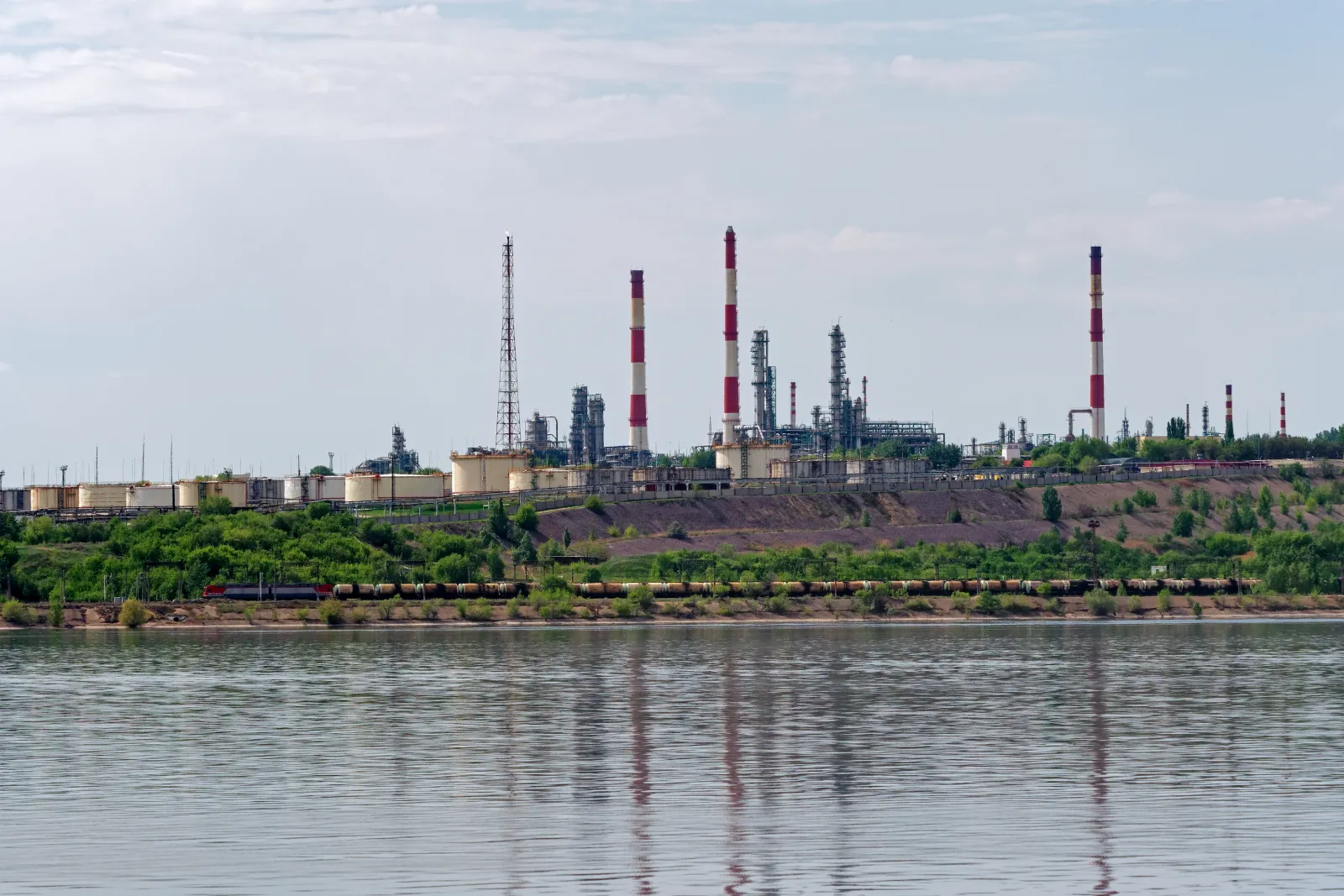
On the night the licence took effect, Ukrainian drones set fire to the Yug Rusi terminal in Rostov-on-Don. Kyiv Post reports that the terminal, linked to the Novoshakhtinsk refinery, has a design capacity of about 2.5 million tonnes a year. The Rostov governor said more than 50 drones were downed over the region. By our calculation the terminal can handle about 208,000 tonnes a month, or 42% of Moscow's first 500,000-tonne tranche. How long it will stay shut could not be verified.
Kyiv's stance keeps this channel open. NBC reports that Zelenskiy said he would halt strikes on Russian oil and gas targets only if Russia accepted the same terms, and called the licence an obvious weakness. Ukraine's second strike, on 8 October, on the Omsk refinery 2,500 km away shows its reach now covers all of European Russia. The licence removed the sanctions constraint, but not the physical risk to loading.
Constraint 2 · Supply security: the threshold for the export ban
The threshold lies in refinery output. Windward and Vortexa data cited by Al Jazeera show Russian diesel and gasoil exports falling from 850,000 barrels a day in the first quarter to 190,000 in the third, a drop of 78%. In the third quarter Russia imported petrol, diesel and gasoil for the first time. Ukraine's Defence Ministry says it has knocked out more than half of Russia's refining capacity. That claim could not be independently verified, and official Russian data have been withheld since a decree of 29 September. Putin has acknowledged that the strikes cost Russia 1% of GDP.
Moscow's decision came without that threshold being crossed. According to The Moscow Times, Novak said on 2 October that the ban had been extended but that a partial opening would be considered if diesel output exceeded domestic demand. Eight days later the government statement tied the decision to the Putin–Trump understanding, not to an output condition. Novak said production would cover both the domestic market and exports. Neil Atkinson, a former IEA official speaking to Al Jazeera, judged that Russia could free up the volume in the near term by squeezing domestic supply. The final and largest tranche of the package, 3 million tonnes, was explicitly made conditional on the state of the refineries.
By our calculation the first two tranches in the 9 October announcement, 800,000 tonnes, amount to about 6 million barrels by the end of November. That is 115,000 barrels a day over roughly 52 days. The pace equals about 14% of Russia's first-quarter exports, and 41% of the 281,000 barrels a day that Türkiye alone took from Russia in 2025.
Second round · The diesel bill and Türkiye
The price channel reacted on day one but did not change direction. NBC reports that diesel futures fell 4% on 9 October yet remain more than 110% higher since the start of the year. According to CBS, US diesel cost $6.28 a gallon on 8 October, against a record $6.53 on 22 September; Al Jazeera puts the September record at $6.52. Alhurra reports that European diesel futures had risen 6% on 8 October on the Hormuz attacks. Investing.com data show Brent futures closing 9 October at $104.72.
The link to Türkiye is direct. According to a Reuters report published by Baird Maritime, Türkiye sourced 85% of its diesel imports from Russia in 2025. The ban cut that share to 20% in August, and the gap was filled by more than 120,000 barrels a day from India and 90,000 from the US. The licence opens a route back to cheap Russian diesel, but with two risks. It expires on 7 April 2027, and according to Al Jazeera the 2026 sanctions law signed in September allows 100% tariffs on the five largest buyers of Russian oil. Whether the licence covers that tariff risk could not be verified.
What would refute this
Two developments would refute the thesis. First, if ship-tracking data show Russian diesel and gasoil exports averaging more than 400,000 barrels a day in November, the constraint really is sanctions rather than refineries, and the licence has opened up supply. Second, if the Russian government does not tighten the ban again on 31 October and the 1 million-tonne tranche starts on schedule in December, the power of terminal strikes to cut flows has been overstated. Conversely, if Moscow curbs exports again in November, our reading gains strength.
Probabilities
Scenarios
| Scenario | Probability | Trigger | Market impact |
|---|---|---|---|
| H1A token flow | 50% | The first 500,000 tonnes go out piecemeal by mid-November; terminal strikes continue but Moscow does not tighten the ban again. | Russian diesel exports rise slightly above the third quarter's 190,000 barrels a day but come nowhere near the first quarter's 850,000; the global diesel shortage persists. |
| H2Strikes cut the flow | 30% | Ukraine steps up strikes on product terminals and refineries, a new domestic shortage emerges in Russia, and the government extends the ban again on 31 October. | Tranches fall behind schedule and the licence stays on paper; Russia prioritises domestic supply over exports. |
| H3A return at scale | 20% | Another 500,000 tonnes go out in November, the 1 million-tonne tranche starts in December, and refinery repairs outpace the strikes. | Russian product exports rise above 300,000 barrels a day; Türkiye and Mediterranean buyers return to Russian supply. |
Module A
Constraints Matrix
STRUCTURAL AVG 4.3 · TACTICAL AVG 2.8Structural constraints dominate: the outcome is set more by these limits than by the actors' preferences.
Hard structural constraintspersistent · beyond the actors' will
Refining capacity · Russia
5/5Ukraine says more than half of Russia's refining capacity is out of action; the claim could not be verified, and official Russian data have been withheld since the 29 September decree.
The collapse in exports · Russia
5/5Diesel and gasoil exports were 850,000 barrels a day in the first quarter and 190,000 in the third; Russia imported fuel for the first time in the third quarter.
A politically conditional permit · Russia
4/5Novak set a surplus-output condition on 2 October; the 500,000-tonne tranche of 10 October was tied to the Putin–Trump understanding, not to that condition.
The licence's expiry · United States
3/5General License 135 expires on 7 April 2027; the 30-day waivers granted in the spring did not change the price trend.
Tactical frictiontemporary · eases over time
Terminal strikes days
4/5The 2.5 million-tonne-a-year Yug Rusi terminal burned on 10 October; it had also been targeted on 9 July.
The sanctions law months
3/5The 2026 sanctions law allows 100% tariffs on the five largest buyers of Russian oil; its relationship to the licence could not be verified.
Tonnage uncertainty weeks
2/5Trump puts the first tranche at 300,000 tonnes, the Russian government at 500,000; the White House puts the total at 4.8 million tonnes, Ed Hirs at 4 million.
Political backlash weeks
2/5Zelenskiy called the licence a weakness; Republican congressman Don Bacon said buying Russian fuel was the wrong answer.
Module B
Signal vs Noise
SIGNAL 67% · NOISE 33%
- NOISE
The 4.8 million-tonne deal will end the global diesel shortage.
By our calculation 4.8 million tonnes is about 35.8 million barrels, or 1.2 days of global consumption of roughly 30 million barrels a day.
Al Jazeera — Why is US turning to Russia for diesel despite sanctions?
- SIGNAL
The constraint is refining capacity, not sanctions.
Russian diesel and gasoil exports fell 78%, from 850,000 barrels a day in the first quarter to 190,000 in the third; over the same period Russia imported fuel for the first time.
Al Jazeera — Why is US turning to Russia for diesel despite sanctions?
- SIGNAL
Moscow's decision stemmed from bargaining, not surplus supply.
On 2 October Novak tied a partial opening to output exceeding domestic demand; eight days later the 500,000-tonne tranche was opened with reference to the Putin–Trump understanding.
- NOISE
The licence news pushed diesel prices down.
Diesel futures fell 4% on 9 October but remain more than 110% higher since the start of the year; the rise since the war began is about 70%.
NBC News — Trump eases Russia sanctions, says Putin will release diesel amid massive price spikes
- SIGNAL
Export loading points are also targets.
On 10 October the Yug Rusi terminal, with a design capacity of about 2.5 million tonnes a year, burned after a drone strike.
Kyiv Post — Drones strike Rostov oil terminal, igniting major fire
- SIGNAL
Türkiye's dependence on Russian diesel has already been broken.
Russia's share was 85%, or 281,000 barrels a day, in 2025 and fell to 20%, or 80,000 barrels a day, in August 2026; India exceeded 120,000 and the US 90,000.
Baird Maritime (Reuters) — Turkey turns to US and India for diesel as Russian export ban bites
Module C
Asset-Class and Positioning Implications
| Asset class | Exposure | Transmission channel | H1 | H2 | H3 | Expected | Conviction | Horizon | What to watch |
|---|---|---|---|---|---|---|---|---|---|
| Commodities | Middle-distillate (diesel) margins | Whether Russian tranches actually reach Mediterranean and European diesel supply | + | ++ | − | +0.90 | ●●● | 0–3 months | Diesel loadings at Russian product terminals |
| Freight & insurance | War risk on Black Sea and Azov product tankers | Strikes on loading terminals feeding into premiums and freight | + | ++ | − | +0.90 | ●●● | 0–3 months | New drone strikes on Russian product terminals |
| FX | Energy-importing emerging-market currencies | The diesel bill feeding into current accounts | − | −− | + | −0.90 | ●●● | 3–12 months | Türkiye's monthly energy import bill |
| Credit | Energy trade finance | Sanctions-compliance and tariff risk on Russian-origin product | − | 0 | −− | −0.90 | ●●● | 3–12 months | Whether General License 135 is extended before 7 April 2027 |
Second-order effects
And then what?
Starting point
The US General License 135 of 9 October and the 500,000-tonne tranche Moscow opened on 10 October freed Russian diesel from the sanctions constraint, but Russian exports had already fallen to 190,000 barrels a day in the third quarter.
- 1
Product exportswithin days
Russian companies open contract talks for the first tranche. Cargoes leave from Black Sea, Azov and Baltic terminals, and Ukraine's targeting shifts to these points; the Rostov strike on 10 October is the first example.
Watch: Diesel loadings at Russian product terminals in ship-tracking data, and new strikes on those terminals
- 2
Freight and insurancewithin weeks
As loading points come under fire, war-risk premiums rise for product tankers leaving Russian ports. Buyers demand discounts for delivery assurance, and actual volumes fall short of the 500,000-tonne tranche.
Watch: Black Sea war-risk premiums and the Russian government's ban decision before 31 October
- 3
Imports and sanctions compliancewithin months
Buyers such as Türkiye weigh a return to cheap Russian diesel. The licence's 7 April 2027 expiry and the tariff risk in the sanctions law make that return costly. If supply that shifted to India and the US swings back, compliance costs are added to importers' financing costs.
Watch: Origin breakdown of Türkiye's monthly diesel imports, and whether General License 135 is extended
What breaks the chain
The chain breaks if Kyiv and Moscow mutually halt strikes on energy facilities, or if repairs let Russian refineries lift exports above 400,000 barrels a day. An early withdrawal of the licence by Washington would stop the chain at the first step.
Triggers
Thresholds to watch
| Indicator | Threshold | Today | What it means |
|---|---|---|---|
| Brent crude oil (futures) | > $106 | 104.72 | Brent settling above $105.92, the intraday high of 8 October, would show the product shortage spilling over into crude prices. |
| Brent crude oil (futures) | < $98 | 104.72 | A return to late-September levels would show Russian diesel and Hormuz flows easing together and the licence feeding through to prices. |
Sources
- NBC News — Trump eases Russia sanctions, says Putin will release diesel amid massive price spikes
- Al Jazeera — Why is US turning to Russia for diesel despite sanctions?
- Newsweek — Trump strikes diesel deal with Putin to bring down prices ahead of midterms
- CBS News — Trump announces Russia will release millions of tons of diesel to help with skyrocketing costs
- Anadolu Agency (A News) — Russia partially lifts diesel export ban following Putin-Trump agreement
- Kyiv Independent (Yahoo News) — Russia partially lifts ban on diesel exports after Trump-Putin deal
- The Moscow Times — Russia will consider partial lifting of diesel export ban in case of overproduction, Novak says
- Kyiv Post — Drones strike Rostov oil terminal, igniting major fire
- Baird Maritime (Reuters) — Turkey turns to US and India for diesel as Russian export ban bites
- Alhurra — Tanker attacks spread inside Gulf as Hormuz traffic hits 2-month low
- Investing.com — Brent Oil Futures historical data
Sourcing and verification rules: methodology · Report an error: contact
Related reports
VIEnergy & Supply·Analysis·Eurasia
Four-fifths of Kazakhstan's oil hangs on one terminal in a war zone
Kazakhstan exported 64.8 million tonnes of oil through the CPC terminal at Novorossiysk in 2025. When storage filled in July, output fell 21% the next day. A trans-Caspian route would at best carry half that volume; the near-term alternative is capped at 100,000 tonnes a month.
Energy & Shipping Desk · 10 October 2026 · 8 min
VIEnergy & Supply·Analysis·Middle East and North Africa
Iranian oil hinges on reservoirs and tankers, not on a peace deal
Iran's output fell to 2.16 million barrels a day in August, close to domestic demand. Washington blacklisted 17 more tankers on 8 October. Even if a deal reopens Hormuz, Iran's early exportable surplus is a small fraction of its pre-war level.
Energy & Shipping Desk · 9 October 2026 · 8 min
VIEnergy & Supply·Analysis·Americas
Oil's inventory cushion has worn thin, so shocks now hit prices directly
The EIA raised its fourth-quarter Brent forecast by 14 dollars even as lost output fell from 10.9 million barrels to 4.8 million. The IEA brought forward its last 100 million barrels with diesel first, and in the same week Isaias shut 25% of Gulf of Mexico output.
Energy & Shipping Desk · 8 October 2026 · 7 min