VI Energy Politics & Supply Security·Analysis·Eurasia
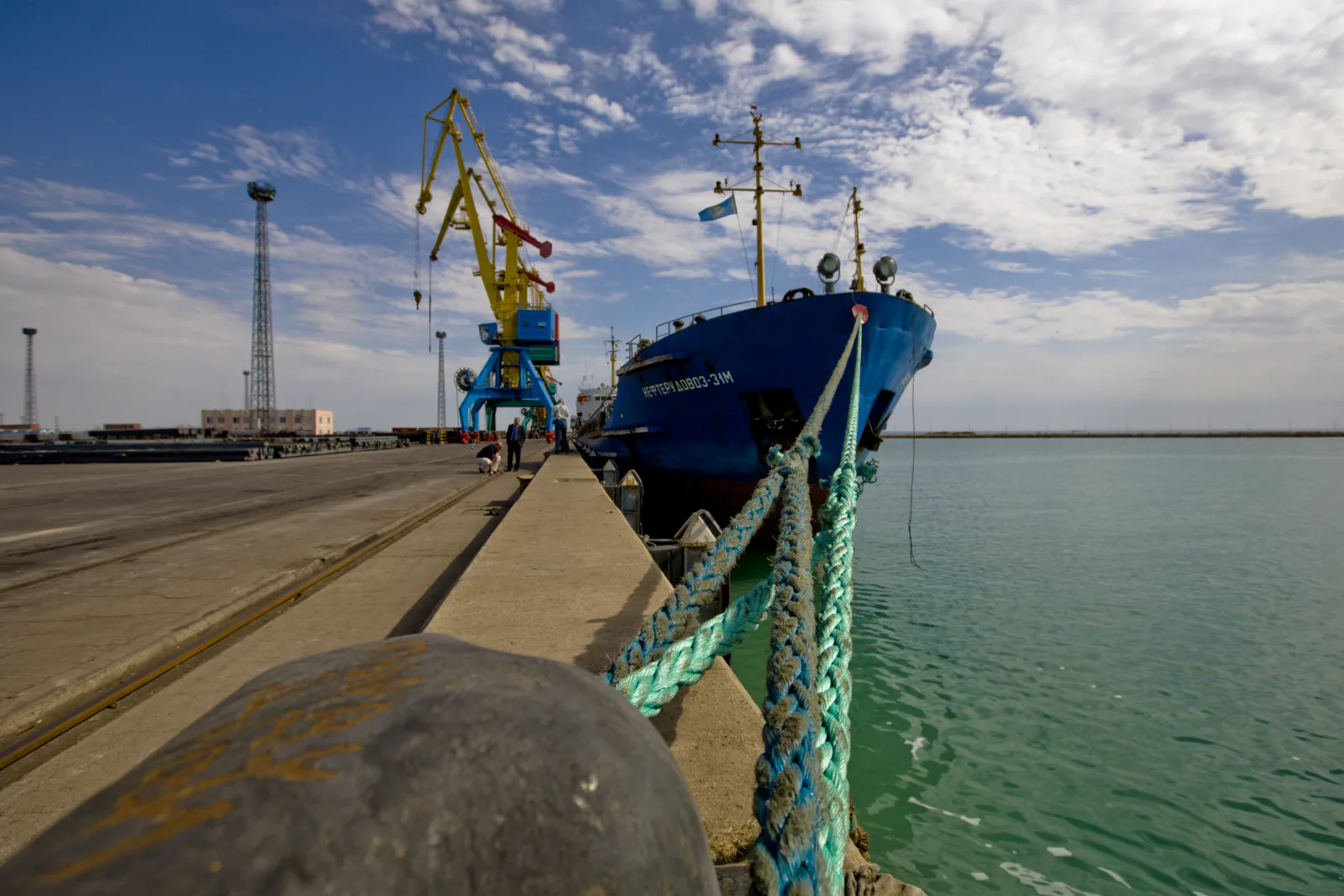
Four-fifths of Kazakhstan's oil hangs on one terminal in a war zone
Kazakhstan exported 64.8 million tonnes of oil through the CPC terminal at Novorossiysk in 2025. When storage filled in July, output fell 21% the next day. A trans-Caspian route would at best carry half that volume; the near-term alternative is capped at 100,000 tonnes a month.
Energy & Shipping Desk · 10 October 2026 · 8 min read · 9 sources
Why it matters
Noise: the study of a 35 million-tonne-a-year trans-Caspian route, launched on 8 October, is being sold as Kazakhstan's way out of dependence on Russia. Signal: the constraint is how long the country can withstand a disruption. When CPC storage filled after attacks in July 2026, Kazakh output fell 21% in one day on 22 July. Volume divertible at short notice is about 100,000 tonnes a month, less than a day of Tengiz output. By our calculation the BTC has roughly 665,000 barrels a day of spare capacity, but no Caspian tanker bridge reaches it.
Implications
- According to the Times of Central Asia, Kazakhstan exported 78.7 million tonnes of oil in 2025, of which 64.8 million passed through the CPC. Oil exports of about $41.3 billion made up half of $81.3 billion in goods exports.
- Six tankers were hit near the CPC in July 2026; on 21 July the consortium stopped accepting Kazakh crude because storage was full, and Tengiz output fell 56%.
- BOTAŞ data show the BTC pipeline carried 96.934 million barrels through Türkiye in the first half of 2026, down 8.4% year on year and, by our calculation, about 45% of its 1.2 million barrel-a-day capacity.
Noise
A trans-Caspian route will break Kazakhstan's dependence on Russia.
Signal
When the terminal shuts, the buffer is measured in hours.
The noise is at the table, the constraint at the terminal
The headline came from Central Asia on 8 October. According to the Times of Central Asia, the eight partners in the Tengiz and Kashagan fields have launched a feasibility study. The route would carry up to 35 million tonnes of crude a year from Atyrau to Aktau, across the Caspian to Baku and into the BTC (Baku–Tbilisi–Ceyhan) pipeline; results are due in November. The route is being read as a move to break Kazakhstan's dependence on Russia.
The quiet parameter lies elsewhere. Four-fifths of Kazakhstan's oil depends on a single marine terminal on a Black Sea that is inside the war, and when that terminal shuts the country has to choke back wells within days. The constraint in this report is not whether an alternative route exists, but how many days Kazakhstan can hold out when the CPC (Caspian Pipeline Consortium) is cut off.
Constraint 1 · Logistics: one terminal, two Russian corridors
According to an Astana Times analysis of 7 September, 64.8 million tonnes, or about 82%, of the 78.8 million tonnes of 2025 exports tracked by route passed through the CPC. The Atyrau–Samara pipeline came second with 9.3 million tonnes; together the two Russian corridors carried about 94% of the volume. Aktau shipped 3.5 million tonnes and the China pipeline 1.1 million. The Times of Central Asia says the CPC line is 1,511km long and carries about 2% of global daily crude supply; Russia holds 31% of the consortium, Kazakhstan 20.75% and Chevron 15%.
The terminal now sits squarely inside the front line. According to the Maritime Executive, three tankers loading at CPC buoys were hit by drones on 19–20 July and loading stopped twice; Kazakhstan's foreign and energy ministries condemned it as the fifth attack. The Times of Central Asia reports that six tankers were hit over the course of July. According to Qazinform, a drone incident near the terminal on 8 September again halted loading at the SPM-2 and SPM-3 buoys. The KSE Institute's tracker of 5 October shows Russia's crude exports from its Black Sea ports fell 55.9% month on month in August; the CPC is a neighbour of the same port.
Constraint 2 · Supply security: the threshold is one day
The July episode revealed the threshold. According to the Times of Central Asia, the CPC stopped accepting Kazakh crude on 21 July because its storage was full. The next day national output fell from the July average of 2.07 million barrels a day to 1.63 million, a 21% drop. At Tengiz the fall was 56%, from 925,000 barrels a day to about 406,000. In short, when the terminal shuts, the buffer is measured in hours, not days.
Alternative capacity does not close this gap. A Times of Central Asia analysis of 8 October puts short-notice diversion to rail or ports at about 100,000 tonnes a month. That is less than a day of Tengiz output. Energy Minister Akkenzhenov said disruptions in January, June and July cost about 3.5 million tonnes; the same report says the 2026 output target was cut from 98 million tonnes to 96 million. Reports in late July still gave the target as 98 million tonnes; the date of the official revision could not be verified.
The BTC has the pipe but not the bridge. According to the Times of Central Asia, BTC's throughput capacity is 1.2 million barrels a day. BOTAŞ data reported by Report.az show the line carried 96.934 million barrels through Türkiye in the first half of 2026; by our calculation that is about 535,000 barrels a day, or 45% of capacity. The bottleneck is the tanker bridge across the Caspian: according to AzerNews, Kazakhstan sent only 704,000 tonnes to the BTC via Aktau in the first half. The 2026 target varies by source: 1.5–2.2 million tonnes (AzerNews), 2.2 million tonnes (Astana Times) or 1.6 million tonnes (Times of Central Asia, July). The 2025 figure also diverges, between 1.2 and 1.3 million tonnes.
Second-order effects · From Kazakh wellhead to Ceyhan
The chain first hits Kazakhstan's budget. According to the Times of Central Asia, IMF data put 2025 oil exports at about $41.3 billion of $81.3 billion in goods exports, and Tengizchevroil paid $10.6 billion directly to the state in 2025. A prolonged CPC outage would cut off, within days, the flow that carries half of that revenue.
The second link is Europe. According to the Astana Times, the EU imported 52.4 million tonnes of Kazakh crude in 2024, making Kazakhstan its third-largest external supplier. An outage would further squeeze Mediterranean supply of light crude, already tight because of Hormuz; Brent closed up 4.1% at $104.28 on 8 October. The third link is Türkiye: if a trans-Caspian route or a larger tanker fleet comes on line, extra volume flows to Ceyhan and BTC's 55% spare capacity strengthens Türkiye's role as a corridor. That link will take years; November's feasibility study is only a first step.
Falsifier
Two developments would refute this thesis. First, if the CPC terminal suffers no attack-related stoppage longer than 48 hours through 31 December and Kazakh output stays above 2 million barrels a day in September–November, the terminal risk is smaller than priced. Second, if Kazakh volumes sent to the BTC via Aktau exceed 1.5 million tonnes in the second half of 2026, the Caspian bridge is being built faster than expected. In that case near-term fragility would be overstated.
Probabilities
Scenarios
| Scenario | Probability | Trigger | Market impact |
|---|---|---|---|
| H1Intermittent continuity | 55% | The CPC terminal keeps operating with occasional stoppages lasting hours or a few days, as in July and September. | Kazakh output stays below its 2026 target but exports do not collapse; the Caspian feasibility study comes out positive and the investment decision slips to 2027. |
| H2Prolonged outage | 25% | An attack-related stoppage at the terminal lasts more than two weeks. | Kazakh output falls by more than 20%, losses exceed the 3.5 million tonnes of 2026 disruptions, and light crude flows to Europe shrink. |
| H3The corridor calms | 20% | A moratorium on civilian shipping in the Black Sea is initialled, or the CPC is in practice kept off target lists. | Output settles above 2 million barrels a day and the urgency of a trans-Caspian route fades. |
Module A
Constraints Matrix
STRUCTURAL AVG 4.5 · TACTICAL AVG 2.5Structural constraints dominate: the outcome is set more by these limits than by the actors' preferences.
Hard structural constraintspersistent · beyond the actors' will
Single-terminal dependence · Russia
5/5In 2025, 64.8 million tonnes of exports, about 82%, passed through the CPC terminal at Novorossiysk.
No storage buffer
5/5When storage filled on 21 July, the CPC refused Kazakh oil; on 22 July output fell 21%, and 56% at Tengiz.
Russian corridors · Russia
4/5The CPC and Atyrau–Samara together carried about 94% of 2025 exports; Russia owns 31% of the CPC.
Caspian tanker bridge
4/5Near-term diversion is about 100,000 tonnes a month; only 704,000 tonnes went to the BTC via Aktau in the first half.
Tactical frictiontemporary · eases over time
Black Sea attacks days
4/5Six tankers were hit around the CPC in July, and loading at SPM-2 and SPM-3 stopped again on 8 September.
Feasibility timetable months
3/5Results of the study on a 35 million-tonne-a-year trans-Caspian route will only be presented to the partners in November.
Target uncertainty months
2/5The 2026 output target is 98 or 96 million tonnes depending on the source; the BTC target varies between 1.5 and 2.2 million tonnes.
Planned maintenance days
1/5The CPC came out of a 12-hour planned stoppage on 6 October; the SCADA system at the marine terminal is being upgraded.
Module B
Signal vs Noise
SIGNAL 67% · NOISE 33%
- NOISE
A trans-Caspian route will break Kazakhstan's dependence on Russia.
The route would carry at most 35 million tonnes a year, about 54% of the 64.8 million tonnes that went through the CPC in 2025; results are due in November and construction will take years.
The Times of Central Asia — Kazakhstan weighs a second major oil export route
- SIGNAL
When the terminal shuts, the buffer is measured in hours.
CPC storage filled on 21 July, and on 22 July Kazakh output fell from 2.07 million barrels a day to 1.63 million, a 21% drop.
- SIGNAL
The BTC has spare capacity, but there is no Caspian bridge.
The BTC carried 96.934 million barrels in the first half, by our calculation 45% of capacity; Kazakhstan sent only 704,000 tonnes via Aktau over the same period.
Report.az — BTC pipeline transports 97 million barrels of oil via Türkiye in H1 2026
- NOISE
The CPC's smooth return from maintenance on 6 October shows the risk has eased.
The maintenance was a 12-hour planned stoppage; a drone incident at the same terminal had halted loading on 8 September.
Qazinform — CPC completes scheduled maintenance on Kazakhstan section of oil pipeline
- SIGNAL
Black Sea ports are inside the war.
According to KSE, Russia's crude exports from its Black Sea ports fell 55.9% month on month in August.
- SIGNAL
Kazakhstan's foreign-currency income depends on one corridor.
Oil exports of about $41.3 billion made up half of $81.3 billion in goods exports in 2025.
The Times of Central Asia — Kazakhstan weighs a second major oil export route
Module C
Asset-Class and Positioning Implications
| Asset class | Exposure | Transmission channel | H1 | H2 | H3 | Expected | Conviction | Horizon | What to watch |
|---|---|---|---|---|---|---|---|---|---|
| Commodities | Mediterranean light crude differentials | A CPC stoppage narrowing light crude supply to European refiners | + | ++ | − | +0.85 | ●●● | 0–3 months | CPC loading notices and drone incidents around the terminal |
| Freight & insurance | Black Sea tanker war risk | Attacks around the CPC and Novorossiysk feeding into premia and freight | + | ++ | −− | +0.65 | ●●● | 0–3 months | Whether the Black Sea civilian shipping moratorium is initialled |
| FX | Central Asian commodity-exporter currencies | Oil export revenue cut off through a single corridor | − | −− | + | −0.85 | ●●● | 3–12 months | Kazakhstan's monthly oil output and export data |
| Commodities | Far end of the crude oil curve | A trans-Caspian route securing Kazakh supply for years ahead | 0 | + | − | +0.05 | ●●● | 12+ months | November's feasibility result and the investment decision |
Second-order effects
And then what?
Starting point
Repeated attacks on the CPC terminal in 2026 and the 8 September incident showed that about 82% of Kazakh exports depend on a single Black Sea terminal. They also showed that output falls 21% the day after storage fills.
- 1
Kazakh outputwithin days
A new stoppage at the terminal lasting more than a few days would, as in July, cut Kazakh output by more than 20% within a day; Tengiz would be the first field to be curtailed.
Watch: Daily output statements from Kazakhstan's Energy Ministry and CPC loading notices
- 2
Mediterranean light crude supplywithin weeks
Once CPC Blend bound for the Mediterranean is cut off, light crude supply already squeezed by Hormuz tightens further for European refiners; the EU bought 52.4 million tonnes of Kazakh oil in 2024.
Watch: CPC Blend's differential to Brent and Mediterranean refining margins
- 3
Pipeline and transitwithin months
A persistent premium and lost revenue push the Tengiz and Kashagan partners towards an investment decision on a Caspian tanker fleet and the BTC; extra volume exits through Ceyhan and Türkiye's transit role grows.
Watch: November's feasibility result and BOTAŞ monthly BTC transit data
What breaks the chain
The chain breaks if Russia and Ukraine initial a moratorium banning attacks on civilian ships in the Black Sea, or if the CPC is in practice left off target lists. Expanding CPC storage capacity would also slow the first step.
Triggers
Thresholds to watch
| Indicator | Threshold | Today | What it means |
|---|---|---|---|
| Brent crude oil (futures) | > 110 | 104.43 | If a prolonged CPC outage is added to pressure on Hormuz, the shortage of light crude in the Mediterranean passes fully into price. |
| Brent crude oil (futures) | < 95 | 104.43 | The market sees Gulf and Black Sea supply risk as low at the same time; the CPC premium has been priced out. |
Sources
- The Times of Central Asia — Kazakhstan weighs a second major oil export route
- The Times of Central Asia — Kazakhstan oil output falls 21% as CPC halt more than halves Tengiz production
- The Astana Times — Kazakhstan is upgrading its oil export strategy, here's how
- The Maritime Executive — Three tankers attacked while loading at Caspian Pipeline
- Qazinform — CPC completes scheduled maintenance on Kazakhstan section of oil pipeline
- Report.az — BTC pipeline transports 97 million barrels of oil via Türkiye in H1 2026
- AzerNews — Kazakhstan transits 704,000 tons of oil via BTC pipeline in H1 2026
- KSE Institute — Russian Oil Tracker, September 2026
- Nation Thailand — Brent crude rises 4.1% to $104.28 on Thursday
Sourcing and verification rules: methodology · Report an error: contact
Related reports
VIEnergy & Supply·Analysis·Middle East and North Africa
Iranian oil hinges on reservoirs and tankers, not on a peace deal
Iran's output fell to 2.16 million barrels a day in August, close to domestic demand. Washington blacklisted 17 more tankers on 8 October. Even if a deal reopens Hormuz, Iran's early exportable surplus is a small fraction of its pre-war level.
Energy & Shipping Desk · 9 October 2026 · 8 min
VIEnergy & Supply·Analysis·Americas
Oil's inventory cushion has worn thin, so shocks now hit prices directly
The EIA raised its fourth-quarter Brent forecast by 14 dollars even as lost output fell from 10.9 million barrels to 4.8 million. The IEA brought forward its last 100 million barrels with diesel first, and in the same week Isaias shut 25% of Gulf of Mexico output.
Energy & Shipping Desk · 8 October 2026 · 7 min
VIEnergy & Supply·Analysis·Middle East and North Africa
The Gulf's oil buffer has filled, but on a single pipeline
The share of Gulf barrels crossing the Strait of Hormuz fell from 83% to 60%. The East-West line, with 11 pumping stations, carries the difference. Yemen's front has reached the Bab el-Mandeb coast; war-risk cover costs 3% at Yanbu.
Energy & Shipping Desk · 7 October 2026 · 7 min