VI Energy Politics & Supply Security·Analysis·Middle East and North Africa
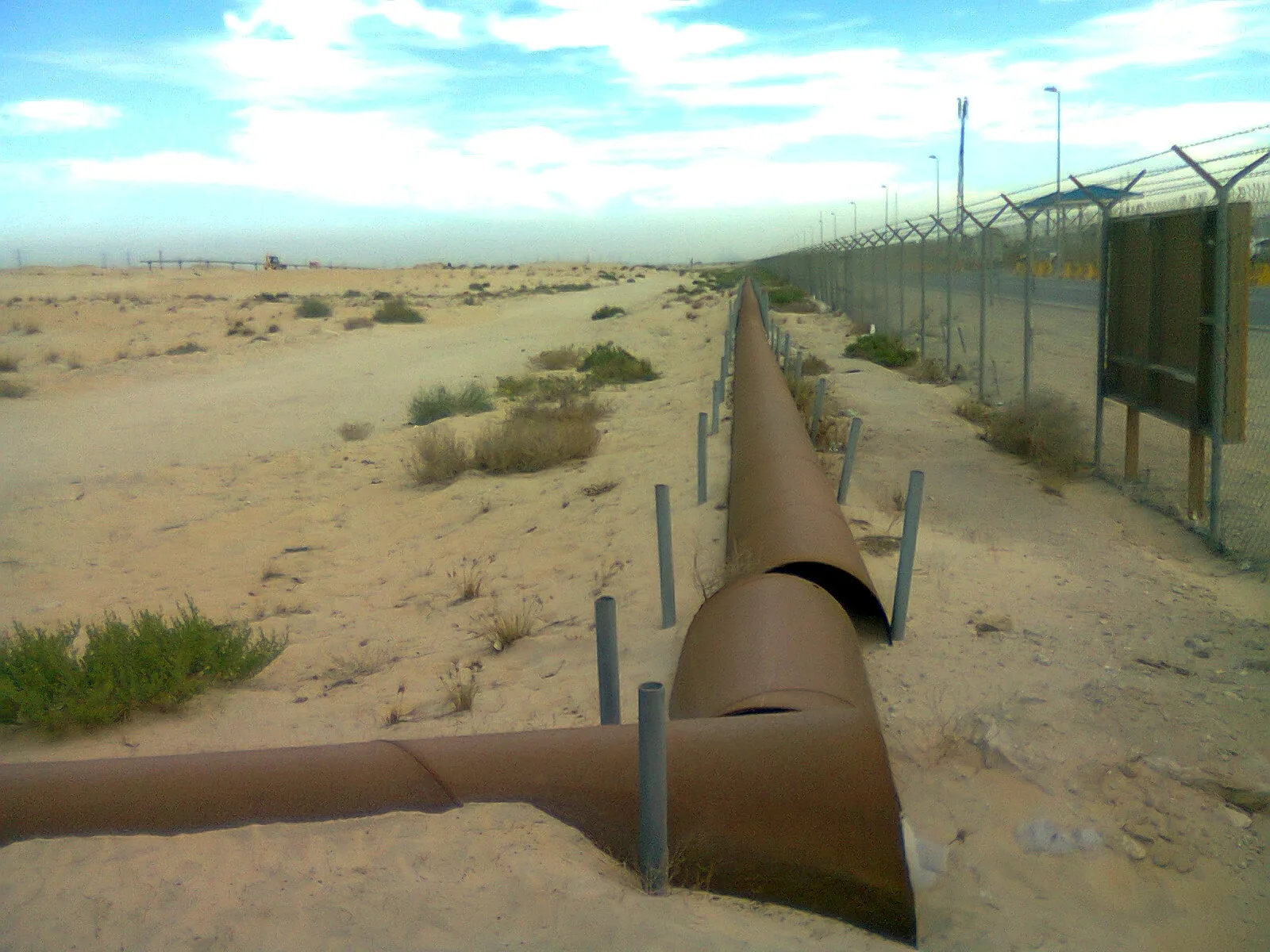
The Gulf's oil buffer has filled, but on a single pipeline
The share of Gulf barrels crossing the Strait of Hormuz fell from 83% to 60%. The East-West line, with 11 pumping stations, carries the difference. Yemen's front has reached the Bab el-Mandeb coast; war-risk cover costs 3% at Yanbu.
Energy & Shipping Desk · 7 October 2026 · 7 min read · 15 sources
Why it matters
Noise: the East-West pipeline returned to 5.8 million barrels on 6 October. One source reports that figure as a daily flow, another as the total moved since 22 September; the two readings differ fourteenfold. Signal: the constraint is concentration, not capacity. The share of non-Iranian Gulf barrels crossing Hormuz fell to 60% in September, against 83% before the war. The bypass load rests on one line with 11 stations; three were hit on 10–11 September and the line was shut for 11 days. The 3% war-risk premium at Yanbu is the price of this concentration.
Implications
- The share of non-Iranian Gulf barrels crossing Hormuz fell to 60% in September, from 83% before the war. The 7 million barrel East-West pipeline carries most of the 23-point shift.
- The war-risk premium for Saudi-linked tankers calling at Yanbu rose from under 1% in early July to 3%; for Red Sea voyages with no Saudi link it is 0.2–0.3%.
- Türkiye's energy import bill rose 33.8% year on year to 6.46 billion dollars in August while crude import volumes fell 1.1%; the bill is growing on price and premium, not volume.
Noise
The East-West line is back near full capacity at 5.8 million barrels.
Signal
The Gulf's buffer outside Hormuz is piling onto a single line.
The noise is in the number, the signal in the concentration
The headline figure is 5.8 million barrels. On 6 October in Manama, Saudi Energy Minister Abdulaziz bin Salman said the East-West pipeline had returned to 5.8 million barrels that morning. Türkiye Today reported this as a daily flow. OilPrice, the same day, presented the figure as the total the line had carried since it reopened on 22 September. If the cumulative reading is right, average flow over 14 days falls to about 0.41 million barrels a day. If the daily reading is right, the line is back at 83% of its 7 million barrel capacity, and the two readings differ more than fourteenfold.
This report does not try to settle which figure is correct; as of 7 October there is no official clarification. The real signal is that the Gulf's buffer outside Hormuz has gathered in a single system. According to OilPrice on 6 October, only 60% of non-Iranian Gulf barrels crossed Hormuz in September; before the war the share was 83%. The 23-point shift moved onto pipelines, alternative ports and ship-to-ship transfers. The backbone of that load is the 1,200-kilometre East-West line.
The constraint is a single point, not capacity
According to Türkiye Today, the line runs from Abqaiq in the east to Yanbu on the Red Sea and can carry 7 million barrels a day. Industry sources cited by Shafaq News say the system has 11 pumping stations and two pressure relief stations. The drone attack of 10–11 September struck three pumping stations directly, and the line was shut for about 11 days. Riyadh named Iraq as the source of the attack. The Islamic Resistance in Iraq denied the charge, and neither side's claim could be independently verified.
The line's fragility was tested again on 5 October. According to Anadolu Ajansı, a new attack on the Hurais pumping station was claimed to have halted the line, and prices rose 1.2%. The gain was given back once Bloomberg reported the line operating normally, with flow above 80% of capacity. The Hurais claim could not be verified. Yet a 1.2% move on a single unverified report shows the market knows that one of 11 stations is enough to close the Gulf's spare outlet.
Three sources also diverge on the size of the recovery the line is carrying. According to OilPrice, Saudi crude exports rose from 2.45 million barrels a day in August to about 6.9 million in September; Türkiye Today gives 6.6 million barrels for September. The Kpler data used in our 6 October report showed 4.2 million barrels for August. Depending on the source, the recovery ranges from 2.4 to 4.45 million barrels a day; its direction is the same in all three.
With Hormuz unmeasurable, the one open gate grows dearer
Flows through Hormuz were unmeasurable as of 6 October. According to Al Jazeera, a Revolutionary Guards commander said only 3–4 million barrels a day were crossing the strait. Global Energy Flow's compilation puts Tankertrackers' estimate at 3.7 million barrels and Bloomberg's at 6–8 million. A CENTCOM statement points to about 16.4 million barrels a day. The gap between the lowest and highest estimates exceeds fivefold. According to Windward, 37% of the 119 commercial transits in the week to 30 September were made with transponders switched off.
While flows cannot be measured, buyers place a higher value on the one large gate that can be: the 7 million barrel line to Yanbu. Prices show this not in a crude level of around 100 dollars but in the premium on seaborne barrels. Investing.com data show ICE Brent futures closing 6 October up 0.76% at 101.08 dollars, and WTI futures up 0.37% at 89.76 dollars. The spread between Brent and the US domestic barrel is 11.32 dollars. That gap is consistent with risk being loaded onto sea routes outside the Atlantic.
Yemen's front has reached the Red Sea coast
According to The National on 6 October, Saudi-backed Yemeni forces announced they had taken the Bab el-Mandeb coast, the Dhubab area and the port of Mokha. The coalition says 100 warplanes destroyed 324 Houthi targets; the Houthis reject the casualty claims. According to The New Arab, 115 government soldiers and 160 Houthi fighters were killed in the 24 hours to 6 October, and the fighting has displaced 184,000 people. Neither side's claims of control could be independently verified.
On 6 October the front also edged towards the western end of the line. According to The National, the Houthis claimed to have targeted King Khalid Airport in Riyadh that day. They also claimed a strike on an Aramco refinery at Rabigh, on the same Red Sea coast as Yanbu; the claim could not be verified. On 6 October the Saudi Interior Ministry warned that filming and sharing footage of interceptions would carry legal liability. The ban narrows the independent ground data used to monitor the security of one pipeline and one port. According to OilPrice on 25 September, daily transits through Bab el-Mandeb had dropped to around 30, against a normal 80.
Second round · From the policy to Türkiye's bill
The price of concentration shows up in two policy lines: hull and cargo cover. According to Marine Insight, London's Joint War Committee moved the Red Sea listed area northwards as of 31 July, bringing Yanbu and Jeddah into the high-risk zone. OilPrice and Ship Universe data dated 25 September show the war-risk premium for Saudi-linked tankers calling at Yanbu rising from under 1% in early July to 3% of hull value. The premium reaches 7% at southern Saudi ports and 6–9% in Hormuz. Red Sea voyages with no Saudi link stay at 0.2–0.3%. For a 100 million dollar tanker, that is about 3 million dollars for seven days of cover. On a VLCC carrying 2 million barrels, it works out at roughly 1.5 dollars a barrel.
In September Riyadh began shifting insurability, meaning a risk's ability to find cover at a reasonable market price, onto the state balance sheet. The approval was reported one day before the line shut on 11 September. According to Asharq Al-Awsat on 10 September, the cabinet approved a national war-risk insurance pool led by Saudi Re, covering hull, cargo and P&I liability. The pool's capacity had not been disclosed as of 7 October. The same report says India's 2026 pool, with 1.5 billion dollars of capacity and a 1.4 billion dollar state guarantee, cut premiums by 35–40%. The pool is tied to the same single point. A hit at Yanbu would strike both the flow and the balance sheet of the state providing the cover, at once.
The 3% premium at Yanbu passes into freight, and freight passes into the importer's bill. According to TÜİK and Trade Ministry data cited by Capital, Türkiye's energy imports rose 33.8% year on year to 6.46 billion dollars in August, from 4.83 billion dollars a year earlier. In the same month crude import volumes fell 1.1% to 2.84 million tonnes. A growing bill on falling volume shows Türkiye's energy cost now depends more on the delivery premium than on the barrel itself. September trade data were not available to us as of 7 October.
What would refute this reading
Our thesis is that the Gulf's spare capacity will stay concentrated in one line and one port over the next three months. The price of that risk will be carried through insurance policies. We see this as the most likely path, at 55%. First falsifier: if October tanker-tracking data show the share of Gulf barrels crossing Hormuz back above 70% from 60%, the load comes off the single line. Second falsifier: if the war-risk premium at Yanbu falls below 1%, the insurance market is no longer pricing the concentration.
Third falsifier: if daily transits through Bab el-Mandeb rise above 60 from around 30 on 25 September, Red Sea routes multiply and Yanbu's monopoly weakens. The risk in the other direction is also clear. A verified hit on any of the 11 stations or on the Yanbu terminal would repeat the 11-day outage of 10–11 September, this time with Hormuz flows also unmeasurable.
Probabilities
Scenarios
| Scenario | Probability | Trigger | Market impact |
|---|---|---|---|
| H1The single point holds and the premium settles | 55% | The East-West line flows above 5 million barrels and no new hit is verified; the Hormuz share stays near 60% and Bab el-Mandeb transits within 30–40. | Volumes hold, but risk stays concentrated in one line and at Yanbu; the war-risk premium settles near 3% and the Saudi pool fills the cover gap. |
| H2The single point breaks | 25% | A verified hit on one of the pumping stations, the Yanbu terminal or the Rabigh refinery; Houthi fire concentrates on the Red Sea coast. | September's 11-day outage repeats while Hormuz flows remain unmeasurable; Saudi exports are forced back through the strait. |
| H3Outlets multiply | 20% | The Bab el-Mandeb coast verifiably changes hands and transits exceed 60; the Hormuz share returns above 70%. | The bypass load comes off the single line, Yanbu's monopoly weakens and the war-risk premium falls below 1%. |
Module A
Constraints Matrix
STRUCTURAL AVG 4.0 · TACTICAL AVG 2.8Structural constraints dominate: the outcome is set more by these limits than by the actors' preferences.
Hard structural constraintspersistent · beyond the actors' will
The bypass rests on one pipeline · Saudi Arabia
5/5Saudi flows avoiding Hormuz depend on a single 1,200-kilometre line with 7 million barrels of capacity; three of its 11 pumping stations were hit on 10–11 September and it was shut for 11 days.
Hormuz flows cannot be measured · Iran
4/5Estimates range from 3–4 million (Revolutionary Guards) to about 16.4 million barrels a day (CENTCOM); 37% of 119 transits in the week to 30 September ran with transponders off.
Yemen's front on the Bab el-Mandeb coast
4/5The government said on 6 October it had taken Mokha, Dhubab and the Bab el-Mandeb coast, which the Houthis denied; more than 270 fighters were killed in 24 hours.
The west coast is one target cluster · Saudi Arabia
3/5The Yanbu terminal, the Rabigh refinery and the Jizan and Najran airports sit on the same Red Sea front; the Houthis claimed on 6 October to have targeted Rabigh, which could not be verified.
Tactical frictiontemporary · eases over time
Yanbu war-risk premium at 3% weeks
4/5The premium for Saudi-linked tankers rose from under 1% in early July to 3%; for Red Sea voyages with no Saudi link it is 0.2–0.3%.
Bab el-Mandeb transits below half weeks
3/5As of 25 September daily transits were around 30, against a normal level of 80; premia at southern Saudi ports reach 7%.
Footage ban narrows verification days
2/5On 6 October the Saudi Interior Ministry attached legal liability to sharing footage of interceptions and strikes; claims such as Hurais moved prices 1.2% before 24 hours of verification.
State pool capacity unknown months
2/5The cabinet approved a Saudi Re-led war-risk pool before 10 September; capacity is undisclosed, whereas India's pool cut premiums by 35–40% with 1.5 billion dollars of capacity.
Module B
Signal vs Noise
SIGNAL 57% · NOISE 43%
- NOISE
The East-West line is back near full capacity at 5.8 million barrels.
The minister's 5.8 million barrels of 6 October is a daily flow in Türkiye Today and a total since 22 September in OilPrice; if cumulative, the 14-day average is 0.41 million a day, a gap of over fourteenfold.
OilPrice — Saudi East-West Pipeline Moves 5.8 Million Barrels as Red Sea Route Recovers
- SIGNAL
The Gulf's buffer outside Hormuz is piling onto a single line.
The share of non-Iranian Gulf barrels crossing Hormuz was 60% in September against 83% before the war; three of the 11 pumping stations on the line carrying the load were hit on 10–11 September.
Data: Strait of Hormuz transits ›Türkiye Today — Saudi Arabia restores East-West pipeline flows to 5.8M barrels a day
- SIGNAL
The price of concentration sits in the policy and splits on Saudi links.
The war-risk premium for Saudi-linked tankers at Yanbu is 3%, from under 1% in early July; for Red Sea voyages with no Saudi link it is 0.2–0.3%.
Data: Bab el-Mandeb transits ›Ship Universe — Saudi Red Sea tanker insurance costs surge as Yanbu war-risk premium hits 3%
- SIGNAL
Riyadh is moving insurability onto the state balance sheet.
The cabinet approved a national war-risk pool led by Saudi Re (reported 10 September); capacity is undisclosed, and in India a 1.5 billion dollar pool cut premiums by 35–40%.
Asharq Al-Awsat — Saudi Arabia shields supply chains with national war-risk insurance pool
- NOISE
Oil crossing Hormuz can be captured in a single number.
Estimates range across 3–4 million barrels a day (Revolutionary Guards), 3.7 million (Tankertrackers), 6–8 million (Bloomberg) and about 16.4 million (CENTCOM); the spread exceeds fivefold.
Data: Strait of Hormuz transits ›Global Energy Flow — Is the Strait of Hormuz Open? Day 220
- NOISE
The Bab el-Mandeb coast has passed to Saudi-backed forces.
The government said on 6 October it had taken Mokha, Dhubab and the Bab el-Mandeb coast, which the Houthis denied; 115 soldiers and 160 Houthi fighters died in 24 hours, and control could not be independently verified.
Data: Bab el-Mandeb transits ›The New Arab — Yemen gov't forces advance against Houthis, Hormuz deadlocked
- SIGNAL
The risk premium sits in the seaborne barrel more than in the crude price level.
On 6 October ICE Brent futures closed at 101.08 dollars and WTI futures at 89.76 dollars; the Brent–WTI spread was 11.32 dollars.
Data: Brent crude oil (futures) ›Investing.com — Brent Oil Futures Historical Data
Module C
Asset-Class and Positioning Implications
| Asset class | Exposure | Transmission channel | H1 | H2 | H3 | Expected | Conviction | Horizon | What to watch |
|---|---|---|---|---|---|---|---|---|---|
| Freight & insurance | Red Sea war-risk premium | Concentration of the bypass load in one line and at Yanbu | + | ++ | −− | +0.65 | ●●● | 0–3 months | Path of the Yanbu war-risk premium relative to 3% |
| Commodities | Brent–WTI spread | Route and cover premia loaded onto seaborne barrels | + | ++ | − | +0.85 | ●●● | 0–3 months | Brent–WTI spread relative to its 11.32 dollar level on 6 October |
| Commodities | Crude oil futures curve | An outage at the single point coinciding with unmeasurable Hormuz flows | 0 | ++ | − | +0.30 | ●●● | 0–3 months | ICE Brent front-month close relative to the 110 dollar threshold |
| Credit | Saudi sovereign risk premium | The war-risk pool moving the cover burden onto the state balance sheet | 0 | −− | + | −0.30 | ●●● | 3–12 months | Saudi Arabia 5-year CDS and disclosure of pool capacity |
| FX | Turkish lira | An energy bill and currency demand growing independently of volume | − | −− | + | −0.85 | ●●● | 3–12 months | September–October energy import bill against August's 6.46 billion dollars |
Second-order effects
And then what?
Starting point
The share of non-Iranian Gulf barrels crossing Hormuz fell from 83% to 60% in September; the bypass load piled onto one line with 11 pumping stations and onto Yanbu, where the war-risk premium rose to 3%.
- 1
Insurabilitywithin weeks
The international insurance market covers Saudi-linked Red Sea voyages at premiums at least ten times those without a Saudi link. A Saudi state pool of undisclosed capacity tries to fill the gap, and the risk moves onto the state balance sheet.
Watch: Yanbu war-risk premium (3%) and Saudi Re pool announcements on capacity and first policies
- 2
Freight and insurancewithin weeks
Premium and cover costs are added to the delivered price of barrels leaving Yanbu. Mediterranean buyers keep paying extra for this route around Hormuz, and Bab el-Mandeb transits stay low.
Watch: Mediterranean differential in Aramco's December official selling price and daily Bab el-Mandeb transits
- 3
Trade and FX demandwithin months
Mediterranean importers such as Türkiye pay a higher energy bill on falling volumes. The August pattern of 6.46 billion dollars persists, and the energy component of the trade deficit widens.
Watch: Trade Ministry and TÜİK September–October energy import bill and crude import volumes
What breaks the chain
If the share crossing Hormuz returns above 70% or Bab el-Mandeb transits exceed 60, outlets multiply, the Yanbu premium falls below 1% and the chain stops at the first step.
Triggers
Thresholds to watch
| Indicator | Threshold | Today | What it means |
|---|---|---|---|
| Strait of Hormuz transits | Share > 70% | 13 | If the share of Gulf barrels crossing Hormuz rises above 70% from 60% in September, the bypass load eases and the single-line concentration thesis weakens. |
| Bab el-Mandeb transits | < 30 transits/day | 42 | Daily transits below the roughly 30 of 25 September would show Yemen's land front spilling into coastal traffic. Saudi flows out of Yanbu would lose their southern gate too. |
| Brent crude oil (futures) | > $110 | 101.08 | Brent rising above 110 dollars from 101.08 dollars on 6 October would show the market repricing a physical outage on the East-West line or at Yanbu. |
Sources
- Türkiye Today — Saudi Arabia restores East-West pipeline flows to 5.8M barrels a day
- OilPrice — Saudi East-West Pipeline Moves 5.8 Million Barrels as Red Sea Route Recovers
- Anadolu Ajansı — Saudi Arabia's East-West oil pipeline operating normally: Report
- Shafaq News — Saudi pipeline attack damaged three pumping stations
- OilPrice — Aramco Restores East-West Pipeline as War Risk Closes In on Yanbu (25 September 2026)
- Ship Universe — Saudi Red Sea tanker insurance costs surge as Yanbu war-risk premium hits 3%
- Marine Insight — London insurers expand Red Sea high-risk zone after Houthi attacks on Saudi-linked ships
- Asharq Al-Awsat — Saudi Arabia shields supply chains with national war-risk insurance pool
- The National — Saudi Arabia warns against filming missile interceptions as Houthi attacks intensify
- The New Arab — Yemen gov't forces advance against Houthis, Hormuz deadlocked
- Al Jazeera — Middle East oil exports surpass pre-war levels despite tensions, data shows
- Global Energy Flow — Is the Strait of Hormuz Open? Day 220
- Investing.com — Brent Oil Futures Historical Data
- Investing.com — Crude Oil WTI Futures Historical Data
- Capital — Energy import bill rose 33.8% in August
Sourcing and verification rules: methodology · Report an error: contact
Related reports
IIIConflict & Defence·Analysis·Middle East and North Africa
Makkah pact moves off paper, tying Türkiye to the Red Sea front
On 5 October a rapid deployment arrangement was approved in Riyadh and the first secretary-general appointed. The same day Yemen's government launched its Sanaa offensive with Saudi air support. For the first time, Türkiye has signed up to an implementation commitment.
Defence & Conflict Desk · 6 October 2026 · 6 min
VIEnergy & Supply·In-depth analysis·Middle East and North Africa
Oil's squeeze moves from crude to products, and the Mediterranean pays
Aramco gave Asia its deepest discount in six years while raising prices to the Mediterranean by $3. Gulf crude exports are back to 91% of pre-war levels, but products remain at 60%, and the US strategic reserve is at its lowest since 1982.
Energy & Shipping Desk · 6 October 2026 · 8 min
VIEnergy & Supply·Analysis·Middle East and North Africa
The blockade reroutes oil, and the constraint moves into insurance policies
Iran loaded not a single barrel in September, yet regional exports reached 19.5 million barrels a day, above pre-war levels. Dated Brent sits roughly $19 above futures; the constraint lies not in volume but in insurance and flag-state liability.
Energy & Shipping Desk · 4 October 2026 · 6 min