VI Energy Politics & Supply Security·Analysis·Middle East and North Africa
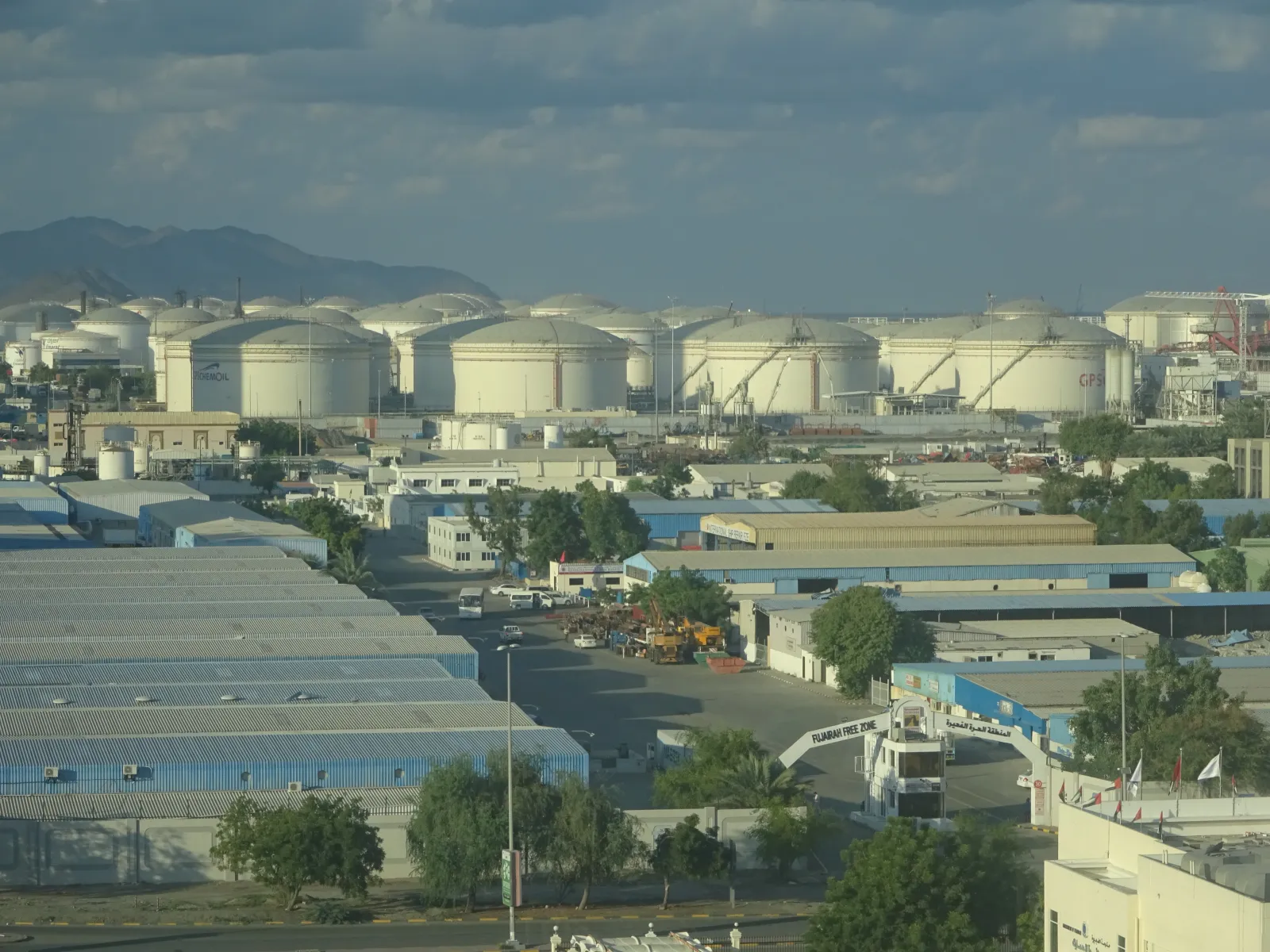
Empty tankers are turning away from Fujairah, the Gulf's last buffer
At least 10 empty supertankers turned back from Fujairah, and Kpler put Gulf crude exports at about 10 million barrels a day on 7 October. What caps the price is not extra supply but demand, which OPEC has cut by 1 million barrels, and drawn-down stocks.
Energy & Shipping Desk · 12 October 2026 · 8 min read · 13 sources
Why it matters
Noise: Riyadh says supply will keep flowing come what may, and Gulf exports recovered to 81% of pre-war levels in September. Signal: both routes around Hormuz are at their limits. The East-West pipeline runs at 83% of its 7 million barrel capacity, and at least 10 empty VLCCs failed to reach the Fujairah transfer hub. The buffer holding the price is lost demand plus reserve releases; OPEC cut its 2026 demand growth forecast from 1.4 million barrels to 400,000. The threshold is no longer the strait but the meeting point in the Gulf of Oman.
Implications
- According to Bloomberg data, at least 10 empty VLCCs and several Suezmaxes abandoned voyages to Fujairah in recent days; Kpler put Gulf crude exports at about 10 million barrels a day on 7 October, against 15.5 million in September.
- OPEC now forecasts 2026 demand growth at 400,000 barrels a day, down from 1.4 million at the start of the year; that gap and OECD reserve releases held Brent at $106.12 on 12 October.
- War-risk premiums are spreading across basins: tanker insurance in the Black Sea rose from $200,000 to $2.5 million, and EU gas storage was 73.8% full on 11 October against a 5-year average of 88.6%.
Noise
Saudi supply keeps flowing come what may, and Gulf exports have recovered.
Signal
The meeting point of the transfer system is cracking.
The noise is in Riyadh, the signal in the Gulf of Oman
The headline came from Riyadh. According to The National, Energy Minister Abdulaziz bin Salman said on 11 October that supply would keep flowing whatever happens. Oilprice reported that Gulf oil exports had recovered in September to 81% of pre-war levels, and crude and condensate shipments to 91%. Yet on 12 October, Arab News reported, the same minister declined to give an export figure. Describing an 8-month crisis, he did not share a single export number.
The quiet parameter sits on the Gulf of Oman coast, at the transfer hub outside Hormuz. Bloomberg tanker-tracking data, reported by GuruFocus and Briefs, show that at least 10 empty VLCCs heading for Fujairah stopped or turned back in recent days, along with several Suezmaxes. A VLCC is a supertanker that carries 2 million barrels. According to Maritime Executive, Kpler put Gulf crude exports at about 10 million barrels a day as of 7 October, down from 15.5 million in September. The gap between the September average and the October trend shows how fragile the recovery is.
1 · The logistics constraint and its threshold
The Gulf has two routes that bypass Hormuz, and both are at their limits. The first is the Saudi East-West pipeline. The National reports that it stopped after the Houthi attacks in September and had recovered to about 5.8 million barrels a day by 6 October. Its capacity is roughly 7 million barrels a day, so the line is running at 83% with no spare outlet behind it.
The second is the ship-to-ship transfer system. Small shuttle tankers cross the strait and offload onto large vessels waiting off Fujairah and Oman. The system relied on the assumption that the waiting area was safe. According to Maritime Executive, shots were fired near a VLCC anchored off Fujairah on 8 October. Argus data cited by Oilprice show that a Suezmax carrying Iraqi crude was hit on 11 October, with 2 seafarers missing. The threshold is this: if empty VLCCs stop arriving, shuttle tankers cannot discharge, and exports halt even while the strait stays open.
2 · Supply security and critical thresholds
What caps the price today is not extra barrels but vanished demand. According to Arab News, OPEC Secretary General Haitham al-Ghais put 2026 demand growth at 400,000 barrels a day on 12 October; at the start of the year the forecast was 1.4 million. Al-Ghais gave 3 reasons why the price has not reached $200: lower Chinese imports, reserve drawdowns led by the OECD, and slowing demand.
That buffer can run out. Oilprice reports that the International Energy Agency's coordinated release in the spring totalled 400 million barrels. According to a Bloomberg report published by Energy Connects, Japan urged Asian countries on 12 October to build up their stocks. The US Energy Information Administration put Japan's reserves at 263 million barrels in April. Refilling the released stocks will come on top of the 1.7 million barrels a day of demand growth OPEC expects for 2027. Investing.com data show the ICE Brent December contract (LCOZ6) closed at $106.12 on 12 October.
Barrels loaded outside Hormuz already command a premium. Investing.com data show Murban futures, Abu Dhabi crude delivered at Fujairah, closed at $110.60 on 9 October, when the Brent December contract stood at $104.72. The gap of about $5.9 is what Asia pays for Gulf barrels that do not depend on Hormuz. If the Fujairah transfer hub falters, this premium should be the first price to react.
3 · Second-round effects
The constraint is spreading through insurability. According to Novinite, Lukoil's manager in Bulgaria said war-risk cover for a tanker in the Black Sea had risen from $200,000 to $2.5 million within a few months. With Hormuz and the Black Sea becoming dearer at the same time, the supply of tankers carrying crude to the Mediterranean is squeezed from two directions. Türkiye sits where those two basins meet.
In gas the buffer is already thin. Voltstack's GIE AGSI+ data show EU gas storage at 73.8% full on 11 October, against 83.0% a year earlier and a 5-year average of 88.6%. Investing.com data show the Dutch TTF front-month contract closed at €84.735 per megawatt-hour on 12 October, up 4.05%. Gulf LNG depends on the same transfer and transit constraints. As the oil buffer erodes heading into winter, the strain therefore shows up in gas bills too.
4 · What would refute this reading
Our thesis is that over the next 3 months the constraint on Gulf supply will be not Hormuz itself but the utilisation of the two routes around it. As lost demand and the stock buffer thin out, that constraint will pass more directly into prices. We see this as the most likely path, with a probability of 50%.
The first refutation would be the number of empty VLCCs heading for Fujairah rising again within 2 weeks in tanker-tracking data, with Kpler's Gulf crude exports climbing above 12 million barrels a day. That would mean the transfer node is holding. The second would be the ICE Brent December contract falling below $100 without further stock releases, which would mean the buffer is thicker than we think. The third would be the East-West pipeline reaching its 7 million barrel capacity alongside rising Yanbu loadings. That would mean Saudi outlets alone can close the gap.
Probabilities
Scenarios
| Scenario | Probability | Trigger | Market impact |
|---|---|---|---|
| H1The buffer erodes, flows stay tight | 50% | VLCC arrivals at Fujairah stay partial, Gulf crude exports hold in a 10–12 million barrel a day band and reserve releases continue. | The East-West pipeline runs close to its ceiling and the shortfall comes out of stocks; prices stay high but contained. |
| H2The transfer node breaks | 30% | New strikes off Fujairah and Oman drive large vessels out of the area entirely, or the East-West pipeline is hit again. | Gulf exports fall below 10 million barrels a day and the stock buffer melts quickly. |
| H3A transit arrangement | 20% | The US and Iran announce a transit arrangement and direct passages through Hormuz increase. | The need for the transfer system declines and Gulf exports return to the September average. |
Module A
Constraints Matrix
STRUCTURAL AVG 4.5 · TACTICAL AVG 2.3Structural constraints dominate: the outcome is set more by these limits than by the actors' preferences.
Hard structural constraintspersistent · beyond the actors' will
A single pipeline near its ceiling · Saudi Arabia
5/5The East-West pipeline carried about 5.8 million barrels a day on 6 October against 7 million of capacity; it was halted for 2 weeks by Houthi attacks in September and has no spare outlet.
Transfer hub inside the strike zone · Iran
5/5At least 10 empty VLCCs abandoned voyages to Fujairah; shots were fired near a VLCC off Fujairah on 8 October, and a Suezmax carrying Iraqi crude was hit on 11 October.
A finite stock buffer
4/5The IEA's spring release totalled 400 million barrels; OPEC names OECD reserve use as one factor capping the price, and those stocks will have to be refilled.
Thin European gas storage · European Union
4/5EU storage was 73.8% full on 11 October, against 83.0% a year earlier and a 5-year average of 88.6%.
Tactical frictiontemporary · eases over time
War-risk premiums across basins weeks
3/5War-risk cover for a tanker in the Black Sea rose from $200,000 to $2.5 million within a few months; the London market extended the high-risk area to the whole basin in September.
Data gap days
2/5The Saudi energy minister gave no export figure; the Fujairah count relies on Bloomberg tracking data and could not be independently verified.
Investors keeping their distance months
2/5The CEOs of ExxonMobil, Shell, BP and TotalEnergies stayed away from the Riyadh congress that opened on 12 October; King Khalid Airport was hit 4 times in 5 days.
Module B
Signal vs Noise
SIGNAL 71% · NOISE 29%
- NOISE
Saudi supply keeps flowing come what may, and Gulf exports have recovered.
The minister said on 11 October that supply would continue, but gave no export figure on 12 October; Gulf exports were 81% of pre-war levels in September and, per Kpler, fell to about 10 million barrels a day on 7 October.
Arab News — Saudi Arabia's mindset helped kingdom beat longest energy crisis, says minister
- SIGNAL
The meeting point of the transfer system is cracking.
According to Bloomberg data, at least 10 empty VLCCs and several Suezmaxes abandoned voyages to Fujairah in recent days.
GuruFocus — Oil Tankers Retreat from Persian Gulf Amid Rising Tensions (Bloomberg data)
- SIGNAL
The buffer holding the price is lost demand.
OPEC put 2026 demand growth at 400,000 barrels a day, down from 1.4 million at the start of the year; it expects 1.7 million barrels a day for 2027.
Data: Brent crude oil (futures) ›Oilprice — Oil Prices Jump 2% on Saudi Attacks as OPEC Sees Demand Rebound
- SIGNAL
Asia wants to make its stock buffer permanent.
Japan urged Asia on 12 October to build up its stocks; AZEC agreed on regional stockholding and coordinated releases in early October.
Energy Connects (Bloomberg) — Japan Urges Oil Stockpiling, Development as Mideast Risks Rise
- NOISE
At $106, Brent is far from its crisis peak, so the risk has eased.
LCOZ6 stood at $106.12 on 12 October, the same day tanker attacks and turn-backs from Fujairah continued; what holds the price is lost demand, not supply.
Data: Brent crude oil (futures) ›Investing.com — Brent Oil Futures Historical Data (LCOZ6)
- SIGNAL
War-risk premiums are spreading across basins.
War-risk cover for a tanker in the Black Sea rose from $200,000 to $2.5 million.
- SIGNAL
European gas heads into winter with a thin buffer.
EU storage was 73.8% full on 11 October against a 5-year average of 88.6%; TTF stood at €84.735 on 12 October.
Data: EU gas storage fill level ›Voltstack — EU Gas Storage Tracker, Winter 2026 (GIE AGSI+ data)
Module C
Asset-Class and Positioning Implications
| Asset class | Exposure | Transmission channel | H1 | H2 | H3 | Expected | Conviction | Horizon | What to watch |
|---|---|---|---|---|---|---|---|---|---|
| Commodities | Front end of the crude futures curve | Disruption at the transfer node erodes the stock buffer | + | ++ | −− | +0.70 | ●●● | 0–3 months | The ICE Brent December contract relative to the $110 threshold |
| Freight & insurance | War-risk premiums | Attacks spreading to waiting and transit areas from Fujairah to the Black Sea | + | ++ | −− | +0.70 | ●●● | 0–3 months | London market risk-area notices and UKMTO incident counts |
| Commodities | European natural gas | Low storage levels combined with the Gulf LNG constraint | + | ++ | − | +0.90 | ●●● | 0–3 months | AGSI+ EU storage level on 1 November |
| Credit | Credit of energy-importing emerging markets | Energy bills and foreign currency needs growing with delivered costs | − | −− | + | −0.90 | ●●● | 3–12 months | TurkStat's September energy import bill, due on 30 October |
| Volatility | Oil options volatility | Outage risk for supply that hinges on one pipeline and one transfer hub | + | ++ | − | +0.90 | ●●● | 0–3 months | New reports of attacks on the East-West pipeline and Yanbu |
Second-order effects
And then what?
Starting point
At least 10 empty VLCCs heading for Fujairah stopped or turned back; the meeting point of the transfer system that bypasses Hormuz is now in the line of fire, and Kpler put Gulf crude exports at about 10 million barrels a day on 7 October.
- 1
Physical supplywithin days
Shuttle tankers that cannot find a large vessel cannot discharge; the loading cycle lengthens and Gulf crude exports fall even with the strait open, shifting volumes onto the East-West pipeline and Yanbu.
Watch: Kpler's weekly Gulf crude exports relative to 10 million barrels a day, and Yanbu loadings
- 2
Stocks and the futures curvewithin weeks
Once the East-West pipeline hits its 7 million barrel ceiling, the shortfall is met from stocks; consumer countries keep releasing reserves while Asia brings forward its stockbuilding, and the premium on physical barrels rises.
Watch: The ICE Brent December contract relative to $110, and Japan's decision on reserve repurchases
- 3
External balance and creditwithin months
As war-risk premiums spread from Hormuz to the Black Sea, insurance and freight add to delivered prices; importers' energy bills grow regardless of volume, lifting external financing needs and the cost of capital.
Watch: TurkStat's September energy import bill, due on 30 October
What breaks the chain
If the number of empty VLCCs heading for Fujairah rises again and Kpler's Gulf crude exports exceed 12 million barrels a day, the transfer node is holding and the chain stops at the first step.
Triggers
Thresholds to watch
| Indicator | Threshold | Today | What it means |
|---|---|---|---|
| Brent crude oil (futures) | > $110 | 106.12 | The ICE Brent December contract breaking above $110 from its $106.12 close on 12 October would show the disruption at the transfer node turning into a physical loss of supply. |
| EU gas storage fill level | < 75% (1 November) | 73.5 | EU storage staying below 75% on 1 November, from 73.8% on 11 October, would mean entering winter well short of the 80% target, with a growing risk of demand curtailment. |
| Strait of Hormuz transits | > 20 transits/day | 4 | IMF PortWatch's daily count rising above 20 from 4 transits on 4 October would show reduced reliance on the transfer system. |
Sources
- GuruFocus — Oil Tankers Retreat from Persian Gulf Amid Rising Tensions (Bloomberg data)
- Maritime Executive — More Tankers Struck as IRGC Expands Threat Against Non-Compliant Vessels
- The National — Saudi Arabia says oil supply to continue to flow despite Riyadh attacks
- Arab News — Saudi Arabia's mindset helped kingdom beat longest energy crisis, says minister
- Oilprice — Oil Prices Jump 2% on Saudi Attacks as OPEC Sees Demand Rebound
- Oilprice — Two More Oil Tankers Attacked Near Strait of Hormuz
- Oilprice — Japan Urges Asia to Build Up Oil Reserves as Middle East Risks Mount
- Energy Connects (Bloomberg) — Japan Urges Oil Stockpiling, Development as Mideast Risks Rise
- Novinite — Black Sea Shipping Insurance Soars to $2.5 Million per Vessel, Bulgaria's Lukoil Manager Says
- Investing.com — Brent Oil Futures Historical Data (LCOZ6)
- Investing.com — Dutch TTF Natural Gas Futures Historical Data
- Voltstack — EU Gas Storage Tracker, Winter 2026 (GIE AGSI+ data)
- Investing.com — Abu Dhabi Murban Crude Oil Futures Historical Data
Sourcing and verification rules: methodology · Report an error: contact
Related reports
VIEnergy & Supply·Analysis·Türkiye and Its Neighbourhood
Half-empty pipelines and a swelling bill keep Türkiye in Riyadh
Bayraktar discussed a four-country power link in Riyadh on 12 October, and Turkish contractors stayed in a tender despite Houthi missiles. What binds Ankara to the Gulf is not diplomacy but the energy bill: in August crude imports fell by tonnage while the bill rose 33.8%.
Türkiye & Neighbourhood Desk · 13 October 2026 · 7 min
VIEnergy & Supply·Analysis·Middle East and North Africa
Oil's binding constraint is now ships, not barrels
Supertanker hire from the Gulf to East Asia hit a record $1.4 million a day on 7 October, against roughly $30,000 in January. The workaround for Hormuz is tying up the fleet, freight now exceeds a quarter of delivered cost, and US crude is being priced out of Asia.
Energy & Shipping Desk · 12 October 2026 · 7 min
VIEnergy & Supply·Analysis·Eurasia
Russian diesel has its licence; refineries and terminals remain the bottleneck
On 9 October the US licensed Russian diesel until April 2027, and Moscow approved 500,000 tonnes of exports the next day. Russian exports had fallen to 190,000 barrels a day in the third quarter. That same night a 2.5 million-tonne export terminal in Rostov went up in flames.
Energy & Shipping Desk · 11 October 2026 · 8 min