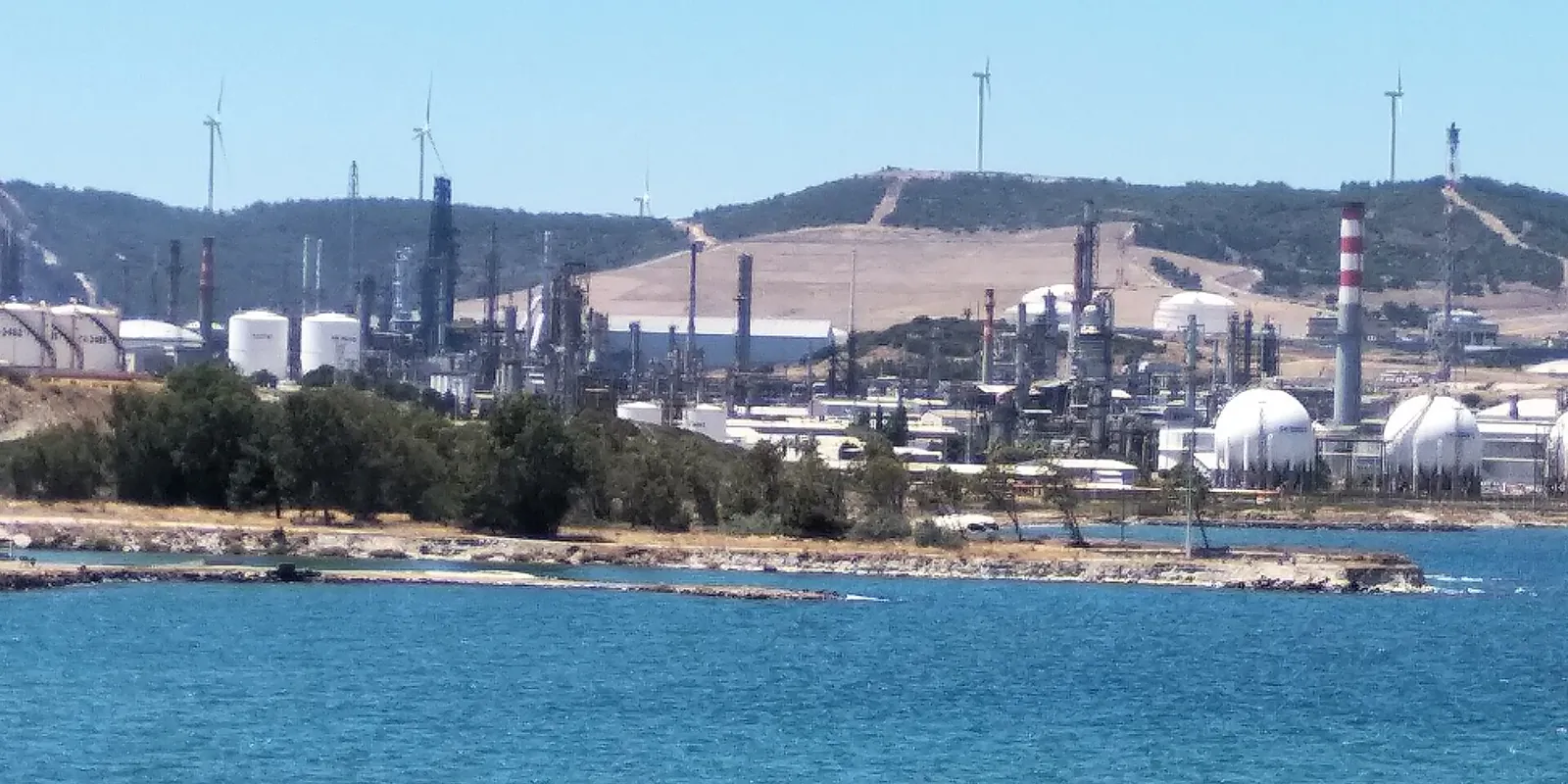
VI Energy Politics & Supply Security·In-depth analysis·Middle East and North Africa
Oil's squeeze moves from crude to products, and the Mediterranean pays
Aramco gave Asia its deepest discount in six years while raising prices to the Mediterranean by $3. Gulf crude exports are back to 91% of pre-war levels, but products remain at 60%, and the US strategic reserve is at its lowest since 1982.
Energy & Shipping Desk · 6 October 2026 · 8 min read · 14 sources
Why it matters
Noise: tanker attacks in Hormuz and $100 Brent. Despite the attacks, Brent closed 5 October down 2.05% at $100.32. Signal: the constraint has shifted from crude to refined products and to buffers. Gulf crude exports returned to 91% of pre-war levels in September, while product exports stayed at 60%; Aramco priced the secure Yanbu–Sidi Kerir route into the Mediterranean at +$3. The US strategic reserve stands at 283.8 million barrels, 39.69% of capacity, and 81% of the IEA's 400 million barrel pledge has been used. The buffer against a second shock is thin.
Implications
- For November, Aramco set Arab Light's Asia price $5 below Oman/Dubai and raised its Europe and Mediterranean prices by $3; the same barrel is priced differently depending on the route.
- The US strategic reserve stood at 283.8 million barrels on 25 September, its lowest since 1982; about 75 million barrels remain of the IEA's 400 million barrel coordinated release.
- Russia's share of Türkiye's diesel imports fell from 85% in 2025 to 20% in August; eşel mobil ended on 1 October, and diesel rose 12.93% on the month in September.
Noise
Hormuz attacks are pushing oil above $100.
Signal
Aramco is pricing the route: a discount to Asia, a premium to the Mediterranean.
The headline says $100; the constraint lies elsewhere
The headline has two elements: tankers hit almost daily in Hormuz, and Brent circling $100. TradeWinds data cited in Straits.live's 5 October brief show Iran hit 11 ships in a week. The same source says daily transits fell from a pre-war 85 to as low as 1 on 27 September. Prices did not respond with a rally. Investing.com data show ICE Brent futures closed 5 October down 2.05% at $100.32, and slipped to $98.69 in the 6 October table.
The signal lies not in the level of price but in its distribution. On 5 October Aramco cut its official selling price for Arab Light to Asia for November loadings by $3 a barrel, to $5 below the Oman/Dubai average. The official selling price is the differential Aramco adds to or subtracts from the benchmark each month. According to The National the market had expected a $5 increase; Arabian Post says it is the deepest discount since June 2020. The same decision raised prices for Northwest Europe and the Mediterranean by $3 and left the US price unchanged. The same barrel got cheaper in Asia and dearer in the Mediterranean.
This report reads three shifts. The constraint has moved from crude to refined products; the strategic buffer that would absorb a second shock is at its thinnest since 1982; and the OPEC+ quota no longer binds. Our two reports of 3 and 4 October argued that the blockade was redistributing oil and that Russian diesel was being withdrawn from the market. This piece examines how those two lines converged in the Mediterranean as of 6 October.
Constraint 1 · The route is priced, and the Mediterranean pays a premium
Aramco's price split is a route calculation. According to The National on 5 October, Aramco has restarted flows on the East-West pipeline. It is now exporting through three gates: Ras Tanura in the Gulf, Yanbu on the Red Sea and Sidi Kerir on Egypt's Mediterranean coast. Arabian Post says the $3 increase for Europe and the Mediterranean followed the resumption of loadings at Yanbu. A barrel moving from Yanbu to Sidi Kerir or Suez never touches Hormuz. Aramco is passing the value of that secure route on to European and Mediterranean buyers.
On the Asian side the calculation runs the other way. According to Arabian Post, the daily charter rate for a very large crude carrier, the VLCC that carries about 2 million barrels, was around $1.2 million on 5 October, against roughly $80,000 a year earlier. On a rough calculation, charter alone adds about $18 a barrel to a 2 million barrel cargo on a 30-day voyage. Aramco is partly offsetting that jump in Asian buyers' delivered costs with a $5 discount. According to The National, Aramco sold about 100 million barrels to Asian buyers in mid-September; the aim is market share.
The secure route is fragile too. According to Baird Maritime on 29 September, the East-West line shut after drone attacks on 11 September and reopened on 22 September. Sidi Kerir also resumed loading on 22 September after a 10-day pause. Kpler estimates flows on the line at about 2.65 million barrels a day, against a pre-attack level of 5.5 million, and a full recovery could take another month. The $3 passed on to Europe is the price put on the security of a single pipeline and the Red Sea.
Constraint 2 · Crude recovers, products do not
Kpler and Vortexa data cited by Oilprice on 6 October show Gulf crude exports returned to 91% of pre-war levels in September. Crude, condensate and LPG combined stood at 81%, while refined product exports were at just 60%. Saudi exports rose from 4.2 million barrels a day in August to 6.6 million in September. Vortexa puts total flows at 19.2 million barrels a day in September, against 23.6 million before the war. The barrels are coming back; processed products such as diesel and jet fuel are not.
The second source of the product shortfall is Russia. According to AP on 5 October, Ukraine's Defence Ministry claimed its strikes had knocked out 51% of Russian refining capacity; the figure could not be independently verified. The firmer measure comes from the IEA: the same report says Russian diesel output has fallen by about 30%. According to Anadolu Agency, Moscow on 30 September extended its ban on producers' diesel and marine fuel exports to 31 October; a broader fuel export ban runs until 31 January 2027.
In this picture the OPEC+ decision does not change supply. According to The National, the seven core members held their combined November quota at 31 million barrels a day on 4 October, and most members are producing below quota. The Moscow Times reports that the group produced 25 million barrels a day in August, about 5 million below the pre-war level of February. The gap of roughly 6 million barrels between quota and output shows the constraint lies not at the table but in pipelines, tanker charters and refineries. The next meeting is on 1 November.
Threshold · The buffer has thinned, leaving less room for a second shock
According to Rigzone on 5 October, the US Strategic Petroleum Reserve, the government's crude stock for emergencies, fell to 283.8 million barrels on 25 September. That is the lowest level since 22 October 1982 and 39.69% of its 714 million barrel capacity. The reserve shrank by 122.9 million barrels, or 30.2%, in a year.
The collective buffer has also largely been spent. According to Rigzone, 325 million barrels of the IEA's 400 million barrel coordinated release, announced on 11 March, had been used by early October, 81% of the pledge. The US share of the package is 172 million barrels. The G7 has also agreed a release of 100 million barrels of crude and diesel over four months. The roughly 75 million barrels left in the IEA package equal just three days of the 23.6 million barrels a day of pre-war Gulf exports cited by Vortexa.
Washington is buying the buffer time through exchanges. According to Rigzone, bids for a new 40 million barrel exchange close on 6 October, with deliveries from the Big Hill and Bryan Mound sites in November and December. In an exchange, companies return the barrels they borrow with additional premium barrels. That boosts supply today, but the barrels owed will be drawn back out of the market in 2027. The threshold is clear: as the SPR falls below 283.8 million barrels, the state's response time to a second disruption at Yanbu or Bab el-Mandeb shrinks.
Second round · From the Mediterranean to Türkiye's pumps
The product shortfall and the route premium meet in the Mediterranean, and Türkiye is one of the basin's most exposed importers. Kpler data cited by Daily Sabah show Russia's share of Türkiye's diesel imports fell from 85% in 2025 to 20% in August 2026. Russian flows dropped from more than 200,000 barrels a day at the start of the year to 80,000. India filled the gap with more than 120,000 barrels a day and the US with 90,000, both records since 2017.
The new supply comes via routes that are more extended and riskier. Indian diesel arrives through Bab el-Mandeb and Suez, US diesel across the Atlantic. On 5 October Yemen's Saudi-backed government launched its Sanaa offensive and claimed gains on the Bab el-Mandeb coast; the Houthis rejected the claim. Türkiye's new diesel corridor thus runs straight through a conflict line. The $3 Aramco passed on to the Mediterranean also raises input costs for every Mediterranean refinery running Saudi crude; imported products and refinery feedstock are getting dearer in the same direction.
There is no longer a tax buffer at the pump. According to Haber Ekspres, eşel mobil ended on 1 October and diesel rose by 3.60 lira a litre. TurkStat data cited by Habertürk show diesel was among the fastest-rising items in September, up 12.93% on the month, and transport was the fastest-rising main group at 2.79%. Annual inflation fell to 29.73% in data released on 5 October, but that decline came from a 0.20% monthly fall in food.
The CBRT meets on 22 October. If the diesel increase spreads into transport services and food distribution costs in October, September's 1.84% monthly CPI will prove a low base and room for a rate cut will narrow. That the energy bill is now growing on product premiums rather than crude prices explains why pump prices do not fall even if Brent drops below $100.
What would refute this reading
Our thesis is that in October and November the constraint will stay in refined products and buffers, not in crude; we see this as the most likely path, at 55%. The first falsifier: if Kpler and Vortexa October data show Gulf refined product exports above 80% of pre-war levels, the product-constraint thesis weakens. The second: if Russia does not extend its diesel export ban on 31 October and Türkiye's imports of Russian diesel return to 200,000 barrels a day, the Mediterranean product premium reading collapses.
The third falsifier: if Aramco narrows the Asia discount to below $2 in its December prices and withdraws the Mediterranean premium, the route premium reading is proved wrong. The risk in the opposite direction is also clear. A confirmed disruption on the Yanbu line or at Bab el-Mandeb would bring H2 to the fore. In that case the 283.8 million barrel SPR and the roughly 75 million barrels left in the IEA package would be decisive in the first weeks.
Probabilities
Scenarios
| Scenario | Probability | Trigger | Market impact |
|---|---|---|---|
| H1Crude plentiful, products scarce | 55% | Gulf crude exports stay above 90%, product exports remain below 70%, and the Russian diesel ban is extended into November. | Brent holds flat around $100 while diesel and Mediterranean product premiums stay high; the SPR erodes through exchanges and the buffer thins. |
| H2A second shock with no buffer | 25% | A confirmed disruption on the East-West line, at Yanbu or at Bab el-Mandeb; Hormuz attacks cut flows again. | The secure route closes, and the 283.8 million barrel SPR and the roughly 75 million barrels left in the IEA package are not enough to close the gap. |
| H3Product flows recover | 20% | Russia lifts its diesel ban on 31 October, Gulf refined product exports exceed 80% and the Yanbu line returns to 5.5 million barrels. | Product premiums narrow, Aramco withdraws the Mediterranean premium and SPR exchanges slow. |
Module A
Constraints Matrix
STRUCTURAL AVG 4.2 · TACTICAL AVG 2.8Structural constraints dominate: the outcome is set more by these limits than by the actors' preferences.
Hard structural constraintspersistent · beyond the actors' will
Strategic buffer at a low · United States
5/5The SPR stood at 283.8 million barrels on 25 September, 39.69% of capacity and the lowest since 1982; 81% of the IEA's 400 million barrel package has been used.
The secure route rests on one pipeline · Saudi Arabia
4/5The East-West line shut on 11 September and reopened on 22 September; Kpler puts flows at about 2.65 million barrels a day, against 5.5 million before the attack.
Gulf product exports at 60%
4/5In September Gulf crude exports returned to 91% of pre-war levels while refined product exports stayed at 60% (Kpler, Vortexa).
Russian diesel export ban · Russia
4/5The producer diesel ban runs to 31 October and the broader fuel ban to 31 January 2027; the IEA says Russian diesel output has fallen by about 30%.
Attack campaign in Hormuz · Iran
4/5According to TradeWinds, Iran hit 11 ships in a week; daily transits fell from a pre-war 85 to 1 on 27 September.
Tactical frictiontemporary · eases over time
Eşel mobil has ended days
3/5The tax buffer was lifted on 1 October and diesel rose by 3.60 lira; diesel was up 12.93% on the month in September.
VLCC charter at a record weeks
3/5Daily VLCC charter is about $1.2 million, against $80,000 a year ago; that adds roughly $18 a barrel on a 30-day voyage.
Ground offensive at Bab el-Mandeb weeks
3/5Yemen's government launched its Sanaa offensive with Saudi air support on 5 October; the Houthis rejected its claimed gains on the Bab el-Mandeb coast.
Exchange repayment burden months
2/5In the 40 million barrel exchange, companies will return barrels with a premium; today's supply will later be drawn back out of the market.
Module B
Signal vs Noise
SIGNAL 57% · NOISE 43%
- NOISE
Hormuz attacks are pushing oil above $100.
Despite 11 ships hit in a week, ICE Brent futures closed 5 October down 2.05% at $100.32 and slipped to $98.69 in the 6 October table.
Data: Brent crude oil (futures) ›Investing.com — Brent Oil Futures Historical Data
- SIGNAL
Aramco is pricing the route: a discount to Asia, a premium to the Mediterranean.
November Arab Light to Asia fell to $5 below Oman/Dubai, the deepest discount since June 2020; Northwest Europe and Mediterranean prices rose $3 as Yanbu loadings resumed.
The Arabian Post — Saudi sets six-year low Arab Light discount in Asia
- SIGNAL
Crude has recovered; refined products have not.
Gulf crude exports were at 91% of pre-war levels in September, crude plus condensate plus LPG at 81% and refined products at 60%; Saudi exports rose from 4.2 to 6.6 million barrels a day.
Oilprice — Gulf Oil Exports Recover to 81% of Pre-War Levels
- SIGNAL
The strategic buffer against a second shock is thin.
The SPR stood at 283.8 million barrels on 25 September, the lowest since 1982 and 39.69% of capacity; 325 million barrels of the IEA's 400 million barrel package have been used.
- NOISE
The OPEC+ November decision will set supply.
The combined quota of the seven core members is 31 million barrels a day; the group produced 25 million in August. The quota does not bind.
The Moscow Times — Opec+ agrees to keep November oil output targets steady
- SIGNAL
Türkiye's diesel supply has shifted to more distant, riskier routes.
Russia's share of Türkiye's diesel imports fell from 85% in 2025 to 20% in August 2026; India at 120,000 and the US at 90,000 barrels a day set records.
Data: Bab el-Mandeb transits ›Daily Sabah — Türkiye's diesel imports from US, India hit record high after Russia ban
- NOISE
Ukraine has shut half of Russia's refining capacity.
The 51% claim could not be independently verified; the measurable data point is the IEA's estimate of a roughly 30% fall in Russian diesel output.
ABC News (AP) — Ukraine claims attacks have taken out half of Russia's oil refining capacity
Module C
Asset-Class and Positioning Implications
| Asset class | Exposure | Transmission channel | H1 | H2 | H3 | Expected | Conviction | Horizon | What to watch |
|---|---|---|---|---|---|---|---|---|---|
| Commodities | Middle distillate margins | Gulf product exports stuck at 60% and the Russian diesel ban | ++ | ++ | −− | +1.20 | ●●● | 0–3 months | Kpler and Vortexa October ratio for Gulf refined product exports |
| Commodities | Crude oil futures curve | Balance between recovering crude flows and a thin strategic buffer | − | ++ | − | −0.25 | ●●● | 0–3 months | ICE Brent front-month close relative to the $110 threshold |
| Freight & insurance | VLCC and product tanker freight | Extended routes and delivered costs in Asia | + | ++ | − | +0.85 | ●●● | 0–3 months | VLCC daily charter rates relative to the $1.2 million level |
| Credit | Energy-importing emerging market credit | Product-premium-driven fuel bills and FX demand | − | −− | + | −0.85 | ●●● | 3–12 months | TurkStat October energy import bill |
| Sovereign debt | Türkiye local currency government debt | CPI via diesel and the CBRT's room to cut | − | −− | + | −0.85 | ●●● | 0–3 months | Transport group in TurkStat's October CPI and the 22 October MPC decision |
Second-order effects
And then what?
Starting point
Gulf crude exports returned to 91% of pre-war levels in September while refined product exports stayed at 60%, and Russian diesel exports are banned until 31 October. Aramco priced the secure route into the Mediterranean at +$3.
- 1
Freight and product premiumwithin weeks
Mediterranean importers cover the diesel shortfall from India and the US via more distant routes through Bab el-Mandeb and across the Atlantic; delivered costs rise regardless of crude prices.
Watch: Kpler origin shares in Türkiye's September–October diesel imports (Russia at 20%, India and the US at records)
- 2
Pump priceswithin days
With eşel mobil ended on 1 October, imported product costs pass to the pump without a tax buffer; diesel stays high even if Brent eases.
Watch: Istanbul diesel pump prices and adjustments after the 3.60 lira increase on 1 October
- 3
CPI and monetary policywithin months
The diesel increase spreads through transport and distribution costs into the transport group and services; October CPI rises above September's 1.84%, and the CBRT's room to cut narrows.
Watch: The transport group in TurkStat's October CPI (2.79% on the month in September) and the 22 October MPC decision
What breaks the chain
If Russia lifts its diesel ban on 31 October, or Gulf refined product exports exceed 80% of pre-war levels, the product premium fades and the chain stops at the first step.
Triggers
Thresholds to watch
| Indicator | Threshold | Today | What it means |
|---|---|---|---|
| Brent crude oil (futures) | > $110 | 100.32 | Brent rising above $110 from $100.32 on 5 October would show the constraint shifting back from products to crude, meaning a physical disruption on the Yanbu or Red Sea route is being priced. |
| Bab el-Mandeb transits | If a disruption is confirmed | 42 | A confirmed attack or closure at Bab el-Mandeb would hit the diesel corridor from India to Türkiye and Saudi flows out of Yanbu at the same time. |
| Strait of Hormuz transits | Daily transits > 40 | 13 | Daily Hormuz transits approaching half the pre-war 85 would be the first condition for Gulf refined product exports to recover from 60%. |
Sources
- The Arabian Post — Saudi sets six-year low Arab Light discount in Asia
- The National — Saudi Aramco cuts Asia crude prices to six-year low amid recovery as oil flows rebound
- Oilprice — Gulf Oil Exports Recover to 81% of Pre-War Levels (Kpler and Vortexa data)
- Rigzone — USA continues Strategic Petroleum Reserve release
- Investing.com — Brent Oil Futures Historical Data
- Baird Maritime — Saudi crude flows again from Red Sea port of Yanbu as key pipeline restarts
- Straits.live — Strait of Hormuz brief, 5 October 2026
- The National — Opec+ keeps oil output targets unchanged for November
- The Moscow Times — Opec+ agrees to keep November oil output targets steady
- ABC News (AP) — Ukraine claims attacks have taken out half of Russia's oil refining capacity
- Anadolu Agency — Russia extends ban on diesel, marine fuel exports by producers until Oct. 31
- Daily Sabah — Türkiye's diesel imports from US, India hit record high after Russia ban (Kpler data)
- Haber Ekspres — Sliding-scale fuel system ends, diesel and LPG prices rise
- Habertürk — TurkStat releases September inflation
Sourcing and verification rules: methodology · Report an error: contact
Related reports
IIIConflict & Defence·Analysis·Middle East and North Africa
Makkah pact moves off paper, tying Türkiye to the Red Sea front
On 5 October a rapid deployment arrangement was approved in Riyadh and the first secretary-general appointed. The same day Yemen's government launched its Sanaa offensive with Saudi air support. For the first time, Türkiye has signed up to an implementation commitment.
Defence & Conflict Desk · 6 October 2026 · 6 min
VIEnergy & Supply·Analysis·Middle East and North Africa
The blockade reroutes oil, and the constraint moves into insurance policies
Iran loaded not a single barrel in September, yet regional exports reached 19.5 million barrels a day, above pre-war levels. Dated Brent sits roughly $19 above futures; the constraint lies not in volume but in insurance and flag-state liability.
Energy & Shipping Desk · 4 October 2026 · 6 min
IGeo-Economics·Analysis·Middle East and North Africa
As Hormuz heats up, oil's real risk shifts to the Red Sea
Three ships were hit in the Strait of Hormuz on 29 September, yet transits rose to 17. Saudi crude has moved back from the Red Sea to the strait, and Bab el-Mandeb flows have more than halved. Somali pirates have also killed crew for the first time in over a decade.
Energy & Shipping Desk · 1 October 2026 · 7 min